Two business owners can ask for the same thing, a corporate tax return, and receive completely different quotes.
One accountant charges a few hundred dollars. Another quotes $2,500. Both say they’ll prepare and file the company’s T2 return.
So what’s the difference? And how do you know whether you’re paying a fair price?
The answer usually has more to do with your company’s financial records than the tax form itself.
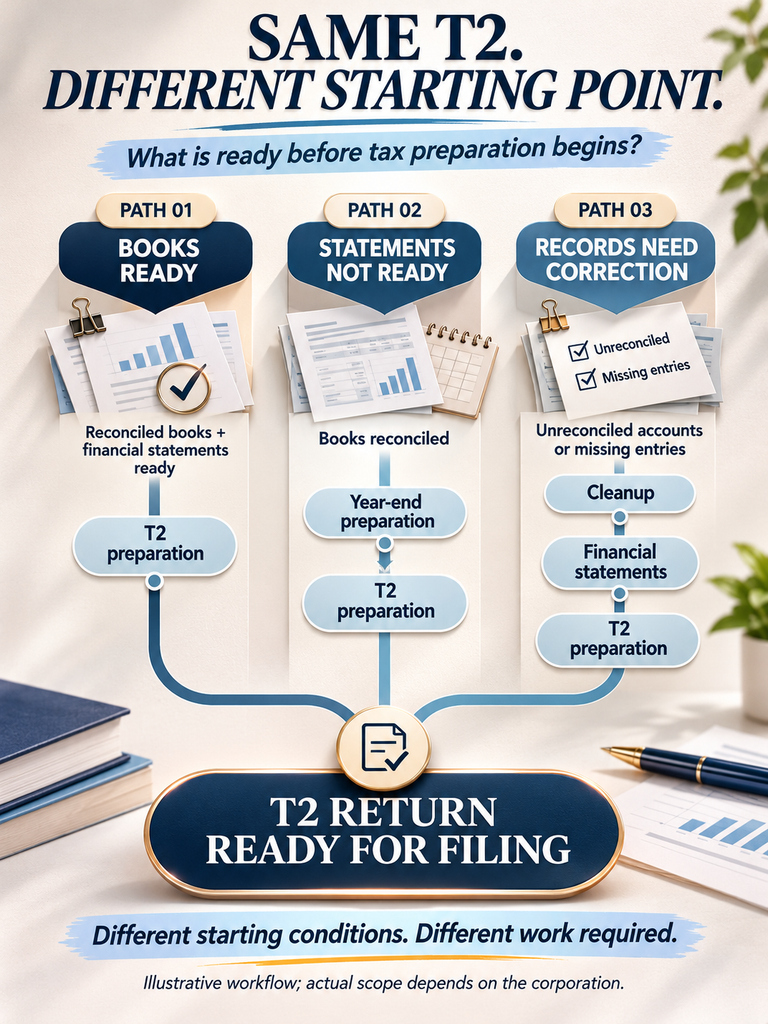
If your books are complete and your financial statements are ready, the accountant may only need to prepare the return and its supporting schedules. But if bank accounts don’t reconcile, shareholder transactions are unclear, or the financial statements haven’t been prepared, there’s more work to do before the return can be filed.
That’s why understanding the corporate tax return cost in Canada means looking beyond the advertised filing fee.
At TaxRecon, corporate tax preparation begins with the information behind the return. Knowing what’s already complete, what needs attention, and what’s included in a quote makes it easier to choose the right accounting service.
Here’s what Canadian corporations can expect to pay in 2026, what makes T2 accountant fees increase, and how to avoid surprises when the final invoice arrives.
Key Takeaways
- Basic online T2 preparation can start around $299, while a full corporate year-end engagement may cost $2,500 or more.
- Nil and inactive corporation returns may cost less, but the company’s remaining assets and transactions still matter.
- Financial statement preparation, bookkeeping cleanup, and complicated tax schedules can increase your quote.
- Corporate tax preparation fees are separate from the income tax your company owes CRA.
- Request a written quote that clearly identifies what’s included and what costs extra.
How Much Does a Corporate Tax Return Cost in Canada?
A corporate tax return in Canada can cost anywhere from a few hundred dollars for straightforward online preparation to several thousand dollars for a complete year-end accounting engagement. Published 2026 prices include T2-only services starting around $299, while some CPA firms quote $2,500 or more for corporate year-end accounting and tax preparation together.
There is no single government-set fee for having a corporate tax return professionally prepared.
Accounting firms determine their own prices based on the work involved.
Your corporation’s activity, financial statements, bookkeeping condition, and tax reporting requirements all affect the amount.
2026 T2 Corporate Tax Return Pricing Comparison
The following examples come from publicly available Canadian accounting-service prices reviewed in November 2026.
| Corporate tax service | Published starting price or estimate | What the price generally represents |
| Simple zero-income return | From $199 | Basic online filing for an eligible inactive corporation |
| Straightforward online T2 preparation | From $299 | Corporate return prepared using existing financial information |
| More complicated online T2 | From $899 | Additional corporate tax reporting complexity |
| CPA-prepared small-corporation T2 | 1,200–3,500 | Published Ontario professional-fee benchmark |
| Minimal-activity corporate year-end | From $1,500 | Limited-activity corporation with additional year-end work |
| Full corporate year-end and T2 | From $2,500 | Broader accounting and corporate tax preparation |
| Year-end bookkeeping plus T2 | 2,500–6,000+ | Published estimate for combined year-end accounting and tax work |
These are advertised starting prices and provider estimates, not a statistically calculated Canadian average. The amounts represent different services and may exclude taxes, additional accounting work, and other charges.
For a current example, the October 2026 corporate tax pricing published by HBT Accounting lists a corporate year-end and T2 package starting at $2,500, a minimal-activity corporate return starting at $1,500, and a nil return starting at $750.
Specialized online providers publish lower entry prices for certain straightforward files.
The takeaway isn’t that one firm is expensive and another is cheap.
It’s that you need to compare what each accountant is actually being paid to do.
Why Do Corporate Tax Return Fees Vary So Much?
The T2 is the corporation’s annual income tax return. The work required to prepare it depends on the quality and complexity of the information behind it.
Think of two corporations.
The first is a consulting company with clean bookkeeping, reconciled accounts, and prepared financial statements.
The second is a retail business with missing transactions, inventory adjustments, unpaid invoices, and shareholder withdrawals that haven’t been properly recorded.
Both need a T2.
But the second corporation may require substantial accounting work before tax preparation can begin.
What Usually Affects the Price?
| Cost factor | Why it matters |
| Bookkeeping quality | Missing or incorrect records require additional investigation |
| Transaction volume | More activity can increase reconciliation and review work |
| Financial statements | Preparing statements adds work when they aren’t already complete |
| Corporate structure | Related companies and shareholders may create additional reporting |
| Business assets | Depreciation and asset disposals may require tax adjustments |
| Payroll and dividends | Owner compensation and payroll balances must be recorded correctly |
| Investment income | Passive income and investment transactions can affect the tax calculations |
| Provincial operations | Certain provinces and multi-province operations require additional reporting |
| Prior-year issues | Missing returns or incorrect opening balances can affect current filings |
| Deadlines | Urgent engagements may attract additional charges |
The condition of your records is often one of the largest factors you can influence.
Keeping your accounts current throughout the year can reduce the amount of corrective work needed at tax time.
What Is Actually Included in a T2 Tax Preparation Fee?
Before accepting a quote, find out what the accountant means by “corporate tax return preparation.”
Some providers mean tax preparation using finalized financial statements.
Others include year-end accounting adjustments, financial reports, and related filing work.
Preparing the T2 Return
A typical T2 preparation engagement may include:
- Reviewing the corporation’s identification and tax year
- Examining available financial information
- Calculating taxable corporate income
- Reviewing applicable deductions and credits
- Completing required tax schedules
- Calculating federal and relevant provincial income tax
- Preparing the corporate return for electronic filing
- Reviewing and submitting the completed return
However, these services are not guaranteed to be included in every advertised package.
An accountant may charge separately for financial statement preparation or correcting the records used to calculate taxable income.
Supporting Tax Schedules
Depending on your corporation’s situation, the T2 may require schedules covering:
- Accounting income adjustments
- Capital cost allowance
- Losses carried forward or backward
- Dividends paid or received
- Shareholder information
- Associated corporations
- Provincial income allocation
- Investment income
- Tax credits and deductions
A straightforward service corporation may need fewer adjustments than a company with investments, property transactions, or several related entities.
GIFI and Financial Reporting
The Canada Revenue Agency requires most corporations to report financial statement information through the General Index of Financial Information (GIFI).
This commonly involves:
- Schedule 100: Balance sheet information
- Schedule 125: Income statement information
- Schedule 141: Additional financial statement information
Certain inactive corporations qualify for exceptions to some GIFI schedule requirements.
The accountant needs reliable figures before completing these sections.
That’s why “T2 preparation” and “preparing the financial statements for the T2” should be discussed separately.
Does T2 Filing Include Financial Statements?
Not necessarily.
Your corporation may already have financial statements prepared through its regular bookkeeping and accounting process.
If those statements are complete and accurate, the accountant may be able to use them as the starting point for the tax return.
If they haven’t been prepared, additional year-end work may be necessary.
What Financial Statements Might Your Accountant Need?
Most incorporated businesses need financial information covering:
- Assets and liabilities
- Revenue and expenses
- Shareholder equity
- Retained earnings
- Accounts receivable and payable
- Loans and other outstanding balances
Year-end adjustments may also be required for depreciation, accruals, prepaid expenses, inventory, or other transactions.
Financial Statements vs a Compilation Engagement
These are not necessarily the same service.
An accountant may prepare financial information for tax reporting without performing a formal compilation engagement.
A compilation engagement under Canadian Standard on Related Services (CSRS) 4200 involves professional reporting requirements and a compilation engagement report.
It does not provide the assurance associated with a review engagement or audit.
A bank, lender, or shareholder may require a particular type of financial statement engagement.
That requirement can affect the price.
Before paying for financial statements, ask whether you need them only for T2 reporting or for a separate external purpose.
Is Bookkeeping Cleanup Included in Corporate Tax Fees?
Usually, you should not assume it is.
Corporate tax preparation and bookkeeping cleanup involve different tasks.
Bookkeeping cleanup focuses on correcting the records that will eventually feed into the return.
Tax preparation uses those records to determine the corporation’s tax position.
Common Bookkeeping Problems That Increase Tax Fees
These may include:
- Bank accounts that don’t reconcile
- Duplicate expenses
- Missing supplier invoices
- Unrecorded customer payments
- Personal purchases recorded as business expenses
- Unexplained shareholder loans
- Incorrect GST/HST balances
- Payroll liabilities that don’t agree with remittances
- Inventory records that don’t match the accounting system
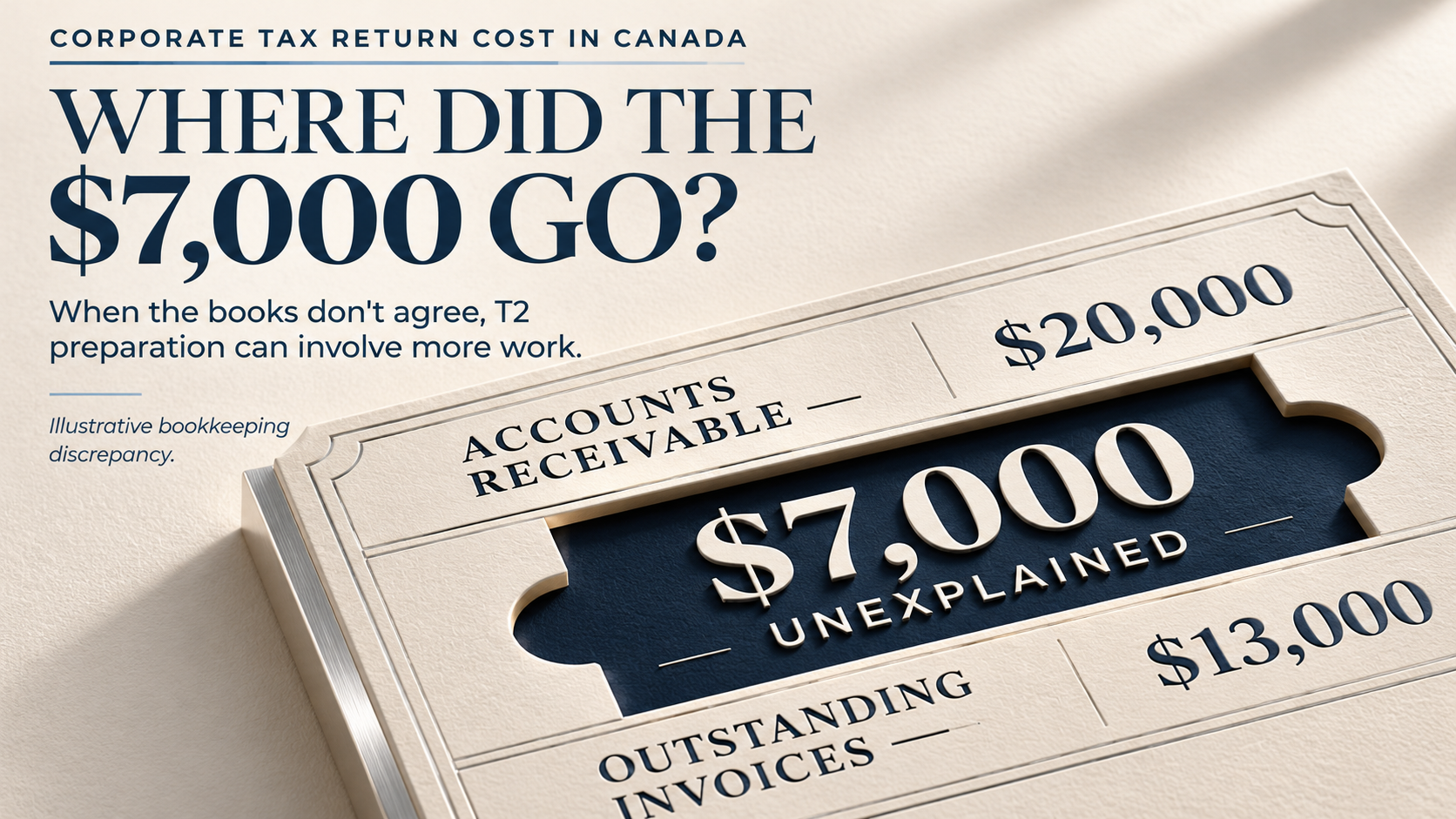
Suppose the accountant receives financial statements showing $20,000 in accounts receivable.
But the list of outstanding customer invoices only totals $13,000.
That difference needs to be understood before the books can be considered reliable.
The accountant may need to trace transactions, correct entries, or obtain missing documents.
That is additional work, not simply another T2 schedule.
TaxRecon’s bookkeeping services in London, Ontario cover reconciliation, transaction categorization, historical cleanup, and the financial records businesses rely on when preparing tax returns.
Keeping your books ready throughout the year can make the tax preparation process more predictable.
How Much Does a Nil or Inactive Corporation T2 Return Cost?
An inactive corporation may qualify for a lower filing fee because it has fewer transactions and less financial activity to review.
Some Canadian online tax providers advertise simple zero-income corporate filing starting at $199.
Other accounting firms publish higher minimum prices, particularly when their service includes professional review or additional year-end responsibilities.
But there is an important distinction.
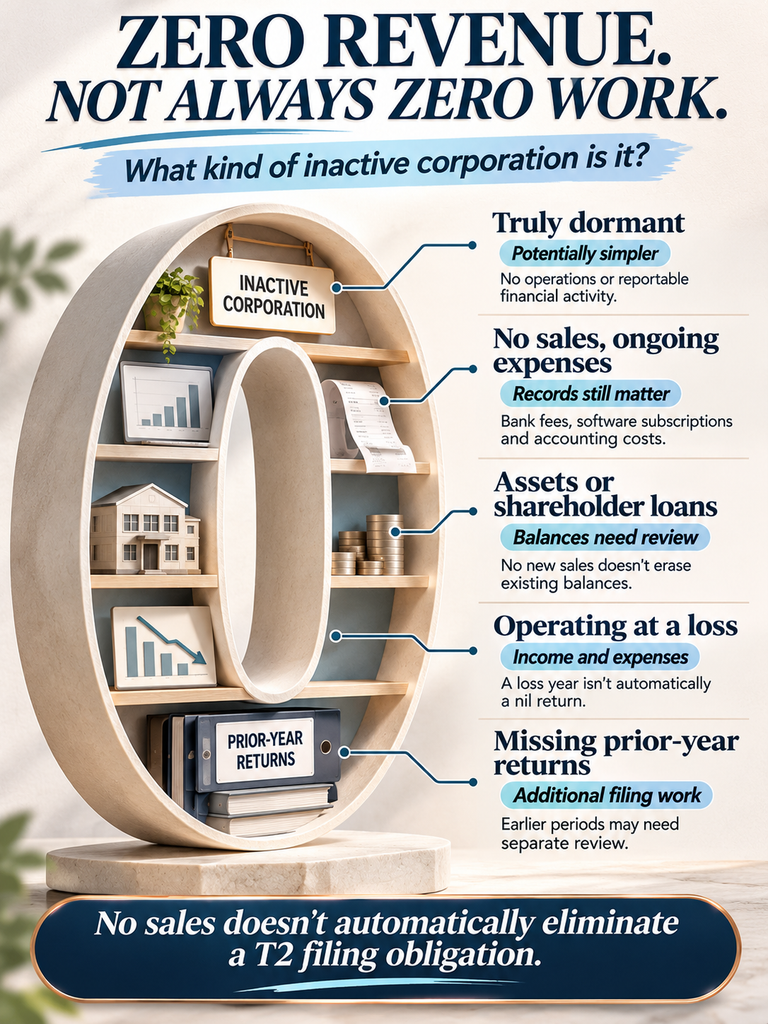
No revenue does not necessarily mean no financial activity.
Nil Corporation vs Minimal-Activity Corporation
| Situation | Financial activity | Possible effect on preparation |
| Truly dormant corporation | No operations or reportable financial activity | May qualify for simplified filing |
| No sales but ongoing expenses | Bank fees, accounting costs, subscriptions | Financial records still need review |
| Minimal-activity corporation | Few business transactions during the year | Less work than a fully active business, but not necessarily nil |
| Corporation operating at a loss | Expenses exceed revenue | Requires income, expense, and loss reporting |
| Corporation with previous balances | Existing assets, loans, or retained earnings | Opening and closing balances need review |
Does an Inactive Corporation Still Have to File?
Generally, yes.
Most Canadian resident corporations must file a T2 return annually, even when they have no income or tax payable.
An inactive corporation with no balance-sheet or income-statement information may be exempt from attaching certain GIFI schedules.
That does not eliminate the T2 filing requirement.
For a closer explanation of what counts as inactive, read TaxRecon’s guide to inactive corporation T2 filing requirements in Canada.
Why an Inactive Return Might Still Cost More
Imagine a corporation that stopped operating two years ago.
Its business bank account remains open, it still owes money to a shareholder, and its previous return contains a balance that hasn’t been reconciled.
Even though there were no sales this year, the accountant may need to review those balances.
That makes the return more involved than one for a corporation that never traded or held assets.
What Does a First-Year Corporate Tax Return Cost?
A newly incorporated business may have additional reporting questions during its first tax year.
The accountant needs to establish when the corporate tax year started, what happened during that period, and how the opening financial position was recorded.
Common First-Year Accounting Issues
These can include:
- Initial share issuance
- Incorporation costs
- Startup purchases
- Shareholder advances
- Equipment transferred into the company
- Opening bank balances
- Early payroll transactions
- GST/HST registration and reporting
Some first-year returns are straightforward.
Others require additional work because the corporation took over an existing business or acquired significant assets.
Your First Fiscal Year-End Matters
A newly incorporated Canadian company generally chooses its first fiscal year-end within 53 weeks of incorporation.
That date establishes the period covered by the first T2.
Choosing a very short first tax year can mean paying for corporate tax preparation sooner than expected.
A longer first period may be more practical, depending on the business and applicable restrictions.
TaxRecon explains the options in its article on choosing a corporate year-end in Canada.
What Extra Costs Can Appear on a Corporate Tax Quote?
The advertised T2 filing fee may not cover everything your corporation needs.
Some additional services are legitimate, but you should know about them before work begins.
Additional Year-End Adjustments
Accountants may charge for work such as adjusting accruals, reviewing depreciation, reconciling shareholder balances, or correcting financial statements.
Payroll and Owner Compensation
A corporation may need separate work involving:
- T4 slips
- T5 slips
- Salary and dividend records
- Payroll source deduction reconciliations
- Shareholder loan adjustments
These responsibilities may be outside the basic corporate tax preparation scope.
GST/HST Returns
GST/HST filing is a separate obligation from the T2 income tax return.
A provider may offer both services, but the T2 fee doesn’t automatically include preparing outstanding GST/HST returns.
Provincial Corporate Tax Returns
Most provinces and territories have their corporate income tax calculations administered through CRA.
Alberta and Quebec administer separate provincial corporate income tax systems.
A corporation with a relevant permanent establishment in those jurisdictions may need an additional provincial return, such as Alberta’s AT1 or Quebec’s CO-17.
Ask whether applicable provincial filing work is included.
CRA Correspondence and Adjustments
Some firms include a limited amount of routine CRA correspondence after filing.
Others charge separately for Notices of Reassessment, return adjustments, formal objections, audit assistance, or other follow-up work.
The agreement should distinguish routine filing support from more involved CRA representation.
Rush Fees and Previous-Year Returns
Urgent filing, missing tax years, and prior-year corrections can also increase the cost.
If an accountant needs to reconstruct earlier balances, the work may extend well beyond the current year’s T2.
Real-World Examples: Why the Same T2 Gets Different Quotes
These are illustrative scenarios, not actual TaxRecon client cases or promises of specific fees.
Scenario 1: A Consultant With Clean Financial Records
An incorporated consultant has one business bank account, organized invoices, and bookkeeping that agrees with the bank.
The year-end financial statements are ready.
The tax preparer can focus mainly on reviewing the information, calculating tax adjustments, and preparing the T2.
A return-only service may be appropriate.
Scenario 2: A Contractor With Mixed Personal and Corporate Spending
An incorporated contractor has several accounts, company expenses paid personally, and payments to the shareholder that haven’t been classified.
The accountant needs to distinguish reimbursements, salary, dividends, and shareholder loans.
The bookkeeping may require adjustments before the corporate tax return can be prepared.
The additional fee reflects work that wasn’t necessary in the first scenario.
Scenario 3: A Retail Company With Inventory and Payroll
A retailer has inventory, employees, business equipment, and numerous supplier transactions.
At year-end, inventory balances and payroll liabilities don’t agree with the accounting reports.
The accountant must review the records, prepare adjustments, and calculate the corporation’s tax position.
A broader year-end accounting package may make more sense than a return-only quote.
Scenario 4: An Inactive Company With Missing Returns
A corporation stopped operating but remained legally active.
Its owners haven’t filed a T2 for several years.
Even if each year involved little activity, the accountant must establish which periods remain outstanding, review the available records, and consider how earlier balances affect subsequent returns.
The scope is larger than a single simple nil return.
How Do You Compare Two T2 Accountant Quotes Fairly?
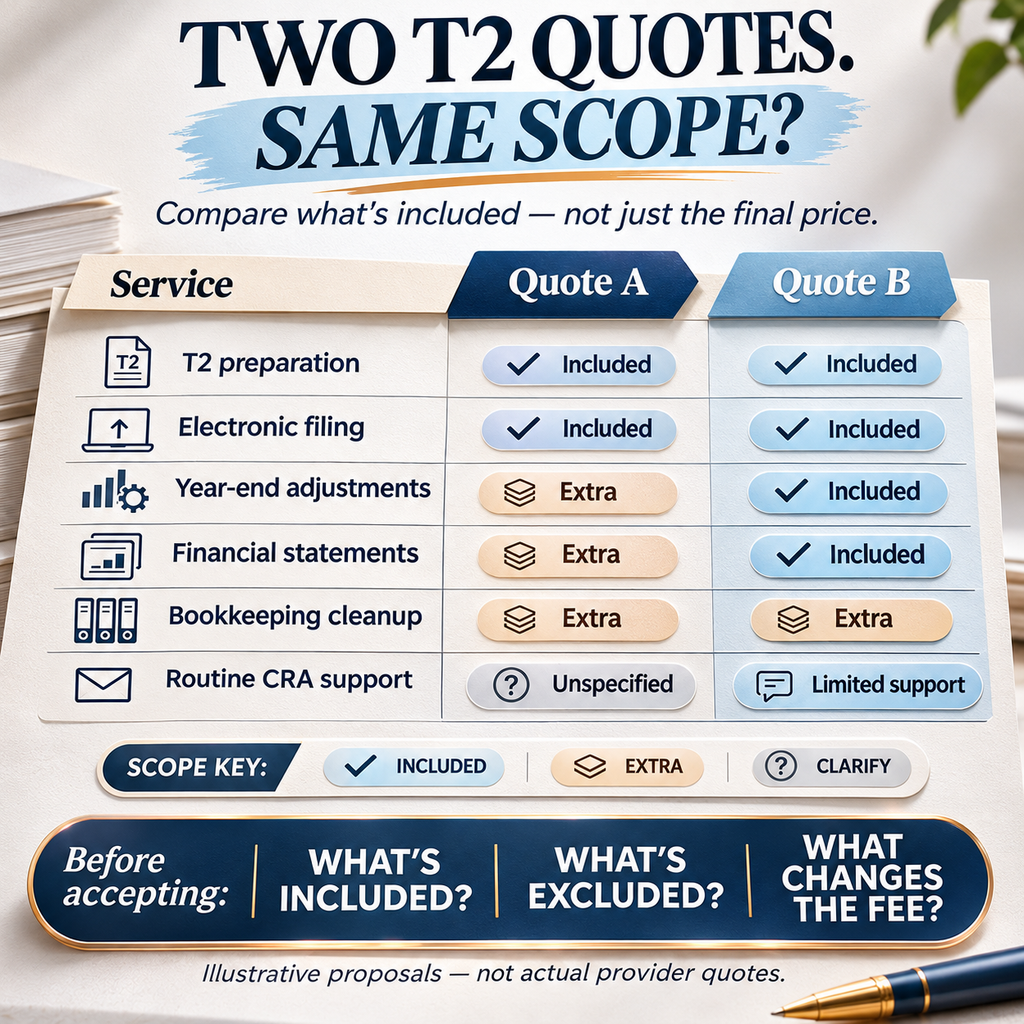
Use a like-for-like comparison rather than choosing based on the lowest number.
Here’s an example of how to review two hypothetical proposals.
| Service | Quote A | Quote B |
| T2 preparation | Included | Included |
| Electronic submission | Included | Included |
| Year-end adjustments | Extra | Included |
| Financial statement preparation | Extra | Included |
| Bookkeeping cleanup | Extra | Extra |
| Routine CRA correspondence | Not specified | Limited support included |
| Owner’s personal T1 | Extra | Extra |
| GST/HST returns | Extra | Extra |
| Final price | Lower initially | Higher initially |
Quote A may be the better choice when your books and financial statements are already complete.
Quote B may provide better value if you still need year-end accounting work.
Neither is automatically better.
The Three-Part Quote Check
Before accepting a price, ask:
What’s included? Identify the return, schedules, financial statements, and filing work covered.
What’s excluded? Clarify bookkeeping, payroll, GST/HST, CRA correspondence, and personal tax returns.
What could change the fee? Ask how additional work will be identified, approved, and billed.
That is a more dependable way to compare accounting services than relying on advertised starting prices.
What Documents Should You Prepare Before Requesting a T2 Quote?
Organizing your information before speaking with an accountant helps them understand the file.
You don’t need to know every tax calculation.
You do need to explain what your corporation has done and what financial records are available.
Corporate Information
- Legal corporation name
- CRA business number
- Incorporation date
- Fiscal year-end
- Province or provinces of operation
- Previous T2 returns, if available
- Recent CRA Notices of Assessment
Financial Records
- Balance sheet
- Income statement
- General ledger or trial balance
- Bank and credit-card statements
- Accounts receivable and payable
- Loan balances
- Inventory information
- Fixed asset records
Other Relevant Information
- Payroll summaries
- Shareholder loan account details
- Salary and dividend records
- GST/HST returns
- Investment income records
- Other corporation or related-party information
- CRA correspondence
Some corporations won’t need every item.
If financial statements aren’t ready, explain which bookkeeping records you do have.
That allows the accountant to separate the cost of preparing the return from the cost of getting the numbers ready.
When Are T2 Returns Due, and What Happens If You File Late?
A corporate tax return is generally due within six months after the end of the corporation’s tax year.
The payment deadline usually arrives earlier.
The CRA’s T2 Corporation Income Tax Guide states:
“File your return within six months of the end of each tax year.”
Corporate Tax Filing vs Payment Deadlines
| Corporate year-end | General T2 filing deadline | General tax balance-due date |
| March 31 | September 30 | May 31, or June 30 if eligible |
| June 30 | December 31 | August 31, or September 30 if eligible |
| September 30 | March 31 of the following year | November 30, or December 31 if eligible |
| December 31 | June 30 of the following year | February 28/29, or March 31 if eligible |
Corporate income tax balances are generally payable within two months after the fiscal year-end.
Certain eligible Canadian-controlled private corporations receive a three-month balance-due period.
Weekend and holiday rules may affect the final due date.
What Happens If Your T2 Is Late?
When a corporation files late and has unpaid tax, CRA generally applies a basic late-filing penalty calculated as:
- 5% of the unpaid tax due at the filing deadline
- Plus 1% for each complete month the return is late, up to 12 months
Higher penalties may apply in certain repeat-filing situations.
Interest on unpaid taxes is a separate issue.
A corporation with no balance owing may avoid the ordinary unpaid-tax-based late-filing penalty, but it can still have an outstanding filing obligation and other compliance consequences.
Does Filing Electronically Cost Extra?
CRA’s Corporation Internet Filing service itself is free.
However, most corporations must use CRA-certified software to prepare and transmit their T2 electronically.
The software or professional preparation service may involve a separate charge.
For tax years beginning after 2023, most corporations are required to file electronically, with specified exceptions.
Non-compliance with mandatory electronic filing may lead to a separate CRA penalty.
Can You Prepare Your Own Corporate Tax Return to Save Money?
Yes, a business owner can prepare a corporate return using suitable CRA-certified software.
But preparing a T2 involves more than entering annual revenue and expenses.
You need to determine taxable income, report financial information correctly, complete the applicable schedules, and understand the corporation’s tax position.
When DIY Filing May Be Reasonable
It may be practical when:
- The corporation is very simple
- Financial information is complete
- You understand corporate tax reporting
- There are no unusual transactions
- The required software supports your situation
When Professional Preparation May Be More Useful
Professional help becomes more valuable when:
- Bookkeeping needs correction
- Shareholder transactions are unclear
- The corporation owns significant assets
- Multiple corporations are involved
- Investment income or capital transactions require review
- Returns from previous years are outstanding
- Provincial or cross-border tax questions arise
DIY filing can reduce the direct preparation fee.
However, you still need to consider software costs, the time involved, and whether you’re comfortable accepting responsibility for the calculations and filing.
How Can You Reduce Your Corporate Tax Preparation Cost?
You can’t control every accounting issue, but you can prepare your records so the accountant spends less time resolving routine problems.
1. Keep Your Bookkeeping Current
Reconcile accounts regularly.
Review outstanding customer invoices, supplier bills, and unexplained transactions before year-end.
2. Separate Corporate and Personal Expenses
Corporations are separate legal entities.
Record personal payments, reimbursements, and shareholder withdrawals according to their actual purpose.
3. Track Equipment and Other Capital Purchases
Keep purchase invoices, dates, costs, and supporting information.
Your accountant may need this information for capital cost allowance calculations.
4. Review Payroll and GST/HST Balances
Compare your accounting records with payroll remittances and filed GST/HST returns.
Investigate differences before the corporate return is due.
5. Prepare Documents Before Requesting a Quote
Send the accountant enough information to understand the corporation’s activity and the state of its records.
A quote based on incomplete information may need revision when the missing work becomes clear.
6. Request a Written Scope of Work
Ask the accountant to confirm what the price includes and how additional services will be approved.
Clear expectations are useful for both parties.
7. Start Before Your Filing Deadline
Waiting until the final weeks may leave less time to collect documents, resolve accounting questions, or consider the corporation’s tax position.
The best cost-saving habit is usually to avoid leaving a year’s worth of accounting problems for tax season.
Are Corporate Tax Preparation Fees Tax Deductible?
Generally, reasonable accounting and tax preparation fees incurred for business purposes may be deductible by the corporation.
That can include eligible costs relating to preparing the T2 return, maintaining financial records, and obtaining business-related accounting advice.
However, the treatment can differ when professional fees relate to capital transactions, acquisitions, or certain reorganizations.
If your accountant provides several services under one invoice, the costs may need to be classified according to their purpose.
Keep the invoice and supporting records.
A deductible accounting fee reduces taxable income where permitted. It does not mean the corporation receives the entire fee back as a tax refund.
How Can TaxRecon Help With Corporate Tax Preparation?
Every corporation arrives at tax season with a different starting point.
Some businesses have complete records and only need the corporate return prepared.
Others have missing reconciliations, overdue filings, or financial information that needs review first.
TaxRecon’s corporate tax filing services cover T2 returns for incorporated businesses, with attention to the tax year, available financial information, and any unresolved questions affecting the filing.
The appropriate engagement depends on what has already been completed and what additional work is necessary.
TaxRecon doesn’t publish one fixed price for every corporate return on its reviewed service pages.
Rather than assuming every company needs the same package, the more practical approach is to review your records, establish the filing requirements, and confirm the scope before proceeding.
Final Thoughts: Know What You’re Paying for Before You File
The cost of a T2 return isn’t determined by the tax form alone.
A corporation with accurate books and completed financial statements may need only straightforward tax preparation.
Another business may require bookkeeping corrections, shareholder account reviews, financial statement preparation, and additional schedules.
Both are filing a T2, but they’re paying for different amounts of work.
When comparing the corporate tax return cost in Canada, don’t focus only on the lowest advertised price.
Ask what the accountant will review, what the fee includes, what will be billed separately, and whether the quote reflects your actual records.
Good bookkeeping can make filing more straightforward. A clearly defined engagement can make the cost easier to understand.
Before agreeing to a fee, make sure you know exactly what you’re getting.
Need a Clear Quote for Your Corporate Tax Return?
Not sure whether your corporation needs T2 preparation only or additional year-end accounting work?
TaxRecon can discuss your corporate filing requirements, review the records you have available, and help establish what needs attention before filing.
Contact TaxRecon to request a quote based on your corporation’s actual circumstances.
Frequently Asked Questions
1. How Much Does an Accountant Charge for a T2 in Canada?
Published T2 prices vary significantly. Simple online preparation may start around $299, while CPA-prepared small-corporation returns can cost more than $1,000. Full year-end packages may begin around $2,500 and increase with complexity. The final amount depends on bookkeeping quality, financial statements, required schedules, and additional accounting services.
2. What Is the Average Cost of a Corporate Tax Return in Ontario?
There is no official average set by CRA or the Ontario government. A published 2026 Ontario CPA fee guide estimates 1,200–3,500 for a small corporation’s T2 engagement. Some online services charge less for straightforward returns, while packages that include bookkeeping and financial statements generally cost more.
3. How Much Does a Nil Corporate Tax Return Cost?
Some online Canadian providers advertise simple nil corporate returns starting around $199. Other firms charge higher minimum fees, depending on their service model. A corporation with no revenue may still have assets, liabilities, bank fees, or previous-year balances that require review, so the cheapest nil-filing package may not fit every business.
4. Does a Corporation With No Income Still Need to File a T2?
Generally, yes. Most Canadian resident corporations must file a T2 return each tax year, even if they earned no revenue or owe no income tax. Certain statutory exceptions apply. A truly inactive corporation may have simpler reporting requirements, but inactivity does not normally eliminate the annual filing obligation.
5. Are Financial Statements Included in Corporate Tax Fees?
Not always. Some accountants prepare the T2 using financial statements supplied by the client. Others include year-end financial statement preparation in their package. A formal compilation, review, or audit engagement is separate from ordinary tax reporting and may have its own fee. Confirm the exact scope before hiring.
6. Can I File a T2 Corporate Return Myself for Free?
CRA’s Corporation Internet Filing service is free, but preparing and electronically submitting the return generally requires CRA-certified software, which may cost money. You can prepare your own return if you understand corporate tax reporting. The software cost and complexity should be considered alongside professional preparation fees.
7. Why Is My Corporate Tax Return More Expensive This Year?
Your fee may increase if the accountant needs to correct bookkeeping errors, prepare financial statements, review shareholder transactions, or complete additional tax schedules. More complicated business activity, investment income, overdue returns, and urgent deadlines can also affect the cost. Ask which specific services changed compared with the previous year.
8. Are Corporate Tax Accountant Fees Deductible in Canada?
Generally, reasonable accounting and tax preparation fees related to business operations may be deductible. Some professional costs associated with capital transactions or reorganizations may require different treatment. Keep detailed invoices showing the services provided and ask your accountant to classify the expenses according to their purpose.
9. How Long Does It Take an Accountant to Prepare a T2?
Preparation time depends on the complexity of the return, the accountant’s workload, and whether financial records are ready. A straightforward corporate return may require less work than a file involving missing transactions, complicated shareholder accounts, or previous-year corrections. Request a timeline based on the documents actually available.
10. How Can TaxRecon Help Me Understand My T2 Filing Costs?
TaxRecon provides corporate tax filing and bookkeeping services for incorporated Canadian businesses. Its published approach starts with reviewing the tax year, available records, and unresolved issues before confirming the work required. This can help distinguish basic return preparation from financial statement work, bookkeeping cleanup, and related accounting responsibilities.