Payroll is almost finished when two employees ask the same question: “Why is my vacation pay different?”
Both work for the same Ontario business. Both have similar annual earnings. Their paycheques look almost identical. Yet one employee receives noticeably more vacation pay than the other.
At first glance, it looks like somebody made a mistake.
Sometimes, the calculation is perfectly correct.
Vacation pay in Ontario depends on more than an employee’s salary. Length of service, qualifying wages, commissions, overtime, vacation entitlement periods and payment arrangements all influence the amount an employer owes.
For small-business owners and payroll managers, the challenge is not simply knowing which percentage to use. It is knowing which earnings belong in the calculation and when a change in entitlement takes effect.
That is why TaxRecon approaches payroll as a connected process involving employee records, wage calculations, statutory deductions and financial reporting.
Key Takeaways
- Ontario’s minimum vacation pay is generally 4% of qualifying wages for employees with less than five years of service and 6% for employees with five or more years.
- Commissions, overtime, public holiday pay and certain bonuses may increase the wages used in the calculation.
- Employees who reach five years of service during a vacation entitlement year may require a vacation pay adjustment.
- Paying vacation pay on each cheque does not remove an employee’s separate entitlement to vacation time.
How Does Vacation Pay in Ontario Actually Work?
Vacation pay is money employees earn based on qualifying wages. Under Ontario’s Employment Standards Act, 2000 (ESA), most employees earn vacation pay at a minimum rate of 4% before reaching five years of employment and 6% once they reach five years.
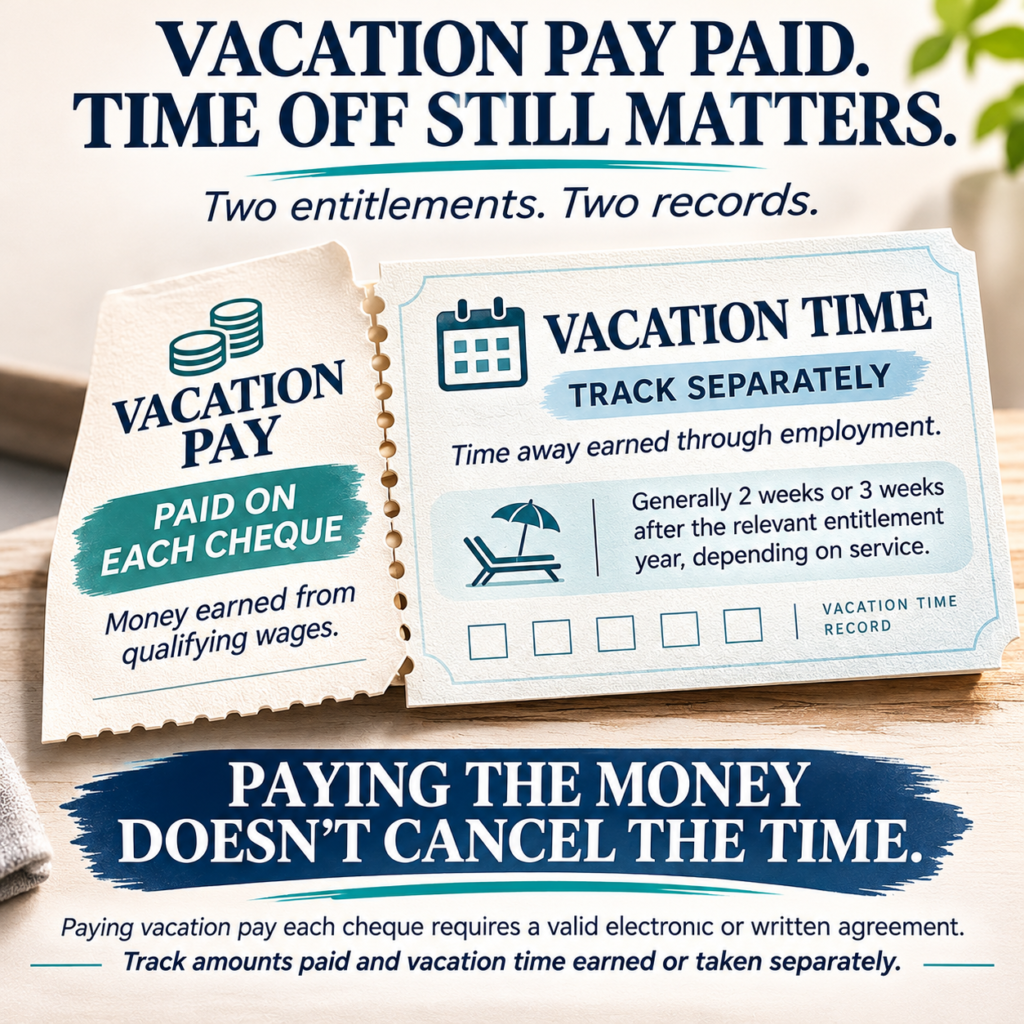
The important detail is that vacation pay and vacation time are different legal entitlements.
The Ontario Ministry of Labour explains:
“This employment standard has two parts: vacation time and vacation pay.”
That distinction appears in the government’s official Guide to the Employment Standards Act: Vacation.
Vacation Time: The Right to Time Away
Most employees covered by Ontario’s general ESA vacation rules receive:
- At least two weeks of vacation after completing a vacation entitlement year while employed for less than five years.
- At least three weeks after completing a vacation entitlement year when their period of employment is five years or longer.
These are minimum standards. An employment agreement or workplace policy may provide a greater benefit.
Vacation Pay: The Money Earned
The usual calculation is:
Vacation pay = qualifying wages × applicable vacation pay percentage
The percentage depends on the employee’s period of employment and the relevant vacation entitlement period.
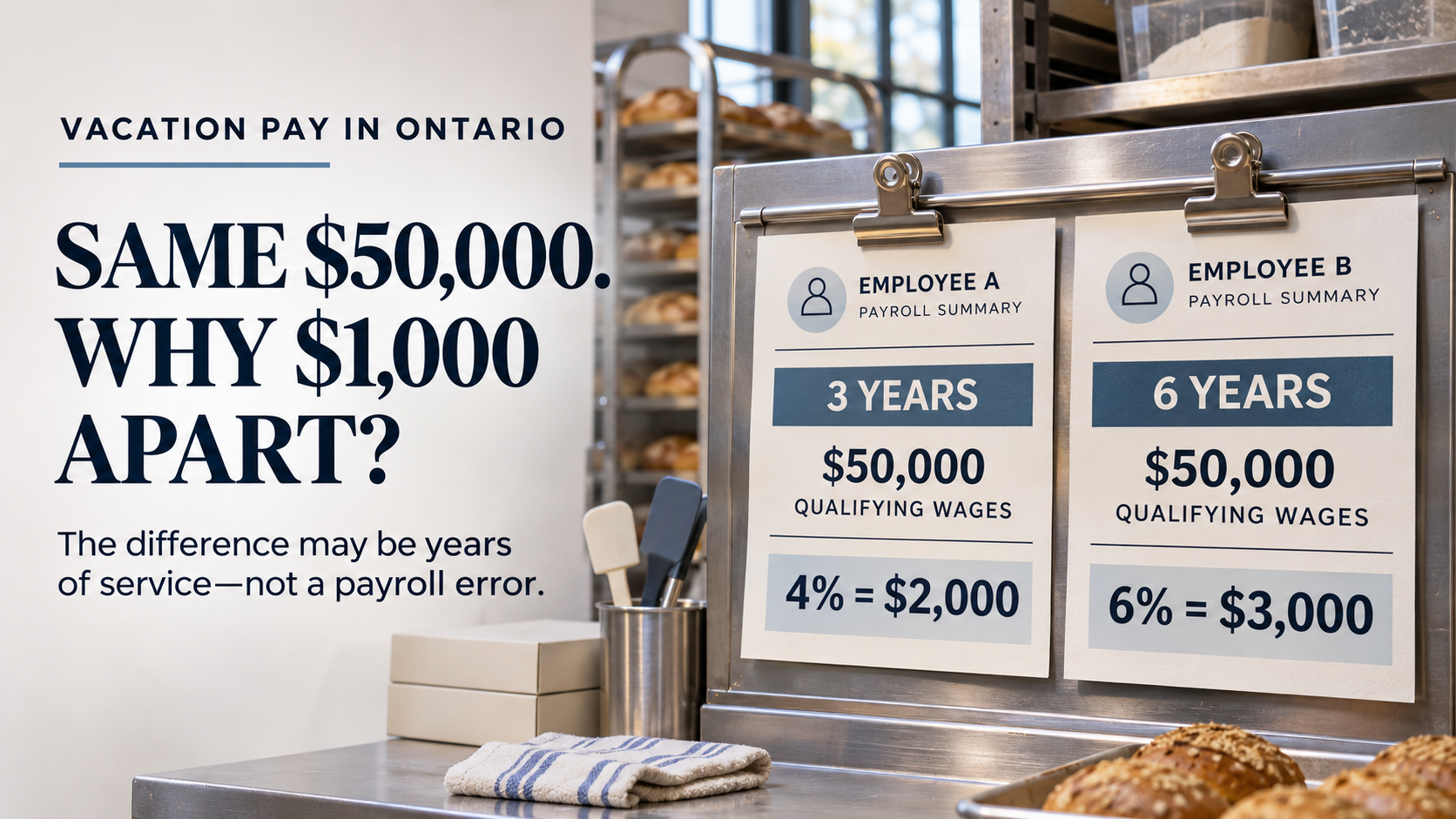
For example, an employee with qualifying annual wages of $50,000 would generally earn $2,000 in vacation pay at 4%.
An employee entitled to 6% on the same qualifying wages would earn $3,000.
The salary is the same. The statutory vacation pay entitlement is different.
Why Can Two Employees With the Same Salary Receive Different Vacation Pay?
Consider an illustrative Ontario company with two employees earning identical annual wages.
One employee joined recently. The other has remained with the company for several years.
| Employee | Employment Length | Qualifying Annual Wages | Vacation Pay Rate | Vacation Pay |
| Employee A | 3 years | $50,000 | 4% | $2,000 |
| Employee B | 6 years | $50,000 | 6% | $3,000 |
| Difference | $0 | $1,000 |
The difference does not come from a different salary, job title or work schedule.
It comes from the employee’s length of service.
For employers, this means the payroll system must track the employment start date and applicable vacation entitlement year.
For employees, it explains why comparing gross salaries alone does not reveal whether vacation pay has been calculated correctly.
What Changes When an Employee Reaches Five Years?
The move from 4% to 6% deserves particular attention.
Employers sometimes assume the higher rate applies only to wages earned after the fifth anniversary.
That assumption can produce an underpayment.
When an employee reaches five years during a vacation entitlement year, their vacation pay entitlement increases to 6% of the qualifying wages earned in that entitlement year.
Where vacation pay has been paid at 4% on each cheque before the anniversary, the employer generally needs to calculate an additional 2% top-up on those earlier wages.
This is one of the most useful checks an Ontario payroll team can make.
The Five-Year Milestone: The Payroll Adjustment Many Employers Miss
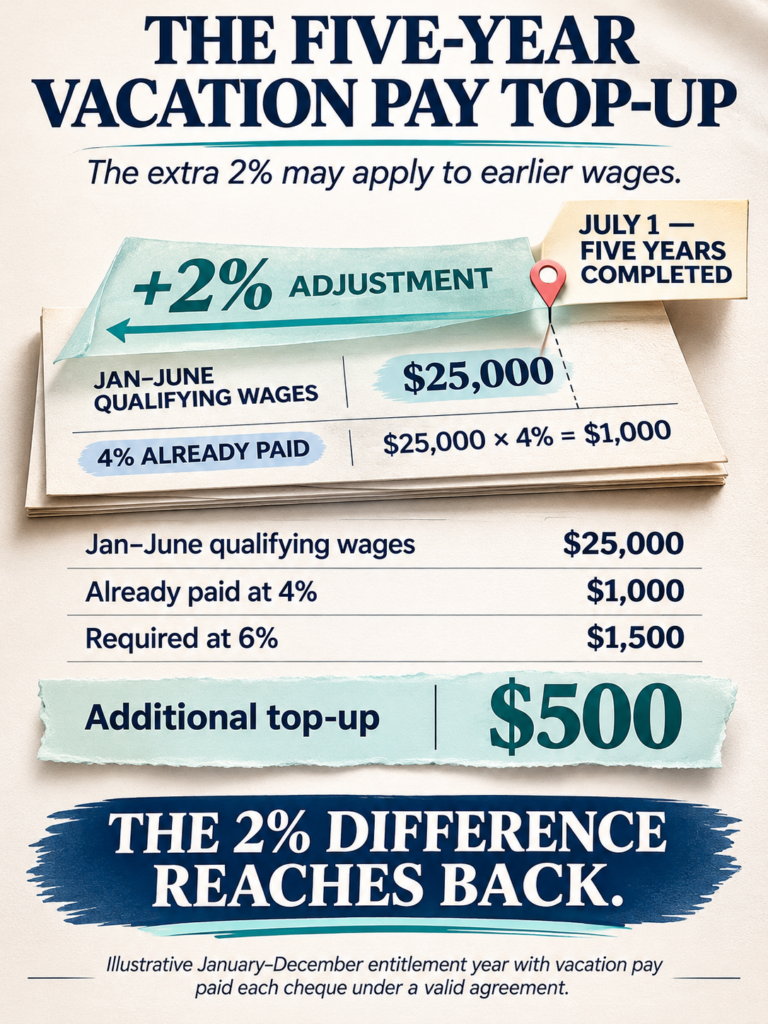
Suppose an employee’s vacation entitlement year runs from January 1 to December 31.
The employee reaches five years of employment on July 1.
During the first half of the year, the employee earns $25,000 in qualifying wages. The employer pays vacation pay on each cheque at 4%, under a valid agreement.
By June 30, the employee has received $1,000 in vacation pay.
When July 1 arrives, the employee’s entitlement increases to 6% of the qualifying wages earned during that vacation entitlement year.
The employer must therefore calculate the difference between the amount already paid and the higher entitlement.
The Calculation
| Item | Amount |
| Qualifying wages earned January to June | $25,000 |
| Vacation pay already paid at 4% | $1,000 |
| Vacation pay required at 6% | $1,500 |
| Additional top-up required | $500 |
The additional $500 is due on the payday for the pay period containing the five-year anniversary.
The employee then generally receives 6% vacation pay on qualifying wages earned from July onward.
This is more than a payroll software setting.
It is a reason to review how the system handles employment anniversaries, accumulated wages and previously paid vacation amounts.
Which Earnings Count Toward Vacation Pay?
One reason vacation pay calculations go wrong is that employers sometimes use base salary when the law requires a broader wage calculation.
Under Ontario’s general ESA rules, vacation pay is based on qualifying wages, excluding vacation pay itself.
But not every amount an employee receives has the same treatment.
Overtime Pay
Overtime earnings generally count as wages for vacation pay purposes.
For an hourly employee who regularly works overtime, calculating vacation pay on standard hours alone can understate the amount owed.
Sales Commissions
Commissions earned as compensation for work generally form part of the vacation pay calculation.
That means a commission-based salesperson may earn more vacation pay than a colleague with the same base salary but fewer qualifying commission earnings.
Bonuses
Not all bonuses are treated alike.
A bonus connected to work performed, productivity, sales results or employment terms may qualify as wages.
A genuinely discretionary gift that is unrelated to hours worked, production or efficiency may fall outside the wage calculation.
The label on a payment is not always enough. Employers should consider what the payment actually represents.
Public Holiday Pay
Public holiday pay generally counts as wages for vacation pay purposes.
Employers should distinguish ordinary wages, public holiday pay, public holiday premium pay and vacation pay when reviewing employee earnings.
What Usually Does Not Count?
Examples that generally fall outside the relevant wage base include vacation pay itself, genuine expense reimbursements and certain discretionary gifts.
Individual circumstances and statutory exceptions can affect particular payments.
The practical rule is to review earnings by payment type, rather than applying vacation pay to only the employee’s regular salary.
Real-World Scenario: Two Employees With the Same Base Pay
Imagine a London, Ontario business employing two customer service representatives.
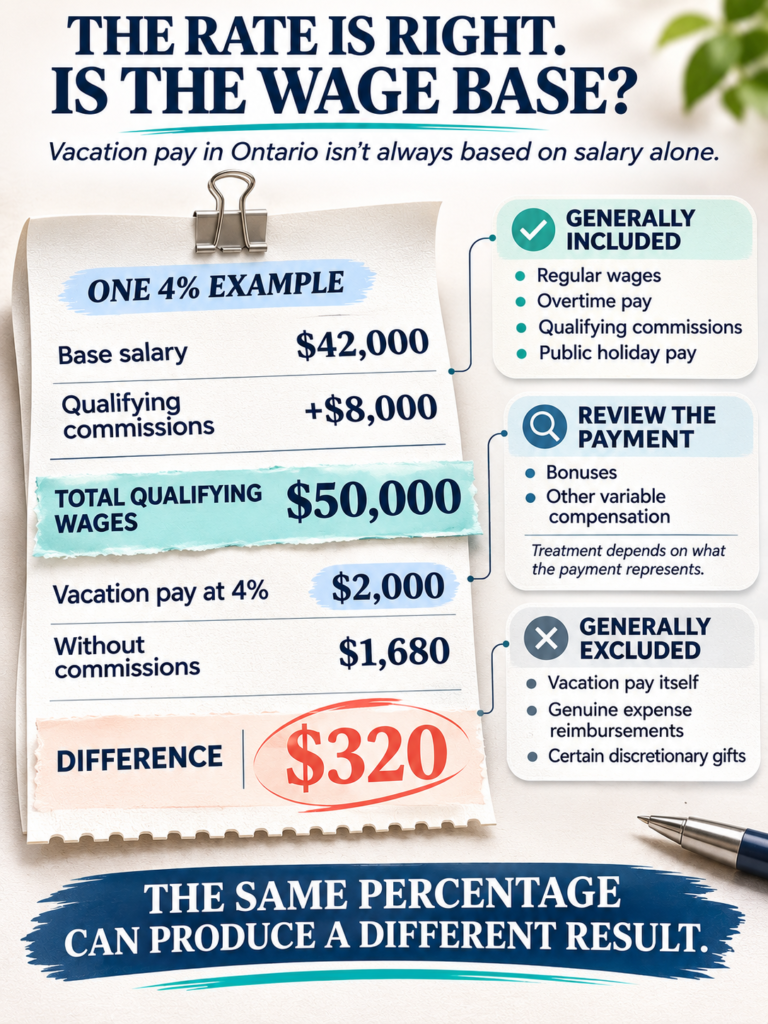
Both receive a base salary of $42,000.
Employee A works in a fixed-pay role with no additional compensation.
Employee B works in a sales-support role and earns $8,000 in qualifying commissions during the same vacation entitlement year.
Both employees have less than five years of employment.
Assuming their only qualifying wages are the amounts described, Employee A earns 4% of $42,000, or $1,680 in vacation pay.
Employee B earns 4% of $50,000, or $2,000.
The difference is $320.
The employees have the same base salary and the same vacation pay percentage. Yet one earns more vacation pay because the eligible wage base is larger.
For a payroll administrator, that is the detail worth checking.
Commission records, overtime earnings and wage adjustments must reach the vacation pay calculation before the payroll period is finalized.
Does Vacation Pay Work Differently for Part-Time and Hourly Employees?
Part-time employees generally qualify for vacation time and vacation pay under Ontario’s ESA, even when their weekly schedules vary.
The misconception that only full-time staff earn vacation pay can create problems for employers with hourly, seasonal or rotating work schedules.
Hourly Employees
An hourly employee’s vacation pay is generally based on qualifying wages earned during the relevant vacation entitlement period.
If working hours increase during busy months, the vacation pay amount increases alongside the qualifying wages.
Part-Time Employees
Part-time status does not automatically remove vacation pay entitlement.
An employee who works fewer hours may earn a smaller dollar amount because total qualifying wages are lower. The applicable statutory percentage still depends on employment length.
Seasonal Employees
Seasonal arrangements require attention to the actual employment relationship.
Whether employment continues between seasons or ends and restarts may affect the period of employment and vacation entitlements.
Employers should not assume that every seasonal return automatically resets service.
Where employment continuity is uncertain, the underlying employment facts need to be reviewed.
When Must Ontario Employers Pay Vacation Pay?
Vacation pay does not always appear on the same payday for every employee.
Under the general ESA rules, an employer normally pays the vacation pay earned during a completed vacation entitlement year or stub period before the employee takes the related vacation.
However, there are permitted alternative arrangements.
Vacation Pay on Every Cheque
An employee may agree electronically or in writing to receive vacation pay on each paycheque as it accrues.
In that situation, the vacation pay amount must be reported separately on the wage statement or in a separate accompanying statement.
Simply configuring payroll software to add vacation pay to every cheque is not a substitute for obtaining the required agreement.
Other Permitted Payment Arrangements
Ontario’s rules also allow certain alternative payment timing arrangements, including circumstances involving direct deposit, vacations taken in shorter periods and agreed payment dates.
The correct approach depends on the arrangement and the applicable statutory conditions.
A Common Misunderstanding
An employee who receives vacation pay on every cheque does not automatically lose the right to vacation time.
Paying the money and providing the time away are separate responsibilities.
Employers need records showing both what was paid and what vacation time was earned and taken.
Vacation Entitlement Years and Stub Periods Explained
Not every employee starts work on the first day of the employer’s vacation year.
Ontario employers may use a standard vacation entitlement year based on the employee’s start date or establish an alternative 12-month vacation entitlement year.
If the employer chooses an alternative year, the period between the employee’s start date and the beginning of that year is called a stub period.
For example, an employee who starts in September may have a stub period ending December 31 if the employer uses a January-to-December vacation year.
The employee can earn vacation time and vacation pay relating to that stub period.
This creates two recordkeeping responsibilities:
- Track the employee’s vacation entitlement for the stub period.
- Track the following full vacation entitlement year separately.
Employers must also consider the statutory deadlines for allowing earned vacation time to be taken.
Under the general ESA rules, earned annual vacation must usually be completed within 10 months after the relevant vacation entitlement year or stub period ends.
Real-World Case Study: What an Ontario Court Decision Says About Unused Vacation
Vacation records can become important long after the original payroll period.
A documented example is Boyer v. Callidus Capital Corporation, 2025 ONCA 79, decided by the Ontario Court of Appeal.
The case involved an employee who left a senior position and disputed several unpaid employment benefits, including accumulated vacation, deferred bonuses and stock options.
What Happened?
The employer challenged the amounts awarded to the former employee.
The lower court had awarded compensation for accumulated unused vacation as well as other employment-related entitlements.
The Ontario Court of Appeal dismissed the employer’s appeal, leaving the relevant awards in place.
The case turned on employment arrangements, accumulated entitlements and the evidence supporting the parties’ positions.
Why It Matters for Employers
The decision illustrates why documented vacation policies, accumulated leave records and clear compensation arrangements matter.
Employers should be able to explain:
- How vacation time was earned
- What vacation time was taken
- Whether unused entitlements remained
- What the employment agreement provided
- How final amounts were calculated
This was a dispute involving contractual and accumulated employment benefits, not a simple decision about applying the ESA’s 4% or 6% minimum to an ordinary paycheque.
Still, the lesson is relevant to businesses of every size: unclear vacation records can become a significant employment dispute.
Read the Ontario Court of Appeal decision in Boyer v. Callidus Capital Corporation.
Why Vacation Pay Errors Still Matter in 2026
Vacation pay problems are not limited to unusual court disputes.
The Ontario Ministry of Labour’s latest published enforcement figures report 474 completed employment standards inspections during the 2025–2026 fiscal year.
The ministry also identifies vacation pay and vacation time among the leading employment standards violations found during inspections for that period.
These inspection figures do not represent the number of vacation pay violations. They provide context showing that employment standards compliance remains an active area of enforcement.
Source: Ontario Employment Standards Enforcement Statistics.
For a small employer, the practical response is not to become anxious about every paycheque.
It is to build a process where employee service dates, qualifying wages, vacation balances and payroll adjustments can be checked before problems accumulate.
Do This, Not That: The Vacation Pay Payroll Checklist
Do This: Track Service Anniversaries
Record each employee’s start date and review upcoming service milestones.
Not That: Assume the vacation pay percentage should remain unchanged until the next annual payroll review.
Do This: Review All Qualifying Wages
Check salary, overtime, commissions, public holiday pay and eligible bonuses.
Not That: Apply vacation pay only to base salary when other qualifying wage components exist.
Do This: Keep Vacation Time and Vacation Pay Separate
Maintain records of both the money earned or paid and the vacation time available or taken.
Not That: Assume paying vacation pay on each cheque removes the need to track vacation time.
Do This: Confirm Payment Agreements
Keep the required electronic or written agreement when vacation pay is paid each payday.
Not That: Rely entirely on a payroll software setting or an undocumented verbal understanding.
Do This: Reconcile Before Year-End
Compare payroll reports, employee earnings, vacation pay calculations and related liabilities.
Not That: Discover unexplained differences only after an employee resigns or requests a detailed breakdown.
For broader payroll checks, TaxRecon’s article on the 2026 Ontario payroll deduction tables explains how bonuses, commissions and other irregular payments can affect employee deductions.
What Happens to Vacation Pay When Employment Ends?
When an employee resigns, retires or has employment terminated, the employer must account for earned but unpaid vacation pay.
Under Ontario’s general ESA rules, outstanding wages, including accrued vacation pay, must normally be paid by the later of:
- Seven days after employment ends
- The employee’s next regular payday
Other amounts arising from termination may require separate calculations, including vacation pay on qualifying statutory termination pay where applicable.
Employers should review the employee’s final earnings, vacation entitlement period, previous payments and remaining vacation balance before issuing final payroll.
The Final-Payroll Check
Before closing an employee’s payroll record, confirm:
- The employee’s service length and applicable vacation pay rate.
- Qualifying wages earned during the final entitlement period.
- Vacation pay already provided.
- Any outstanding vacation pay or applicable adjustments.
- The required final payment date.
Payroll deductions and CRA remittances must also be handled correctly.
TaxRecon’s earlier guide to CRA payroll remittance due dates explains the separate timing obligations for employers remitting payroll deductions.
How Can Ontario Employers Check Vacation Pay Before Payroll Errors Grow?
The most useful payroll review is a repeatable one.
Call it the RATE Check:
R: Review Employment Records
Check the employee’s start date, employment continuity, vacation entitlement year and any alternative payment agreement.
A: Add Eligible Earnings
Confirm that all qualifying wage components have been included.
Do not assume the payroll software has correctly classified every bonus, commission or adjustment.
T: Test the Applicable Percentage
Confirm the minimum vacation pay rate and whether the employee has reached the five-year service threshold.
If the milestone occurred during the current entitlement year, check whether a top-up is required.
E: Examine Payments and Balances
Compare vacation pay accrued, amounts paid, time taken and balances remaining.
Investigate unexplained differences before they carry forward into another payroll period.
This review is particularly valuable for employers with several payment structures, including salaried, hourly, commission-based and part-time staff.
When Professional Payroll Support Makes Sense
Payroll becomes more demanding as employee arrangements vary.
A business with a few salaried employees may manage straightforward calculations for some time. But new hires, varying hours, bonuses, commissions, employment anniversaries and departures can create obligations that need closer review.
TaxRecon’s payroll services in London, Ontario support businesses with employee pay calculations, relevant adjustments, CPP and EI deductions, CRA remittances and year-end reporting.
Related bookkeeping services can help maintain the accounting records and reconciliations that support payroll reporting.
The purpose of professional support is not simply to run payroll software.
It is to make the calculations understandable, identify discrepancies and keep the underlying records connected to the amounts being paid.
For businesses facing a disagreement over statutory entitlements or an employment contract, legal advice may also be appropriate.
Final Thoughts: Similar Paycheques Do Not Always Mean Equal Vacation Pay
Two employees can earn similar salaries and still have different vacation pay entitlements.
One may have crossed the five-year employment threshold. Another may earn qualifying commissions or overtime. A third may receive vacation pay each payday under an agreed arrangement.
The differences are not always errors.
The real risk arises when employers fail to track the details that explain them.
Vacation pay in Ontario becomes easier to manage when businesses treat it as an ongoing calculation linked to wages, service length and vacation records, rather than an amount checked once at year-end.
For employers, the best next step is simple: review the employee records before the next pay run and confirm that the numbers tell the right story.
Need a Clearer Vacation Pay Process?
If your employees’ vacation balances or payroll calculations are difficult to explain, a review of the underlying records is a sensible starting point. TaxRecon helps Ontario businesses manage payroll calculations, reporting and related accounting records with clearly defined responsibilities. Schedule a consultation to discuss the payroll details that need attention.
Frequently Asked Questions
How Much Vacation Pay Does an Employee Receive in Ontario?
Most employees covered by Ontario’s general ESA vacation rules receive at least 4% of qualifying wages while employed for less than five years and 6% after reaching five years. The actual amount depends on eligible earnings, the vacation entitlement period and any more generous employment terms.
Do Part-Time Employees Receive Vacation Pay in Ontario?
Yes. Part-time employees generally qualify for vacation pay under Ontario’s Employment Standards Act. Their entitlement depends on qualifying wages and length of employment, not simply whether they work full-time hours. Vacation time must also be tracked according to the applicable statutory rules.
Does Overtime Pay Count Toward Vacation Pay?
Yes. Overtime pay generally forms part of the wages used to calculate Ontario vacation pay. Employers should include qualifying overtime earnings during the relevant period rather than calculating vacation pay only on ordinary hours or base wages.
Are Commissions and Bonuses Included in Vacation Pay?
Commissions generally count as wages, and certain bonuses can also qualify. A bonus related to work, performance or productivity may be included, while genuinely discretionary gifts unrelated to work may be excluded. The payment’s actual nature matters more than its label.
Does Vacation Pay Increase Automatically After Five Years?
The minimum entitlement increases when an employee reaches five years of employment. Depending on the vacation entitlement year and payment arrangement, an employer may also need to top up vacation pay previously calculated at 4% during that same entitlement period.
Can Ontario Employers Pay Vacation Pay on Every Paycheque?
Yes, when the employee has agreed electronically or in writing to that arrangement. The employer must also show vacation pay separately on the wage statement or provide an accompanying statement. Paying vacation pay this way does not eliminate the employee’s right to vacation time.
Is Vacation Pay Included in an Employee’s Final Pay?
Outstanding earned vacation pay generally must be included in final wages when employment ends. Employers should review qualifying earnings, previous vacation payments and applicable statutory termination-related entitlements before closing the payroll record.
Can TaxRecon Review Vacation Pay Calculations for an Ontario Business?
TaxRecon offers payroll calculation and reporting support for Ontario businesses. An engagement can involve reviewing employee pay information, adjustments and payroll records within the agreed scope. Employment-law disputes or contract interpretation may require advice from an Ontario employment lawyer.
Is Professional Payroll Support Worth It for a Small Business?
Professional support can be useful when a business has changing schedules, commissions, bonuses, employee departures or unexplained payroll balances. The value lies in reviewing calculations, maintaining clear records and identifying issues before they affect multiple pay periods.