You’ve reached the end of your corporation’s financial year, and now it’s time to file taxes. You start looking for an accountant and see one service advertising a T2 return for a few hundred dollars, while another quotes several thousand.
Naturally, you’re wondering why there’s such a big difference.
The answer usually comes down to what the accountant needs to do before filing your return. Some corporations have clean financial statements and straightforward tax situations. Others need months of bookkeeping corrected, shareholder transactions reviewed, and financial reports prepared before anyone can calculate the tax.
So, how much does a corporate tax return cost in Canada?
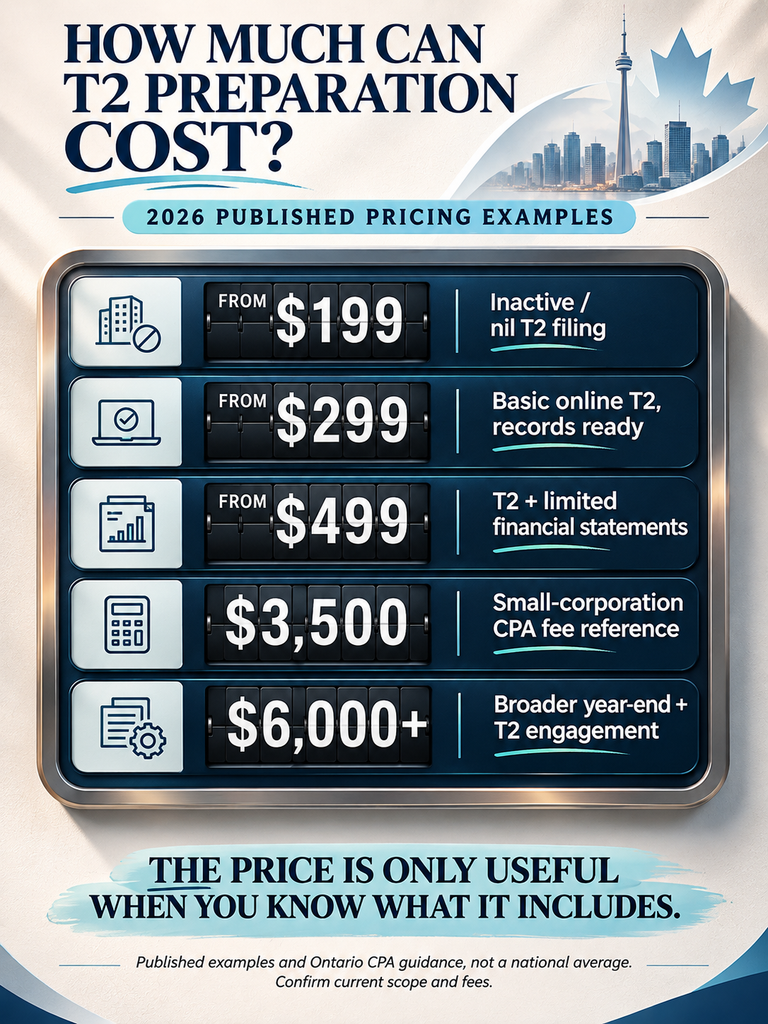
Based on published Canadian accounting-service prices and 2026 Ontario CPA fee guidance, a basic online T2 filing can start around $299, while professional corporate tax engagements commonly cost substantially more. Full year-end accounting packages can reach several thousand dollars.
But the lowest advertised price isn’t necessarily the lowest final bill.
At TaxRecon, corporate tax preparation starts with understanding the records behind the return. Knowing what’s included in your accountant’s fee helps you compare quotes, prepare your documents, and avoid paying for work you don’t need.
Key Takeaways
- Basic online T2 preparation can start around $299, while more involved accounting engagements often cost 1,200–3,500 or more.
- Bookkeeping cleanup, financial statements, complicated transactions, and additional tax schedules can increase fees.
- An inactive corporation may qualify for lower-cost filing, but most resident corporations must still submit a T2.
- Your T2 filing deadline and corporate tax payment deadline are different.
- Compare the work included in each quote, not just the advertised starting price.
How Much Does a Corporate Tax Return Cost in Canada in 2026?
Corporate tax return preparation in Canada can cost a few hundred dollars for a straightforward online T2 filing or several thousand dollars for a more involved accounting engagement. The final fee depends on your corporation’s activity, financial records, required tax schedules, and whether the accountant must prepare financial statements or complete additional year-end work.
There isn’t one regulated national price for T2 preparation.
Accountants and tax preparation services set their fees according to the scope of work. That’s why comparing two quotes without reviewing what each includes can lead to the wrong decision.
2026 Corporate Tax Filing Cost Comparison
The following figures reflect publicly advertised Canadian service prices and a published Ontario CPA fee guide. They are examples and professional estimates, not a statistically representative national average.
| Service type | Published price or estimate | Typical scope |
| Basic inactive corporation return | From $199 | Simple nil or inactive T2 filing |
| Basic online T2 preparation | From $299 | T2 preparation using ready financial statements |
| Online T2 with financial statement preparation | From $499 | T2 plus limited financial statement preparation |
| Small corporation CPA T2 engagement | 1,200–3,500 | Professional corporate tax preparation, depending on scope |
| Corporate year-end bookkeeping and T2 package | 2,500–6,000+ | Broader year-end accounting and tax filing |
| Complex corporate tax engagement | Custom quote | Additional schedules, entities, transactions, and advisory work |
The lower starting prices reflect published offers from online Canadian corporate tax preparers, including T2inc.ca.
For a broader professional accounting comparison, the 2026 Ontario CPA fee benchmarks published by Insight Accounting CPA place a small Canadian-controlled private corporation’s T2 return at 1,200–3,500, with combined year-end bookkeeping and T2 work estimated at 2,500–6,000 or more.
These prices are useful reference points, but they don’t establish what every Canadian accountant charges.
A $299 return-only service and a $2,500 year-end accounting engagement may involve completely different responsibilities.
The question worth asking is: What work is already finished, and what does the accountant still need to prepare?
What Is Included in a T2 Corporate Tax Return Fee?
A T2 Corporation Income Tax Return reports a corporation’s income, expenses, adjustments, deductions, credits, and tax payable to the Canada Revenue Agency (CRA).
For most incorporated businesses, preparing the return involves more than entering a profit figure into tax software.
Core T2 Preparation
A basic professional filing engagement may include:
- Reviewing the corporation’s tax year and filing information
- Using completed financial statements to prepare the return
- Reconciling accounting income with taxable income
- Completing applicable corporate tax schedules
- Calculating federal and provincial corporate income tax
- Reviewing the return before submission
- Electronically filing the return with CRA
The exact inclusions vary by provider.
Some firms charge separately for financial statement preparation, bookkeeping, additional schedules, and support after filing.
Financial Statements and GIFI Reporting
CRA generally requires corporations to report financial statement information using the General Index of Financial Information (GIFI).
For many corporations, that includes information associated with:
- Schedule 100: Balance sheet information
- Schedule 125: Income statement information
- Schedule 141: Additional financial statement information
Other schedules apply depending on the corporation’s activities and tax position.
Your accountant may already have the financial information needed for these schedules.
If not, someone must first prepare or correct it.
That’s why a quote for preparing a T2 from completed financial statements may be much lower than a quote that includes producing those statements.
Additional Corporate Tax Schedules
Some corporations need further calculations involving:
- Capital cost allowance
- Non-capital losses
- Shareholder information
- Associated corporations
- Taxable dividends
- Investment income
- Intercompany transactions
- Provincial income allocation
- Tax credits
Not every corporation needs every schedule.
However, each additional issue can require more review, documentation, and calculation.
What Makes Corporate Tax Accountant Fees Higher?
The biggest cost difference often has less to do with business revenue than the amount of accounting work required.
Two corporations can earn similar amounts but receive very different tax preparation quotes.
1. Incomplete or Disorganized Bookkeeping
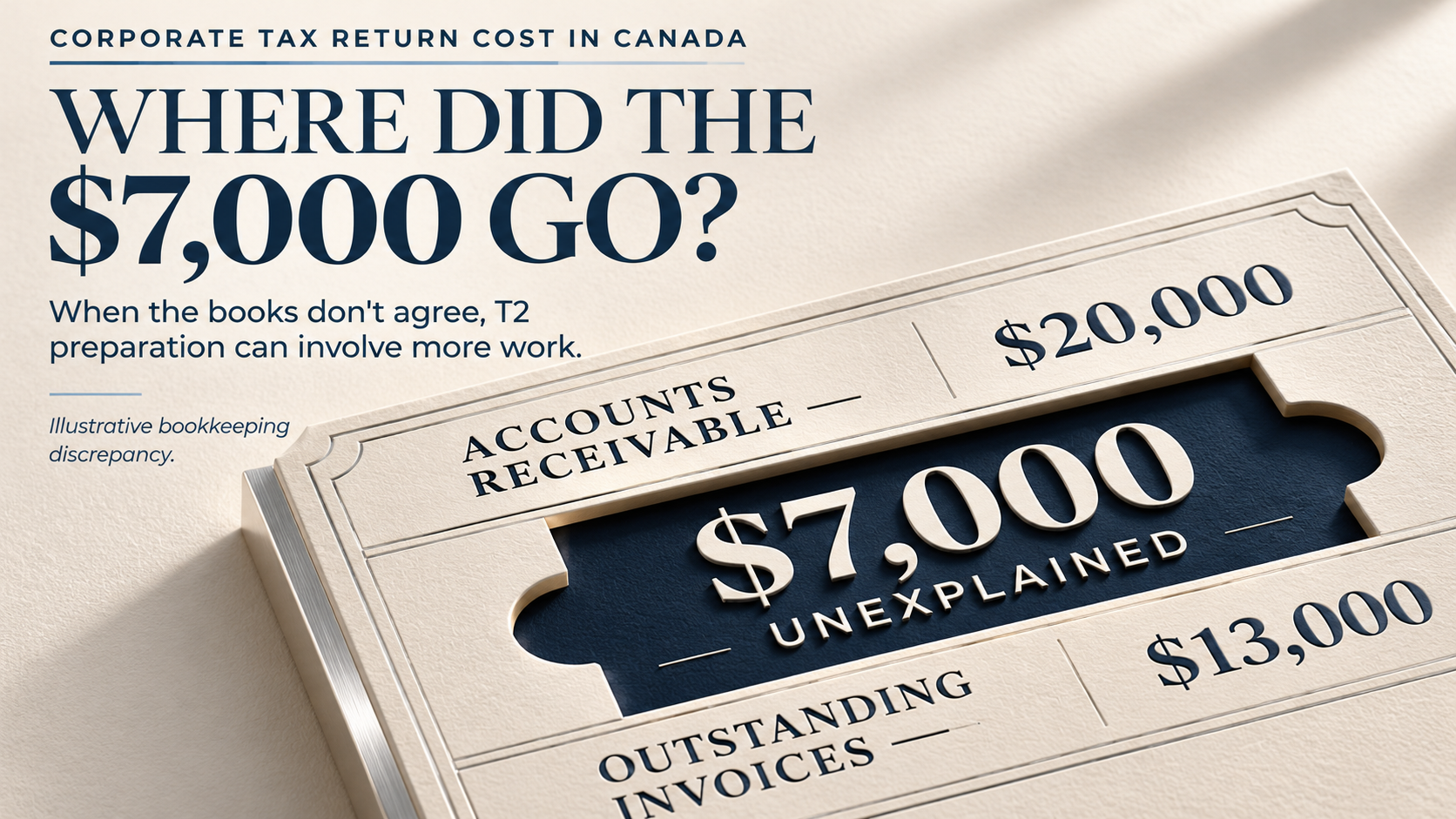
Imagine sending your accountant a spreadsheet with missing transactions, unreconciled bank balances, and expenses that haven’t been categorized.
Before preparing the return, the accountant may need to:
- Reconcile bank and credit-card accounts
- Investigate missing transactions
- Correct duplicated expenses
- Review outstanding invoices
- Separate personal and corporate spending
- Reconcile payroll and GST/HST balances
That work takes time.
Now compare it with a corporation whose bookkeeping is current and whose year-end balances have already been checked.
The second corporation may require less preparation before the T2 can begin.
2. Business Transaction Volume
More transactions don’t always mean a more complicated tax return, but they can increase the accounting review required.
A small consulting corporation with a handful of invoices each month may have fewer transactions to reconcile than a retailer processing numerous sales, refunds, supplier payments, and inventory adjustments.
The underlying records determine how much work is necessary.
3. Shareholder Loans and Owner Payments
Owner-managed corporations often have transactions between the business and its shareholders.
These can include:
- Personal expenses paid by the company
- Money advanced to a shareholder
- Shareholder loans
- Dividends
- Salary and bonuses
- Expense reimbursements
Accountants must classify these transactions correctly because they can affect corporate and personal tax reporting.
Unexplained withdrawals can make year-end work more complicated.
4. Multiple Corporations or Provinces
Holding companies, related corporations, and businesses operating across provincial boundaries may require additional analysis.
For example, associated corporations can affect the small business deduction, while corporations with permanent establishments in multiple provinces may need income allocation calculations.
Cross-border transactions and foreign reporting obligations can add further complexity.
5. Overdue Returns and Previous-Year Issues
Missing returns can create additional work because opening balances, losses, assessments, and prior-year adjustments may affect later filings.
An accountant may need to review earlier records before preparing the current year.
That’s different from preparing a routine annual return using finalized records.
6. Time-Sensitive Filing Requests
Leaving tax preparation until shortly before the deadline may reduce the time available to resolve missing documents or discrepancies.
Some firms charge additional fees for urgent work, although their policies vary.
Requesting a quote early gives you more room to organize records and confirm the scope.
Does Corporate Tax Preparation Include Bookkeeping?
Not always.
This is one of the most important questions to ask before accepting an accountant’s quote.
Bookkeeping records what happened during the year. Corporate tax preparation uses those records to calculate and report the company’s tax position.
The two services are connected, but they are not interchangeable.
What Bookkeeping Usually Covers
Bookkeeping may include recording transactions, reconciling accounts, categorizing expenses, and monitoring receivables and payables.
What Tax Preparation Usually Covers
Corporate tax preparation focuses on taxable income, deductions, tax adjustments, schedules, and the return submitted to CRA.
If your books are already accurate, you may only need year-end accounting adjustments and T2 preparation.
If your records are incomplete, you might need bookkeeping cleanup first.
TaxRecon’s bookkeeping services in London, Ontario help businesses connect transaction records, reconciliations, and financial reporting with their broader accounting responsibilities.
Does a T2 Include a Compilation Engagement?
Not automatically.
Financial statement preparation, a compilation engagement under CSRS 4200, a review engagement, and an audit are different services.
A lender or shareholder agreement may require a particular type of financial reporting engagement.
A basic T2 filing package does not automatically satisfy those requirements.
Before comparing prices, ask whether the quote includes financial statements prepared for tax reporting only or a separate professional engagement with its own reporting requirements.
Can You File a Corporate Tax Return Yourself to Save Money?
Yes. Many Canadian business owners can prepare their own T2 return using CRA-certified corporate tax software.
However, filing your corporation’s return is different from filing a straightforward personal T1 return.
You must understand the required schedules, financial statement information, corporate tax adjustments, and applicable provincial rules.
DIY T2 Filing vs Hiring an Accountant
| Consideration | DIY tax software | Professional accountant |
| Preparation responsibility | Business owner | Accountant within agreed scope |
| Software | You select and pay for it | Usually part of the service |
| Tax calculations | You review and complete them | Accountant prepares or reviews them |
| Bookkeeping corrections | Your responsibility | May be available for an additional fee |
| Complex tax questions | Requires your own research or advice | Can be addressed within the engagement |
| Filing submission | You submit electronically | Provider may file on your behalf |
| Cost | Often lower direct cost | Higher fee for professional work |
| Time required | Depends on your experience | Usually less owner preparation time after records are ready |
DIY filing may be reasonable for a business owner who understands corporate accounting and has accurate financial statements.
A professional accountant may be more useful when the return involves complicated transactions, incomplete records, or tax issues that require judgment.
Is CRA Corporation Internet Filing Free?
CRA’s Corporation Internet Filing service itself is free.
However, you generally need CRA-certified software to prepare and transmit a corporate return electronically. That software may involve a purchase or subscription cost.
For tax years beginning after 2023, most corporations are required to file electronically, subject to specific exceptions.
Failure to comply with mandatory electronic filing can trigger a separate penalty.
Important: Free electronic submission does not mean professional preparation, financial statement work, or commercial software is free.
How Much Does a T2 Cost for an Inactive Corporation?
An inactive corporation may qualify for lower-cost tax preparation because it has fewer transactions and reporting issues.
Some specialist online services advertise simple inactive corporate tax returns starting at approximately $199.
But not every inactive corporation has a completely empty financial history.
For example, your company might have stopped selling products but still have:
- A business bank account
- Outstanding debts
- Shareholder loans
- Assets or investments
- Previous-year losses
- Bank charges or other expenses
Those balances may still require review.
Does a Corporation With No Income Need to File?
Generally, yes.
Most resident corporations must file a T2 return for every tax year, even if they have no income, are inactive, or owe no corporate income tax.
Specific statutory exceptions exist.
TaxRecon covers this issue in more detail in its guide to inactive corporation T2 filing in Canada.
If your corporation had no business activity, tell the accountant exactly what accounts, assets, and liabilities still exist.
That helps them determine whether a simple filing package is appropriate.
What Does a First-Year Corporate Tax Return Cost?
The first corporate tax return may require extra attention because the accountant needs to establish the corporation’s opening tax and accounting position.
The cost depends on how the corporation was formed and what happened during its first fiscal period.
For example, an accountant may need to review:
- Incorporation documents
- Initial share issuance
- Opening balance sheet information
- Startup expenses
- Assets transferred into the corporation
- Shareholder advances
- First-year payroll
- GST/HST registration and reporting
A newly incorporated company with no operations may have a relatively simple return.
A corporation that acquired an existing sole proprietorship’s assets and began trading immediately may require more detailed work.
Your First Corporate Year-End Matters
Canadian corporations generally choose their first fiscal year-end within the permitted period after incorporation.
That date determines when the accounting period closes and when the first T2 return becomes due.
Choosing an impractical year-end can bring your first filing sooner than expected or place annual accounting work during your busiest season.
For a fuller explanation, read TaxRecon’s guide to choosing your first corporate year-end in Canada.
How Do T2 Accountant Fees Compare Across Business Types?
The industry matters less than the accounting and tax responsibilities behind the business, but different business models commonly create different types of work.
| Business type | Common accounting issues | Potential effect on T2 preparation |
| Independent consultant | Owner compensation, expenses, receivables | Often straightforward with clean books |
| Retail business | Inventory, refunds, sales, cost of goods sold | More reconciliation and inventory review |
| Construction company | Work in progress, equipment, subcontractors | Additional accounting and tax adjustments |
| Professional corporation | Shareholder compensation, investments, professional rules | Potentially more detailed tax planning |
| Holding company | Investments, dividends, related-party balances | Specialized corporate tax calculations |
| Multi-province business | Income allocation, different provincial requirements | Additional reporting and review |
| Inactive corporation | Previous balances, outstanding obligations | Often simpler if truly inactive |
A holding company with only a few transactions can still involve complicated tax rules.
A business with many transactions may have a straightforward return if its financial records are complete.
Tax preparation cost follows the work required, not simply the number of invoices or the company’s annual sales.
Real-World Examples: Why Two Corporations Receive Different Quotes
These examples are hypothetical and illustrate how accountants may assess a file. They are not TaxRecon client cases or actual quotes.
Example 1: A Consultant With Clean Financial Records
An Ontario consultant operates through a corporation and uses accounting software throughout the year.
Bank accounts are reconciled, expenses are categorized, and shareholder payments are recorded.
The accountant receives complete financial records and needs to prepare the applicable tax adjustments and T2 return.
Because there is little bookkeeping work left to complete, a return-focused engagement may be suitable.
Example 2: A Retail Business With Missing Records
A retailer has a year of sales activity, but inventory records don’t agree with the accounting system.
Several bank transactions remain unexplained, and the GST/HST balances haven’t been reconciled.
Before completing the T2, the accountant needs to investigate those discrepancies and prepare reliable year-end figures.
A more expensive quote may reflect the additional accounting work rather than a higher fee for filing the return itself.
Example 3: A Corporation With Several Years of Outstanding Returns
A company has missed previous filing years and now wants to bring its corporate tax account up to date.
The accountant may need to establish the correct sequence of returns, review opening balances, and determine whether previous tax assessments or losses affect later years.
The final cost may be much higher than one routine T2 filing because the engagement covers several periods.
What Documents Does an Accountant Need for a T2 Return?
Preparing documents before requesting a quote can help the accountant understand the scope and identify missing information.
Use this checklist as a starting point.
Corporate and Tax Records
- Corporation legal name and business number
- Fiscal year start and end dates
- Incorporation details
- Previous corporate tax returns
- CRA Notices of Assessment or Reassessment
- Relevant CRA correspondence
Financial Information
- Year-end balance sheet and income statement, if available
- General ledger and trial balance
- Business bank statements
- Credit-card statements
- Loan balances
- Accounts receivable and payable
- Inventory records, where applicable
- Capital asset purchases and disposals
Owner and Compliance Records
- Shareholder loan account details
- Salary and dividend information
- Payroll summaries
- GST/HST information
- Intercompany transactions
- Relevant investment records
Not every business will need every document.
The accountant should explain which records apply to your corporation and which information is still missing.
When Is Your Corporate T2 Return Due in Canada?
The CRA generally requires corporations to file their T2 return within six months after the end of their tax year.
However, the corporate income tax payment deadline usually arrives earlier.
The CRA’s T2 Corporation Income Tax Guide explains the filing, payment, and electronic submission rules.
Corporate Filing and Payment Deadlines
| Corporate year-end | General T2 filing deadline | General tax balance due |
| March 31 | September 30 | May 31, or June 30 if eligible |
| June 30 | December 31 | August 31, or September 30 if eligible |
| September 30 | March 31 of the following year | November 30, or December 31 if eligible |
| December 31 | June 30 of the following year | February 28 or 29, or March 31 if eligible |
The filing deadline is generally six months after year-end.
Corporate income tax balances are generally payable within two months, while certain qualifying Canadian-controlled private corporations can receive a three-month balance-due period.
Weekend and holiday rules can affect the actual due date.
What Happens If You File Late?
Late filing and late payment can create different costs.
For a standard late-filed T2 return with unpaid tax, CRA generally applies a penalty based on the unpaid balance, with additional amounts for each complete month the return remains late, subject to the relevant limits.
Repeat non-compliance and specific corporate circumstances can produce different penalties.
Interest may also apply to unpaid taxes.
A corporation that owes no tax may avoid the ordinary balance-based late-filing penalty, but it still has a legal filing obligation and may face other compliance consequences.
Leaving the return unfinished doesn’t eliminate those responsibilities.
How Can You Reduce Your Corporate Tax Preparation Costs?
You cannot control every factor affecting the accountant’s fee, but you can reduce unnecessary work before the engagement begins.
1. Reconcile Your Accounts Before Year-End
Compare accounting records with your bank and credit-card statements.
Investigate differences rather than leaving them for the tax preparer.
2. Keep Personal and Corporate Spending Separate
Use the appropriate corporate accounts and record owner transactions properly.
This makes shareholder balances easier to review.
3. Organize Receipts and Asset Purchases
Keep invoices for equipment, vehicles, software, and other purchases.
Identify assets that may require depreciation calculations.
4. Review GST/HST and Payroll Balances
Check that the year-end balances agree with supporting records and required filings.
Unexplained differences can delay tax preparation.
5. Ask for a Written Quote With a Clear Scope
Don’t rely on a starting price alone.
Find out exactly what the accountant will prepare and whether additional work requires separate approval.
6. Start Before the Deadline Becomes Urgent
Give yourself time to gather records and resolve questions before filing.
Planning ahead may also help you avoid rush-service charges where a provider applies them.
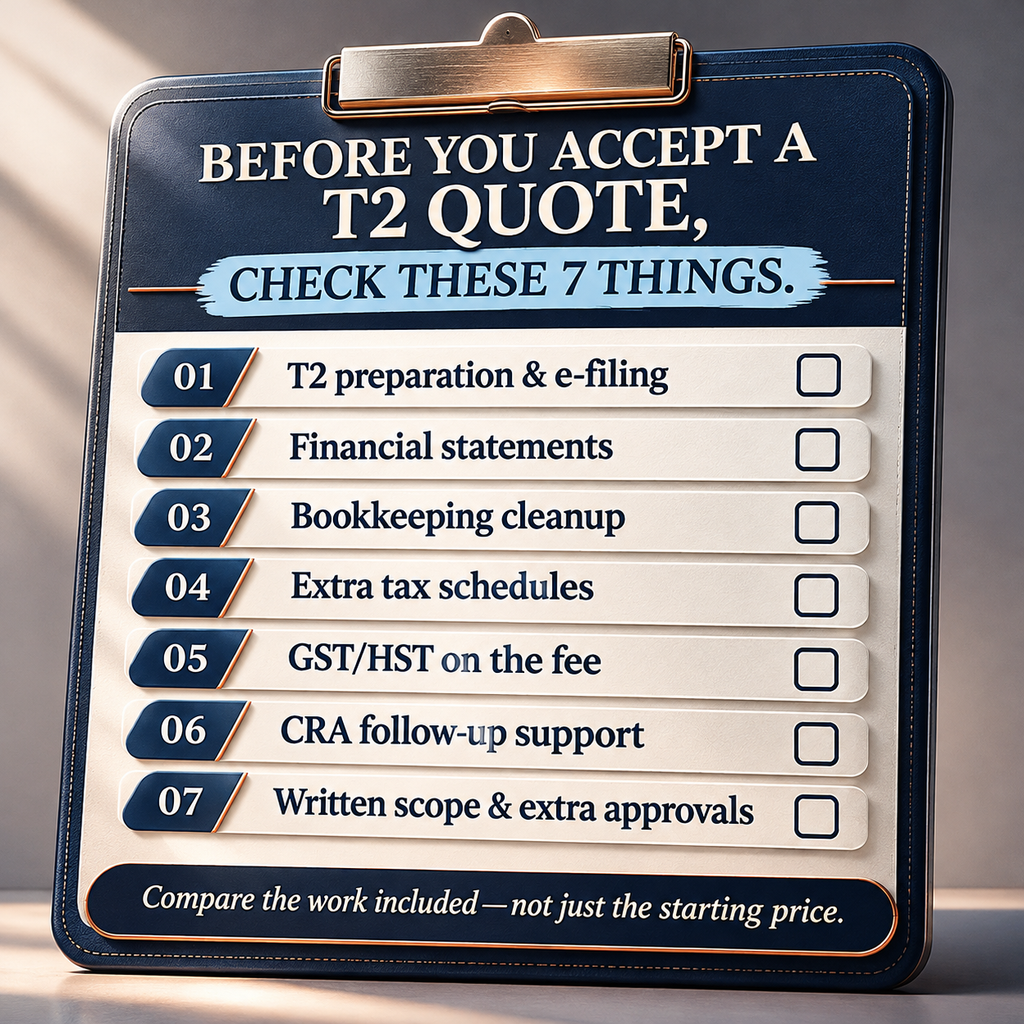
Seven Questions to Ask Before Hiring a Corporate Tax Accountant
Price matters, but the scope behind the quote matters more.
Use the following questions when comparing providers.
| Question | Why it matters |
| Does the fee include T2 preparation and electronic filing? | Confirms what the quoted service actually delivers |
| Are financial statements included? | Distinguishes return-only pricing from broader accounting work |
| Is bookkeeping cleanup included or billed separately? | Identifies a major potential extra expense |
| Which tax schedules are covered? | Clarifies how complex transactions will be handled |
| Does the quote include applicable GST/HST? | Helps you compare the total amount payable |
| What happens if the CRA asks a question after filing? | Establishes whether follow-up support is included |
| Will I receive a written scope and final price? | Makes it easier to understand additional work and charges |
A Useful Rule: Compare Scope Before Price
Choose a return-only service when your financial records are already complete and your tax position is straightforward.
Consider a broader year-end engagement when your financial statements, accounting adjustments, and corporate return all need attention.
Request specialized tax support when the corporation has complex investments, related-party transactions, cross-border activity, or significant tax planning requirements.
The most suitable option is the one that addresses the actual work your business needs.
Are Corporate Tax Accountant Fees Tax Deductible?
Generally, reasonable accounting and professional fees incurred for business purposes can qualify as deductible expenses.
That can include fees related to corporate accounting, bookkeeping, and preparing the company’s income tax return.
However, not every payment to an accountant or lawyer receives identical tax treatment.
For example, certain costs associated with acquiring a capital asset or restructuring a business may need different treatment.
If your accountant charges one combined fee for several services, it may be necessary to identify what each component relates to.
Keep the invoice and supporting documentation with your corporate financial records.
How Can TaxRecon Help With Corporate Tax Filing?
The right starting point is knowing what has already been completed and what still needs attention.
A corporation with reliable financial statements may be ready for T2 preparation.
Another corporation might first need bank reconciliations, corrected shareholder balances, or a review of an earlier tax year.
TaxRecon’s corporate and business tax filing services cover T2 preparation for incorporated businesses, with attention to the relevant corporate tax year, available records, and filing-related issues.
Rather than assuming every business needs the same package, the practical approach is to establish the required work and agree on the service scope.
TaxRecon does not publish one universal T2 filing price on its reviewed service pages. The actual fee should be confirmed based on your corporation’s circumstances.
Final Thoughts: What Should You Budget for a Corporate Tax Return?
Corporate tax filing doesn’t have to be expensive, but it does need to reflect the work involved.
If your financial statements are ready and your corporation has straightforward tax reporting requirements, a basic filing service may be enough.
If your books need corrections, your shareholder transactions are complicated, or several filing years remain outstanding, a broader accounting engagement may be necessary.
The advertised starting price is only one part of the decision.
When comparing the corporate tax return cost in Canada, look at the records you have, the work still required, the filing deadline, and what each accountant includes.
Good bookkeeping throughout the year can reduce the amount of corrective work needed at tax time.
Before choosing a provider, ask for a quote that clearly explains the services included and the circumstances that could change the fee.
Get a Clearer Quote for Your Corporate Tax Return
Not sure whether you need T2 filing only or additional year-end accounting work?
TaxRecon can review your corporate filing needs, identify which records are available, and discuss the scope of work before tax preparation begins.
Contact TaxRecon to discuss your corporate tax return and request a quote based on your business’s circumstances.
Frequently Asked Questions
1. What Is the Average Cost of a Corporate Tax Return in Canada?
There is no official national average for T2 preparation fees. Advertised basic online services can start around $299, while a published 2026 Ontario CPA guide estimates 1,200–3,500 for small-corporation T2 engagements. Your final cost depends on the accountant, the financial records, and the work included.
2. How Much Does an Accountant Charge for a T2 in Ontario?
Published Ontario CPA guidance estimates approximately 1,200–3,500 for a small corporation’s T2 engagement, with broader year-end bookkeeping packages costing more. Online providers may advertise lower starting fees for simpler returns. Compare whether financial statements, bookkeeping, additional schedules, and electronic filing are included.
3. Is It Cheaper to File a Corporate Tax Return Online?
Online preparation services can have lower advertised starting prices than traditional full-service accounting engagements. However, the services may not be identical. Some online packages require completed financial statements and charge separately for extra accounting work. Review the scope before assuming the online option will cost less overall.
4. Can I File My Corporation’s T2 Return for Free?
CRA’s Corporation Internet Filing service is free, but you generally need CRA-certified software to prepare and submit the return electronically. Commercial software may have a cost. You can prepare your own return if you understand the requirements, but professional preparation is a separate paid service.
5. Does a New Corporation Need to File a T2 in Its First Year?
Generally, yes. A resident corporation normally has to file a T2 return for its first tax year, even if it earned no income. The first tax year starts on incorporation and ends on the selected fiscal year-end, subject to applicable CRA rules. Filing requirements depend on the corporation’s status.
6. How Much Does a Nil Corporate Tax Return Cost?
Some online Canadian providers advertise basic inactive corporation returns starting around $199. The fee may increase if the company has existing assets, shareholder balances, prior filings, or other records that require attention. A corporation with no sales is not necessarily a corporation with no accounting activity.
7. Are Financial Statements Included in T2 Accountant Fees?
Not always. Some providers quote only for T2 preparation using completed financial statements. Others include financial statement preparation, year-end adjustments, or broader accounting services. A compilation, review, or audit engagement is different from simply preparing financial information for tax reporting. Confirm the inclusions in writing.
8. How Long Does a Corporate Tax Return Take to Prepare?
Preparation time varies with the condition of the records, the accountant’s workload, and the complexity of the return. A simple file with complete financial statements may require less work than one involving bookkeeping cleanup or unresolved tax questions. Ask your provider for a timeline based on your actual documents.
9. Can Corporate Tax Preparation Fees Be Deducted?
Generally, reasonable business-related accounting and tax preparation fees may qualify as deductible corporate expenses. However, certain capital-related services or restructuring costs can have different tax treatment. Keep detailed invoices and ask your accountant how to classify fees that cover multiple types of professional work.
10. Does TaxRecon Offer a Fixed Price for T2 Filing?
TaxRecon’s reviewed website does not provide a universal published price for all corporate T2 returns. Its service scope includes corporate tax filing and related accounting support. The appropriate fee depends on the corporation’s records and requirements, so request a quote that confirms the work involved.