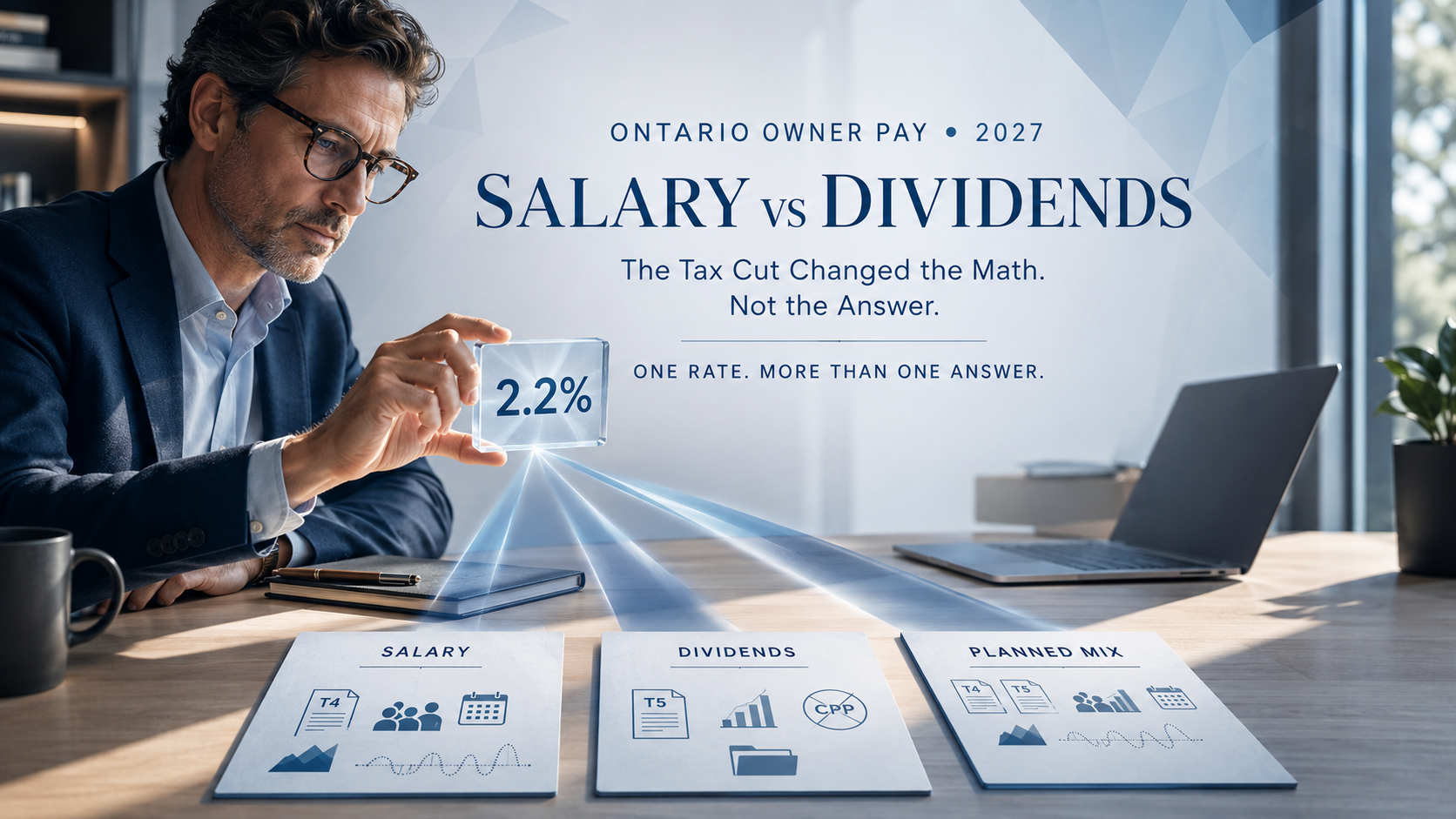
Ontario just changed the salary-versus-dividend conversation for 2027.
The lower small-business corporate tax rate leaves more after-tax profit inside qualifying corporations. At the same time, Ontario is reducing its tax credit on non-eligible dividends. That does not make salary or dividends the automatic winner. Your best mix still depends on CPP, RRSP room, personal cash needs, other income, and the corporation’s records.
The size of the change is not trivial. Ontario says the tax reduction affects more than 375,000 small businesses and could provide qualifying corporations with up to $5,000 in provincial tax relief each year.
The real question is not:
“Which option has the lower tax rate?”
It is:
“Which payment mix leaves the owner and the company in the strongest position after tax, retirement contributions, cash flow, and reporting responsibilities are considered?”
Key Takeaways
- Ontario’s small-business corporate tax rate fell from 3.2% to 2.2% on July 1, 2026.
- Ontario’s credit on non-eligible dividends falls from 2.9863% to 1.9863% in 2027.
- Salary can create RRSP room and CPP participation. Dividends generally do not.
- A lower corporate rate does not automatically make dividends the better choice.
- Many owners should compare salary, dividends, and a planned mix before 2027 begins.
What Actually Changed for Ontario Corporations?
Ontario reduced its lower corporate income-tax rate from 3.2% to 2.2%, effective July 1, 2026. The lower rate generally applies to the first $500,000 of qualifying active business income earned by eligible Canadian-controlled private corporations.
The change is no longer simply a budget proposal. Bill 97 received Royal Assent on April 24, 2026, and Ontario’s current corporate-tax guidance now lists the 2.2% rate as effective from July 1, 2026.
For a corporation with a taxation year that crosses July 1, the province prorates the rate based on the number of days before and after the change.
A corporation with a December 31 year-end therefore does not use 2.2% for its entire 2026 taxation year.
Current combined federal and Ontario rates illustrate the transition:
| Qualifying active business income | Combined federal and Ontario rate |
| 2025 | 12.2% |
| Calendar year 2026 | 11.7% |
| 2027 | 11.2% |
These rates assume the corporation qualifies for the Small Business Deduction and that the income remains within the applicable business limit.
What Changes for Non-Eligible Dividends in 2027?
Ontario is reducing its provincial tax-credit rate for other Canadian dividends, commonly called non-eligible dividends, from 2.9863% to 1.9863% starting in 2027.
A non-eligible dividend commonly comes from income that received the small-business corporate tax rate.
The corporation pays tax on its income first. It may then distribute part of the remaining profit to a shareholder as a dividend.
The shareholder includes a grossed-up amount on the personal tax return and claims federal and provincial dividend tax credits. Those credits recognize that the corporation already paid tax on the underlying income. The system aims to bring the combined corporate and personal tax closer to the tax that would apply if the individual earned the income directly.
Because Ontario is collecting less corporate tax on qualifying small-business income, it is also reducing the personal credit attached to the related non-eligible dividend.
At Ontario’s highest personal tax bracket, PwC projects the combined federal and provincial rate on non-eligible dividends to increase from 47.74% in 2026 to 48.89% in 2027. That is a top-bracket figure, not the rate every business owner will pay.
Why Does the Lower Corporate Rate Not Make Dividends the Clear Winner?
Because salary and dividends travel through the company differently.
Salary generally reduces the corporation’s taxable income when the company pays and reports it properly. The owner reports employment income and may have income tax and CPP deducted through payroll.
A dividend does not reduce corporate income. The corporation pays tax first and distributes the dividend from after-tax earnings. The shareholder then reports dividend income, usually through a T5 slip.
That means comparing only the owner’s personal tax bill misses half of the calculation.
You also need to consider what each method creates or gives up.
| Decision factor | Salary | Dividend |
| Corporate deduction | Generally deductible when properly paid and reported | Not deductible |
| Personal reporting | T4 employment income | T5 dividend income |
| CPP | Usually applies to pensionable salary | Does not apply |
| RRSP room | Can create earned income for future RRSP room | Does not normally create RRSP room |
| Payroll work | Requires deductions, remittances, and T4 reporting | No payroll deductions |
| Corporate records | Payroll records and expense support | Dividend declaration and corporate records |
| Payment pattern | Suits regular income | Suits periodic distributions |
| Retirement effect | Builds CPP participation | Does not add CPP pensionable earnings |
How Much Can CPP Affect the Decision?
CPP can materially change the cash cost of a salary strategy.
For 2026, the first CPP earnings ceiling is $74,600 and the second ceiling is $85,000. The maximum regular employee contribution is $4,230.45, with an additional maximum CPP2 contribution of $416. The corporation generally pays matching employer amounts.
For an owner who reaches both 2026 maximums, the combined employee and employer payments can therefore exceed $9,000.
That amount is not simply a tax. CPP contributions help build eligibility and future benefits. Avoiding CPP today may improve immediate cash flow, but it also reduces the owner’s CPP participation.
The final 2027 CPP ceilings were not included in the current CRA tables available during this review. Use the 2026 figures to understand the scale of the decision, not as final 2027 payroll amounts.
How Does Salary Affect RRSP Room?
The Canada Revenue Agency generally calculates new RRSP room using 18% of the previous year’s earned income, subject to the annual dollar limit and adjustments such as pension amounts. Employment income counts toward earned income for this purpose.
Dividends generally do not create RRSP room.
Suppose an owner wants to build retirement savings outside the corporation. A salary strategy may provide value even when it does not produce the lowest immediate cash tax.
On the other hand, an owner who already has substantial unused RRSP room or does not plan to make RRSP contributions may place less value on that feature.
This is why the right answer depends on what the owner plans to do with the income after receiving it.
A Practical Ontario Example
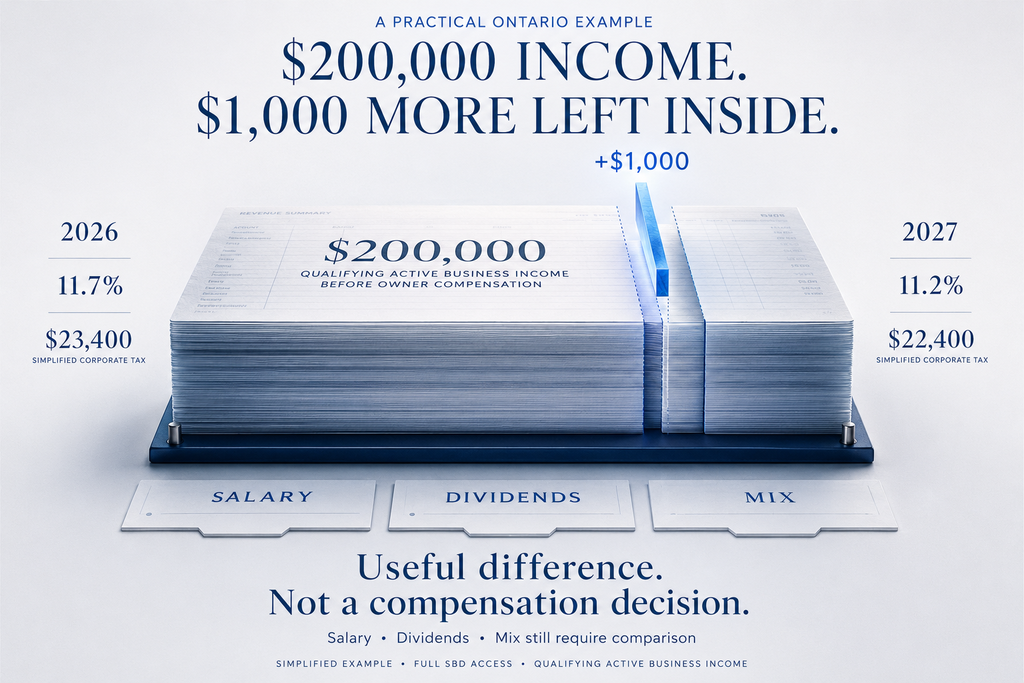
Consider a London, Ontario corporation with:
- A December 31 year-end
- $200,000 of qualifying active business income before owner compensation
- Access to the full Small Business Deduction
- One active owner
- No investment income or unusual transactions
Using the current combined rates:
| Taxation year | Simplified corporate tax on $200,000 |
| Calendar year 2026 at 11.7% | $23,400 |
| 2027 at 11.2% | $22,400 |
| Difference | $1,000 |
The rate reduction leaves approximately $1,000 more inside the corporation before owner withdrawals in this simplified example.
That $1,000 matters, but it does not settle the salary-versus-dividend decision.
Salary-led approach
The corporation pays the owner through payroll.
This approach may:
- Reduce the corporation’s taxable income
- Create RRSP room
- Build CPP participation
- Provide regular documented income
- Require payroll deductions and remittances
Dividend-led approach
The corporation pays tax on its income and distributes part of the remaining profit.
This approach may:
- Avoid CPP contributions on the dividend
- Reduce payroll administration
- Provide flexible payment timing
- Create no new RRSP room
- Produce personal dividend tax
- Require proper dividend records and T5 reporting
Mixed approach
The owner receives a planned salary plus one or more dividends.
This approach may:
- Create some RRSP room
- Maintain some CPP participation
- Provide regular personal cash flow
- Allow an additional distribution after profit becomes clearer
- Require both payroll and dividend reporting
The strongest option depends on the owner’s complete financial position. It cannot be determined from the 2.2% Ontario rate alone.
Use the SCOPE Check Before Choosing Your 2027 Pay Mix
Before deciding, review five areas.
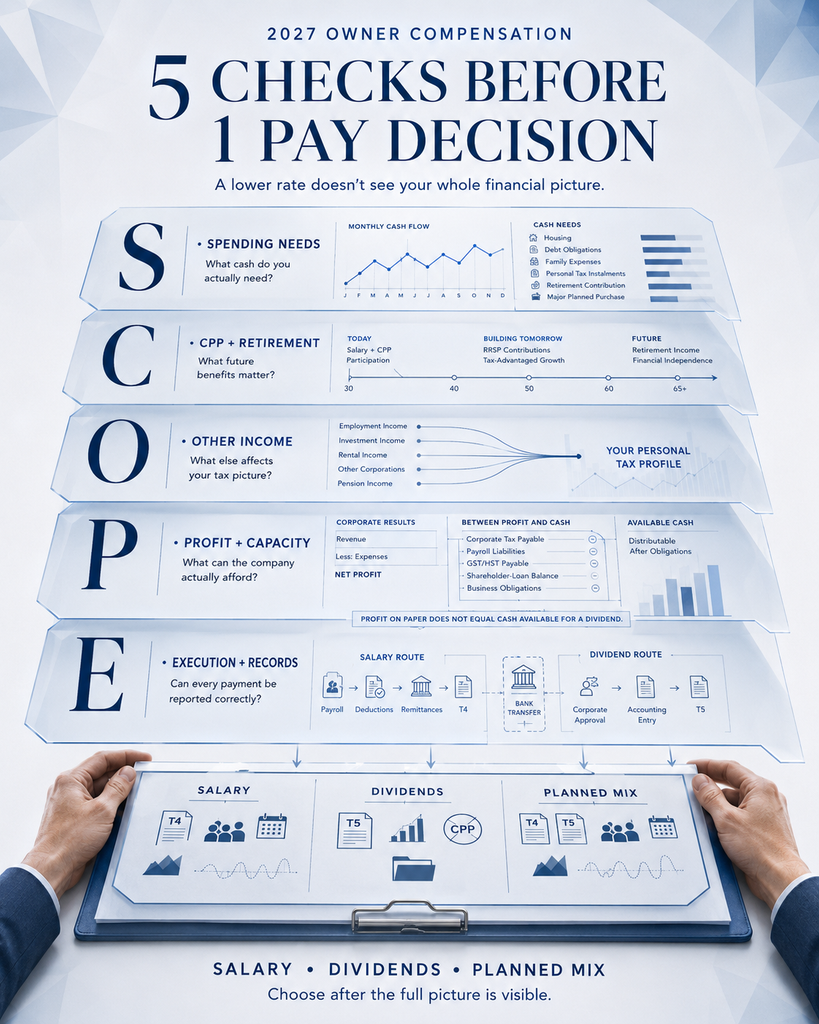
S: Spending needs
How much personal cash will you need during 2027?
Consider:
- Housing costs
- Debt payments
- Family expenses
- Personal tax instalments
- Retirement contributions
- Major purchases
Do not begin with the tax method. Begin with the cash requirement.
C: CPP and retirement plans
Decide how much value you place on:
- CPP participation
- Future CPP benefits
- RRSP contribution room
- Existing unused RRSP room
- Retirement savings held inside the corporation
O: Other personal income
Review income from:
- Another employer
- Investments
- Rental properties
- A spouse or partner
- Other corporations
- Pensions
Other income can change your personal tax bracket and the value of each compensation method.
P: Profit and corporate capacity
Confirm:
- Expected business profit
- Available cash
- Retained earnings
- Shareholder-loan balances
- Existing payroll liabilities
- Upcoming GST/HST and corporate-tax payments
Profit on paper does not always mean the corporation has cash available for a dividend.
E: Execution and records
Determine how the corporation will document and report each payment.
Salary requires payroll records, deductions, remittances, and a T4.
Dividends require the correct corporate approval, accurate accounting entries, and a T5.
Money transferred to the shareholder without proper classification can create bookkeeping, tax, and shareholder-loan problems later.
What Do Business Owners Commonly Get Wrong?
They use 2.2% as the company’s total tax rate
The 2.2% figure represents Ontario’s lower provincial rate. The 9% federal small-business rate also applies when the corporation qualifies.
Do this: Review the combined rate.
Not that: Compare salary and dividends using the Ontario percentage alone.
They assume dividends received the full benefit of the tax cut
Ontario reduced the corporate rate and also reduced the 2027 non-eligible dividend credit.
The changes belong in the same calculation.
They call every withdrawal a dividend
A bank transfer does not become a properly declared dividend simply because the bookkeeper labels it one at year-end.
The company must review its records, share structure, financial position, and required corporate documentation.
They ignore the shareholder-loan account
Personal expenses paid by the corporation may create shareholder-loan or shareholder-benefit consequences when the company does not classify them correctly. The CRA treats dividends differently from benefits provided to shareholders.
They copy another owner’s strategy
Two business owners with the same profit can still require different pay plans.
Age, debt, other income, RRSP room, CPP history, family circumstances, and corporate cash needs can all change the answer.
They use 2026 payroll figures for a 2027 plan
CPP ceilings and payroll tables can change each year.
Use final 2027 CRA amounts when they become available before running payroll.
Which Records Should You Review?
Bring these records together before choosing the payment mix:
- Current profit-and-loss statement
- Current balance sheet
- Bank reconciliations
- Shareholder-loan account
- Previous corporate T2 return
- Previous personal T1 return
- Existing payroll reports
- CRA payroll account information
- Current RRSP deduction limit
- Expected personal income from other sources
- Planned personal withdrawals
- Corporate cash-flow forecast
- Share register and dividend history
This list matters because the compensation decision connects several financial responsibilities.
Incomplete books can make a dividend look affordable when the corporation still owes GST/HST, payroll deductions, corporate tax, or supplier balances.
What Should You Do Before 2027?
1. Bring the books up to date
Reconcile bank accounts, credit cards, payroll liabilities, shareholder activity, and taxes payable.
2. Forecast the company’s profit
Estimate qualifying active business income and identify unusual income or expenses.
3. Set your personal cash target
Decide how much you need and when you need it.
4. Compare three payment scenarios
Review:
- Salary-led compensation
- Dividend-led compensation
- A planned salary-and-dividend mix
Include corporate tax, personal tax, CPP, RRSP room, payroll work, and remaining company cash.
5. Choose the payment schedule
Decide whether the owner needs regular payroll income, periodic dividends, or both.
6. Document each payment correctly
Run salary through payroll. Record dividends using the required corporate process.
7. Review the plan before year-end
Actual profit may differ from the forecast. Revisit the calculation before the year closes.
When Does Professional Advice Become Worthwhile?
Consider a professional review when:
- Corporate profit changed significantly
- You plan to switch from salary to dividends
- You want to build RRSP room
- You are approaching retirement
- You have another source of personal income
- The corporation has several shareholders
- You want to pay dividends to a spouse or family member
- A shareholder-loan balance exists
- The company earns investment income
- Your bookkeeping is behind
- You need predictable documented income for financing
Dividends paid to family members may also trigger Canada’s tax-on-split-income rules unless an exclusion applies. Do not treat family dividends as a simple income-splitting tool.
TaxRecon’s corporate tax, payroll, bookkeeping, and business advisory support connects these records and decisions instead of reviewing one number in isolation.
You can also meet the TaxRecon team before arranging a consultation.
Final Thoughts
Ontario’s 2026 tax cut gives qualifying small corporations more room to retain cash after corporate tax.
The 2027 dividend-credit reduction changes what happens when some of that cash moves to the shareholder as a non-eligible dividend.
Salary still offers features that dividends cannot replace, including RRSP room, CPP participation, and documented employment income. Dividends still offer flexibility and avoid CPP on the amount paid.
The right salary vs dividends Ontario 2027 decision begins with your records, not with a rule of thumb.
Review what the company can afford, what you personally need, and what each option changes before repeating last year’s payment plan.
Review Your 2027 Compensation Plan
You do not need to decide between salary and dividends by looking at one tax rate.
TaxRecon can review your corporate records, expected profit, payroll position, personal cash needs, and retirement priorities together.
Book a free consultation to identify what should be checked before you set your 2027 payment mix.
Frequently Asked Questions
Did Ontario’s 2026 tax cut make dividends better in 2027?
Not automatically. The corporate rate fell, but Ontario also reduced its 2027 tax credit on non-eligible dividends. The final result depends on corporate income, personal income, CPP, RRSP room, and the amount withdrawn from the company.
What is a non-eligible dividend?
A non-eligible dividend commonly represents a distribution from corporate income that received the small-business tax rate. The shareholder reports the dividend using the applicable gross-up and receives federal and provincial dividend tax credits.
Does salary create RRSP room?
Salary generally counts as earned income for the RRSP calculation. New room is usually based on 18% of the previous year’s earned income, subject to the annual limit and other adjustments. Dividends generally do not create RRSP room.
Do dividends require payroll deductions?
No. A corporation does not withhold CPP or payroll income tax from a dividend. The company must still declare, record, and report the dividend correctly, and the shareholder may need to plan for personal tax instalments.
Can I pay myself with both salary and dividends?
Yes. Many owner-managers use both. The salary portion may support regular income, CPP, and RRSP room, while dividends may provide an additional distribution. The corporation must report each payment through the correct process.
When should I review my 2027 payment plan?
Start before the first 2027 payroll or dividend payment. Review the plan again before the corporation’s year-end when actual profit, owner withdrawals, and company cash are clearer.