That 8.8% Quick Method rate can look like easy money.
Your Ontario business charges customers 13% HST, sends a smaller percentage to the Canada Revenue Agency, and keeps the difference. Sounds like an obvious win.
It is not.
When your actual input tax credits are worth more than the allowance built into the Quick Method rate, the Regular Method quietly becomes the better choice. The wrong method can repeat the same costly calculation across every reporting period.
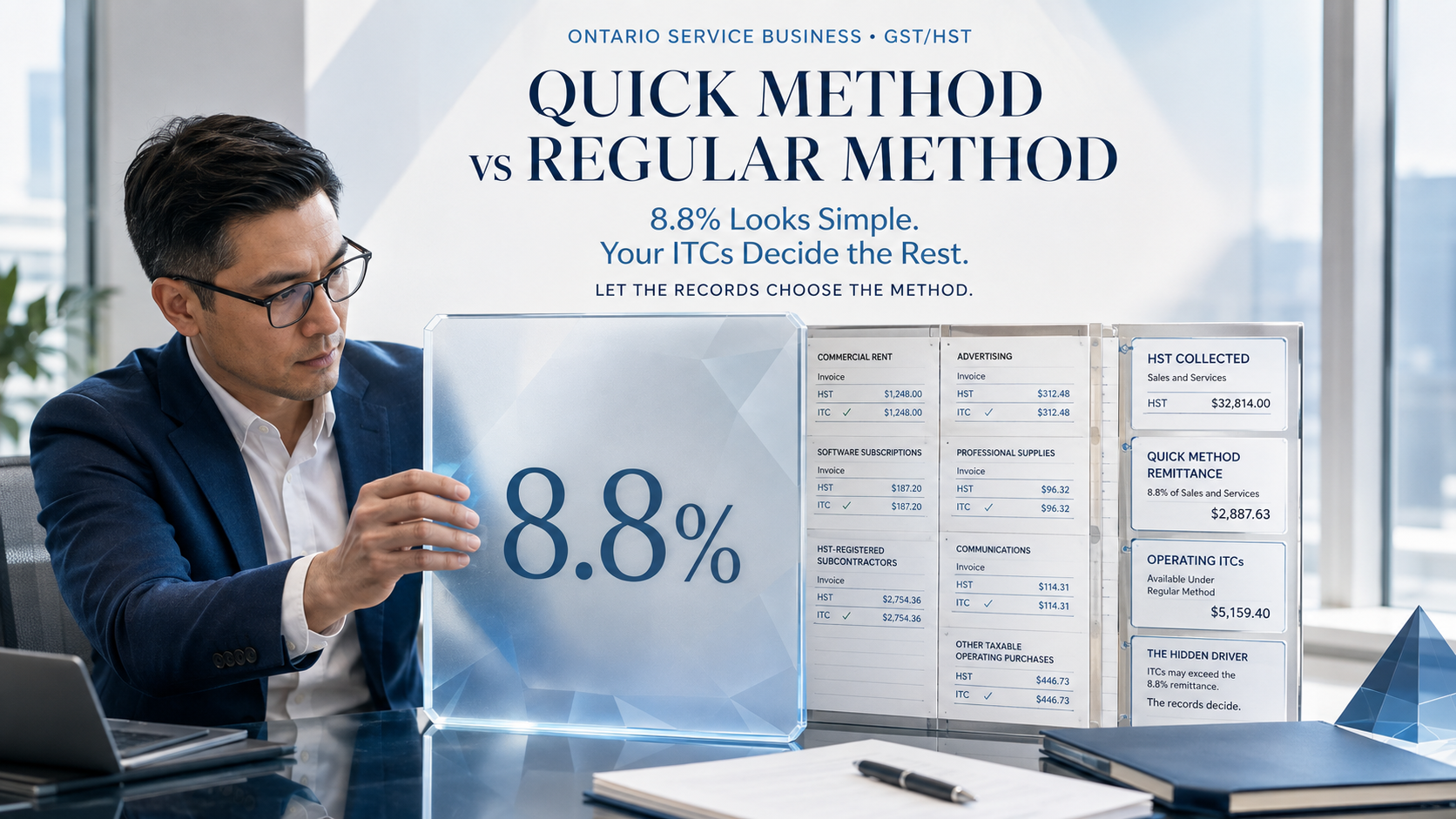
For an eligible Ontario service business, the GST HST quick method vs regular method decision comes down to three numbers: the HST you collect, the Quick Method amount you would remit, and the operating-expense ITCs you would give up.
The issue deserves more than a rule of thumb. The CRA’s latest departmental results report says its delinquent-filer program resolved more than 1.3 million overdue GST/HST returns during 2024–25. That number does not decide which method fits, but it shows how quickly sales-tax problems can grow when filing routines and records fall behind.
TaxRecon’s GST/HST management and compliance support helps Ontario businesses compare the calculation, review the records behind it, and identify what needs attention before an election or return is filed.
Key Takeaways
- Ontario service businesses commonly use an 8.8% Quick Method rate on sales subject to 13% HST.
- The Quick Method generally suits eligible businesses with low operating-expense ITCs.
- The Regular Method generally works better when actual eligible ITCs exceed the Quick Method allowance.
- Quick Method users may still claim certain ITCs on capital assets.
- Always compare both methods using the same reporting period and complete bookkeeping records.
What Is the Real Difference Between the Two Methods?
The Regular Method uses the actual GST/HST activity recorded in your books.
You calculate:
GST/HST collected or collectible − eligible input tax credits = net tax
An input tax credit, usually called an ITC, allows a GST/HST registrant to recover qualifying tax paid or payable on purchases used in its commercial activities. The business needs proper supporting documents and must meet the CRA’s eligibility rules. Review the CRA’s current ITC guidance.
The Quick Method works differently.
You still charge customers the full GST or HST rate. Instead of deducting the ITC on each ordinary operating expense, you multiply eligible tax-included revenue by a CRA remittance rate.
For an Ontario service business making supplies subject to 13% HST, the common service rate is 8.8% of revenue including HST. The CRA’s Quick Method guide lists the current eligibility conditions and rates.
The difference between the tax collected and the Quick Method amount represents an approximate allowance for the ITCs you can no longer claim on most operating costs.
The CRA says the better method “depends on your specific situation.” That short sentence matters because neither option wins for every service business.
Quick Method vs Regular Method at a Glance
| Question | Quick Method | Regular Method |
| How is net tax calculated? | CRA rate multiplied by tax-included eligible revenue | Tax collected minus eligible ITCs |
| Do customers pay less HST? | No | No |
| Can you claim ordinary operating ITCs? | Generally no | Yes |
| Can you claim qualifying capital-asset ITCs? | Yes | Yes |
| Does it require an election? | Yes | No |
| Is there a revenue ceiling? | Generally $400,000 | No Quick Method ceiling |
| Can it produce a refund? | Less commonly | Yes, when eligible ITCs exceed tax collected |
| Does it remove bookkeeping duties? | No | No |
| Best general fit | Low-ITC eligible service businesses | Higher-ITC or ineligible businesses |
Can Your Business Actually Use the Quick Method?
Check eligibility before comparing savings.
A business can generally elect when its worldwide taxable supplies, including zero-rated supplies and GST/HST, do not exceed $400,000 under the CRA’s applicable four-quarter tests.
You must include taxable supplies made by associated persons. You generally exclude revenue from financial services and sales of real property, capital assets, business goodwill, and certain other items. The business must also have a permanent establishment in Canada.
Some service providers cannot use it
The standard Quick Method excludes businesses providing:
- Accounting services
- Bookkeeping services
- Tax consulting or tax-return preparation
- Financial consulting
- Legal services
- Actuarial services
- Certain financial-institution services
It also excludes charities and several public or government-funded organizations, although some may qualify for a separate public-service-body method.
That distinction catches people out.
“Service business” does not mean “every business that sells a service.”
A house-cleaning company, photographer, delivery service, painting contractor or auto repair shop may qualify. A bookkeeping firm or financial consultant does not qualify for the standard method. The CRA lists several eligible service-business examples in its current guide.
What Is the Current Ontario Quick Method Rate?
An eligible service business with a permanent establishment in Ontario commonly uses an 8.8% remittance rate when the supply is subject to Ontario’s 13% HST.
The business applies 8.8% to revenue including HST.
Suppose you invoice an Ontario client:
- Service fee: $10,000
- HST charged: $1,300
- Total invoice: $11,300
- Initial Quick Method calculation: $11,300 × 8.8%
- Initial remittance amount: $994.40
Do not apply 8.8% to the $10,000 subtotal. The calculation uses eligible revenue including HST.
What Is the 1% Credit on the First $30,000?
A qualifying Quick Method user can claim an additional 1% credit on the first $30,000 of eligible tax-included revenue in each fiscal year.
The maximum credit is $300.
The election must be in effect at the start of the fiscal year. A newly registered business may qualify from the date it becomes a registrant. Unused credit cannot move into a later year.
This is not simply a one-time credit for the year you first elect.
That misunderstanding appears in several competing articles and can produce an inaccurate comparison.
The Three-Number Test
Ignore broad claims such as “the Quick Method works when expenses are below 30% of revenue.”
Expense percentages can mislead you because not every dollar of expense produces an ITC.
Use three real numbers instead.
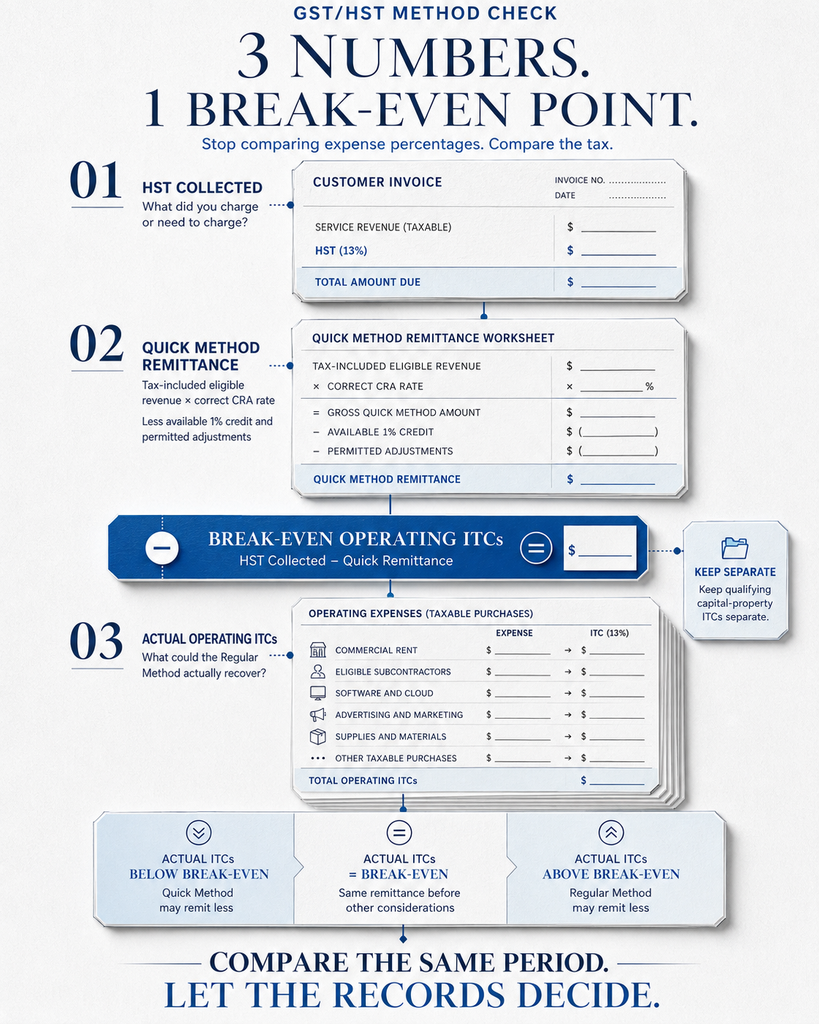
Number 1: HST collected
Calculate the HST you charged or should have charged on eligible taxable sales.
Number 2: Quick Method remittance
Multiply tax-included eligible revenue by the correct CRA rate.
Subtract the available 1% credit and any other permitted adjustments.
Number 3: Actual operating ITCs
Calculate the ITCs you could claim under the Regular Method on ordinary business expenses.
Keep qualifying capital-property ITCs separate because some of them remain claimable under the Quick Method.
Find the break-even point
Use this calculation:
HST collected − Quick Method remittance = break-even operating ITCs
Then compare the result with your actual operating ITCs.
- Actual ITCs below the break-even number may favour the Quick Method.
- Actual ITCs above the break-even number may favour the Regular Method.
- A small difference deserves a closer review because income-tax treatment, timing and bookkeeping work may affect the practical result.
Worked Ontario Service-Business Example
Consider an eligible Ontario service business with:
- $120,000 in Ontario sales before HST
- $15,600 in HST collected
- $135,600 in tax-included revenue
- An 8.8% service-business rate
- The full $300 annual credit
- No sales outside Ontario
- No unusual adjustments
This example illustrates the calculation. It does not represent an actual TaxRecon client.
Quick Method calculation
| Calculation | Amount |
| Tax-included revenue | $135,600 |
| 8.8% remittance calculation | $11,932.80 |
| Less annual 1% credit | $300.00 |
| Quick Method remittance | $11,632.80 |
Now calculate the break-even operating ITCs:
$15,600 − $11,632.80 = $3,967.20
The business should compare $3,967.20 with the operating-expense ITCs it could claim under the Regular Method.
| Actual operating ITCs | Regular Method remittance | Quick Method remittance | Lower remittance |
| $1,800 | $13,800 | $11,632.80 | Quick Method by $2,167.20 |
| $3,967.20 | $11,632.80 | $11,632.80 | Break-even |
| $5,500 | $10,100 | $11,632.80 | Regular Method by $1,532.80 |
This table explains the decision more accurately than an expense-to-revenue percentage.
The business does not need “high expenses” in general. It needs enough eligible operating ITCs to exceed the Quick Method advantage.
Why Your Total Expenses Can Give You the Wrong Answer
Picture two Ontario businesses that each spend $40,000 a year.
The first spends heavily on:
- Wages
- Insurance
- Loan interest
- Bank charges
- Other expenses that may not carry recoverable HST
The second spends heavily on:
- Commercial rent
- HST-registered subcontractors
- Software
- Advertising
- Professional supplies
- Other taxable purchases tied to commercial activities
Both businesses report $40,000 in expenses.
Their ITCs can look completely different.

That is why your profit-and-loss statement alone cannot settle the comparison. You need the GST/HST details behind the expense accounts.
Costs also require closer review when they support both commercial and personal use, relate partly to exempt activities, or face a restricted claim. The CRA explains how commercial-use percentages can affect ITC eligibility.
Do Equipment Purchases Automatically Make the Regular Method Better?
No.
Quick Method users generally cannot claim ITCs on ordinary operating expenses, but they may still claim qualifying ITCs on:
- Real property
- Improvements to real property
- Capital assets such as computers and vehicles
- Improvements to capital property
- Certain purchases made before the election took effect
The CRA does not state that every capital asset must cost more than $30,000 before an ITC becomes available under this rule. The classification and use of the property matter.
This corrects another common weakness in competing content.
A large computer purchase may not automatically push the Regular Method ahead because the business might still claim the qualifying capital ITC under the Quick Method.
A recurring software subscription is different. It is generally an operating cost, so the Quick Method rate already accounts for its ordinary ITC.
The books must distinguish capital assets from operating expenses.
Does an Ontario Business Always Use 8.8%?
No.
The correct rate depends partly on:
- The province where the business has its permanent establishment
- The province where the supply takes place
- The GST/HST rate that applies to the supply
- The type of business
- Whether one of the CRA’s 90% rules applies
For a service business with a permanent establishment in Ontario, the current CRA table includes:
| Tax applying to the supply | Quick Method rate |
| 5% GST | 1.8% |
| 13% HST | 8.8% |
| 14% HST | 9.6% |
| 15% HST | 10.4% |
An Ontario business that serves clients in several provinces may need more than one Quick Method rate.
The CRA provides special treatment when at least 90% of eligible supplies fall into certain participating or non-participating province categories. When those tests do not apply, the business may need to separate sales by jurisdiction.
Before choosing a rate, confirm where the supply occurs under the CRA’s place-of-supply rules.
A London-based agency with clients in Ontario, Alberta and New Brunswick should not apply 8.8% blindly to every invoice.
Does the Quick Method Remove Recordkeeping?
No.
It reduces part of the GST/HST calculation. It does not remove the need for organized books.
Quick Method users must still retain records for:
- Sales and invoices
- Tax charged
- Customer credits and refunds
- Purchases
- Capital assets
- Expenses
- Provincial sales locations
- GST/HST returns
- Election records
The CRA generally requires businesses to keep GST/HST books and records for six years from the end of the year they cover. It may ask a business to retain them longer.
“Less ITC tracking” should never become “throw away the receipts.”
You still need those records for income tax, corporate reporting, audit support and business decisions.
What Happens to the HST You Keep?
The difference between the GST/HST collected and the amount remitted under the Quick Method does not disappear from the income-tax calculation.
The CRA states that the portion not remitted under the Quick Method must be reported as income on the business’s income-tax return.
That means:
A $2,000 reduction in GST/HST remittance does not necessarily create $2,000 of after-tax savings.
A corporation may pay corporate income tax on the retained amount. A sole proprietor may include it in personal business income.
The method comparison should therefore consider:
- GST/HST remittance
- Income-tax effect
- Administrative effort
- Cash-flow timing
- Risk of filing errors
What Do Businesses Commonly Get Wrong?
They multiply the rate by revenue before HST
The Quick Method uses eligible revenue including GST/HST.
Do this: Use the customer’s tax-included amount.
Not that: Apply 8.8% only to the pre-HST subtotal.
They treat the gap between 13% and 8.8% as guaranteed profit
That gap replaces most operating-expense ITCs.
You need to subtract the ITCs you are giving up before calling it a benefit.
They compare expenses instead of ITCs
Payroll, interest and other costs may increase expenses without creating recoverable HST.
They claim ordinary ITCs after electing
The Quick Method rate already accounts for most operating-expense and inventory ITCs. Claiming them again can overstate the return.
They forget associated-company revenue
The $400,000 threshold can include taxable supplies made by associates, not only the business shown on one GST/HST return.
They use 8.8% for every customer
Sales made in other provinces may require a different rate.
They miss the election deadline
A correct comparison does not help when the election takes effect too late for the intended reporting period.
How Do You Elect to Use the Quick Method?
1. Confirm that the business qualifies
Review:
- Business activity
- Worldwide taxable supplies
- Associated persons
- Permanent establishment
- Previous elections or revocations
- Excluded service categories
2. Reconcile at least one representative period
Use complete revenue and expense records.
Separate:
- Operating ITCs
- Capital-property ITCs
- Zero-rated supplies
- Exempt supplies
- Sales outside Canada
- Sales made in different provinces
3. Run both calculations
Use the same period for the Quick and Regular Methods.
Do not compare one estimated year with a different historical year.
4. Confirm the reporting deadline
Annual filers generally need to elect by the first day of their second fiscal quarter.
For a calendar-year business, that usually means April 1.
Monthly and quarterly filers generally elect by the due date of the return for the period in which they begin using the method. The effective date must fall on the first day of a reporting period. (Canada)
5. File the election
You can use the CRA’s online election service in My Business Account or Represent a Client.
You can also file Form GST74, Election and Revocation of an Election to Use the Quick Method of Accounting.
6. Review eligibility each year
Recheck:
- Revenue threshold
- Associated businesses
- Service mix
- Provincial sales
- Remittance-rate category
- Actual ITCs
- Changes in business activity
You generally need to use the Quick Method for at least one year before revoking the election.
Which Method Is More Likely to Fit?
The Quick Method may fit when:
- Your business qualifies
- You provide an eligible service
- Operating-expense ITCs remain below the break-even amount
- Most sales use one provincial rate
- Your bookkeeping records support the calculation
- You expect the result to remain reasonably stable
The Regular Method may fit when:
- Your actual operating ITCs exceed the Quick Method allowance
- You regularly pay HST on commercial rent or subcontractors
- You combine taxable and exempt activities
- You serve several provinces and need several rates
- You expect GST/HST refunds in high-spending periods
- You exceed the eligibility threshold
- Your business belongs to an excluded category
The name “Quick Method” can make it sound like a simpler version of the same answer.
It is not.
It is a different calculation that can produce a different financial result.
When Should You Ask an Accountant to Review It?
A professional review becomes useful when:
- The two calculations produce a close result
- Your business sells into several provinces
- Associated companies may affect eligibility
- Revenue approaches $400,000
- The books contain personal or mixed-use expenses
- The company recently purchased capital assets
- Previous returns claimed ITCs under the Quick Method
- The election date is unclear
- The business changed services or sales patterns
- GST/HST returns are behind
TaxRecon’s bookkeeping and financial management support can also help when the comparison cannot be completed because revenue, expenses or tax accounts have not been reconciled.
You can learn more about TaxRecon’s working approach and accounting team before sharing your records.
Final Thoughts
The Quick Method can work well for an eligible Ontario service business with low operating-expense ITCs.
The Regular Method can work better when the business pays enough recoverable GST/HST on its ordinary costs.
The winning method does not depend on the size of your expense account. It depends on the eligible ITCs hiding inside those expenses.
Run the GST HST quick method vs regular method calculation using the same sales period, the correct provincial rates, and properly classified ITCs.
Then let the records choose the method.
Review Your GST/HST Calculation Before You Elect
You may already have every number needed for the comparison. The challenge is knowing which amounts belong in it.
Book a free consultation with TaxRecon to compare both methods and identify what should be corrected, confirmed or organized before your next GST/HST return.
Frequently Asked Questions
Is the GST/HST Quick Method always better for service businesses?
No. It generally works better when the business qualifies and its operating-expense ITCs stay below the allowance built into the Quick Method rate. Businesses with higher recoverable ITCs may remit less under the Regular Method. Calculate both options using the same records.
Can a consultant use the GST/HST Quick Method?
Some consultants may qualify, but financial consultants cannot use the standard method. The actual service matters more than the word “consultant.” Tax consultants, accountants, bookkeepers, tax-return preparers, legal professionals and actuaries also fall within the CRA’s excluded categories.
Can I claim ITCs on a computer while using the Quick Method?
You may claim a qualifying ITC when the computer counts as a capital asset and meets the normal ITC requirements. Quick Method users generally cannot claim ITCs on ordinary operating costs, but the CRA permits claims for certain capital assets, including computers and vehicles.
Do I receive the $300 credit every year?
You may receive up to $300 each fiscal year when the election is in effect at the beginning of that year and you earn at least $30,000 in eligible tax-included revenue. A new registrant may qualify from the registration date. Unused credit does not carry forward.
Can TaxRecon compare both methods for my business?
Yes. TaxRecon can review your sales, operating-expense ITCs, capital purchases, provincial customers and filing history. The goal is to identify the correct calculation and any recordkeeping or compliance issue that should be addressed before an election or return is filed.