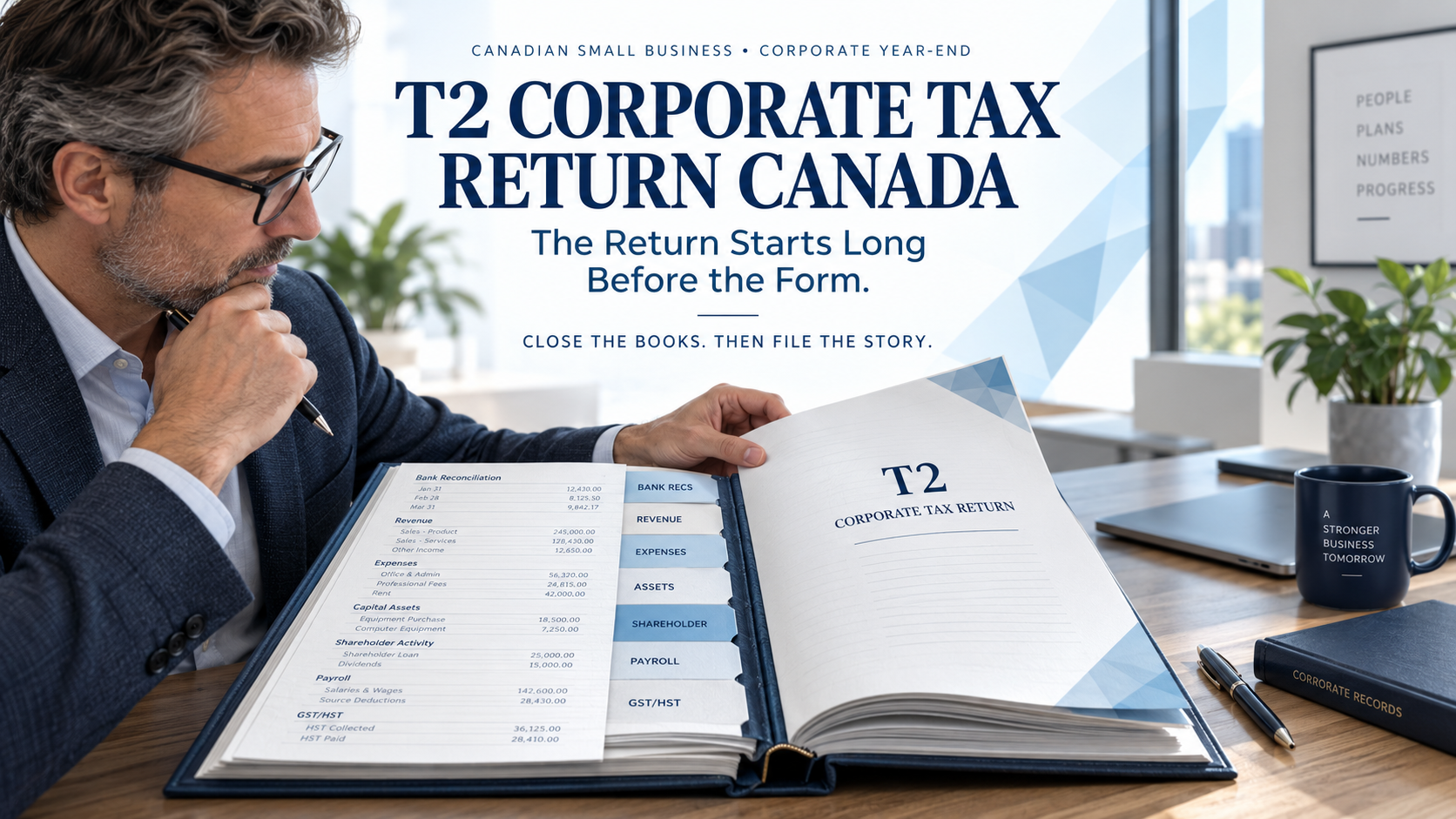
Your T2 does not begin when somebody opens tax software.
It begins with the bank reconciliation that was never finished, the equipment purchase sitting in the wrong expense account, the personal payment running through the company card, the dividend that needs proper records, and the revenue that may not all receive the same tax treatment.
For most incorporated businesses, filing a T2 corporate tax return Canada means turning an entire year of accounting records into a corporate income tax return that agrees with the company’s financial statements and CRA requirements.
Most resident corporations must file one every tax year, even when no tax is payable. The return is generally due six months after the corporation’s fiscal year-end, but the tax balance may be due much earlier.
That timing difference alone is reason enough to understand what happens before the return reaches the CRA.
TaxRecon’s corporate tax filing support looks at the records behind the return, not only the final form.
Key Takeaways
- Most Canadian corporations file a T2 for every tax year, including many inactive corporations with no tax owing.
- Your T2 filing deadline and corporate tax payment deadline are not the same.
- Financial statements and GIFI information form a major part of the return.
- Shareholder transactions, capital assets, payroll and income type can change which schedules and tax rules apply.
What Is a T2 Corporate Tax Return?
The T2 is the corporation income tax return used by Canadian corporations to report financial results, calculate taxable income and determine federal and applicable provincial or territorial corporate tax. It is separate from the owner’s personal T1 return and follows the corporation’s own tax year rather than the individual’s calendar year.
Think of the T2 as the tax version of your company’s financial story.
The return pulls information from:
- Revenue
- Operating expenses
- Assets
- Liabilities
- Share capital
- Retained earnings
- Tax deductions
- Capital assets
- Dividends
- Shareholder activity
- Other income sources
The Canada Revenue Agency’s T2 page describes the standard T2 as a federal, provincial and territorial corporation income tax return, with separate provincial filing requirements applying in Quebec and Alberta.
Your company’s accounting profit is not automatically its taxable income.
Accounting rules and income-tax rules treat some amounts differently. That is why the T2 includes adjustments and supporting schedules rather than simply asking for the profit shown at the bottom of your income statement.
Who Has to File a T2 in Canada?
Most resident corporations have to file a T2 for every tax year, even when no tax is payable.
The CRA specifically includes ordinary corporations that:
- Earned business income
- Reported a loss
- Had little activity
- Became inactive
- Owe no corporate income tax
Certain entities have different filing rules or exemptions, including registered charities and some other specifically excluded organizations.
Non-resident corporations can also have Canadian T2 filing obligations in certain circumstances, such as carrying on business in Canada.
The safest rule for an ordinary Canadian small corporation is simple:
Incorporation usually creates an annual corporate filing responsibility until the corporation is properly dissolved or another specific exception applies.
Do not assume that closing the bank account, stopping sales or taking a year off automatically removes the filing requirement.
The current CRA guidance on who must file a T2 explains the resident and non-resident rules in detail.
Why Does Your T2 Start With the Books?
Tax software cannot repair accounting records simply because the return has a deadline.
Before the tax calculation works, the company’s year-end information needs to make sense.
That usually means confirming:
- Bank and credit-card balances
- Accounts receivable
- Accounts payable
- Loans
- Payroll liabilities
- GST/HST balances
- Fixed assets
- Shareholder loans
- Revenue
- Expenses
- Share capital
- Retained earnings
The CRA receives financial statement information through the General Index of Financial Information, better known as GIFI.
GIFI assigns standardized codes to items from your income statement and balance sheet.
Your software may call an account “Software Subscriptions.” The GIFI system still needs that amount mapped into an appropriate standardized financial category.
This is where clean bookkeeping matters.
A $10,000 classification difference may have little effect when two expense categories receive identical tax treatment. The same casual approach becomes risky when the classification changes the tax result.
Business income, rental income, investment income, dividends, asset purchases and shareholder transactions can all lead to different tax consequences.
The Five-Part T2 Reconciliation Check
Before preparing the return, review five areas.
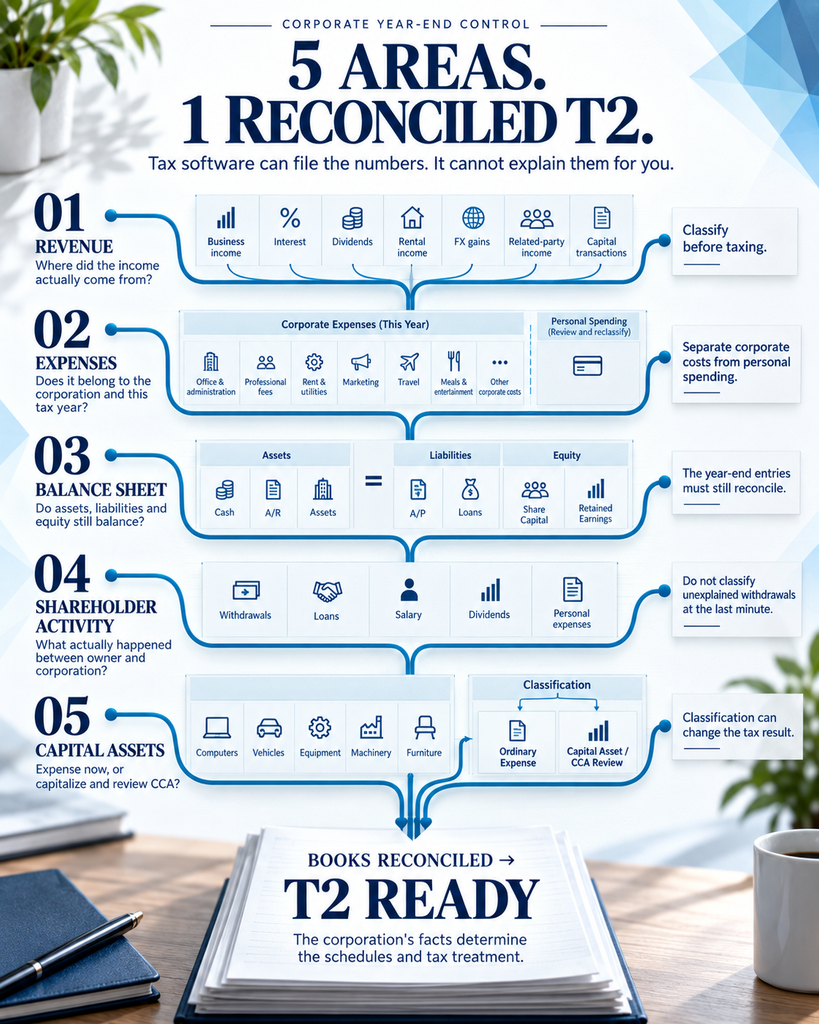
1. Revenue
Confirm where the company’s income actually came from.
Separate ordinary business revenue from items such as:
- Interest
- Dividends
- Rental income
- Foreign-exchange gains
- Related-party income
- Capital transactions
The label matters when the tax treatment changes.
2. Expenses
Check that expenses belong to the corporation and the correct tax year.
Personal spending inside the corporate books needs particular attention.
3. Balance Sheet
Confirm cash, receivables, payables, loans, assets, share capital and retained earnings.
The balance sheet must still balance after the year-end entries.
4. Shareholder Activity
Review:
- Owner withdrawals
- Shareholder loans
- Salary
- Dividends
- Personal expenses paid by the corporation
- Amounts the shareholder paid on behalf of the business
Do not wait until the return is almost finished to decide what unexplained withdrawals were.
5. Capital Assets
Separate long-term assets from ordinary expenses.
Computers, machinery, vehicles, furniture and equipment may need capital cost allowance treatment instead of a full current-year deduction.
This five-part review turns T2 preparation from “enter numbers until the software accepts them” into a controlled reconciliation process.
What T2 Schedules Does a Small Business Usually See?
The schedules depend on what happened inside the corporation.
Common areas include:
| T2 area | What it deals with |
| Schedule 1 | Reconciles accounting income with income for tax purposes |
| Schedule 8 | Capital cost allowance for depreciable property |
| Schedule 50 | Certain shareholder information |
| Schedule 100 | Balance sheet information through GIFI |
| Schedule 125 | Income statement information through GIFI |
| Schedule 141 | Additional GIFI information and financial statement questions |
Other schedules can apply when the company has dividends, losses, investment income, associated corporations, capital dispositions or other tax matters.
Do not treat an online schedule list as a universal checklist.
The corporation’s facts determine which schedules belong in the return.
The CRA’s current GIFI guidance also notes that certain inactive corporations with no balance-sheet or income-statement information may have different GIFI attachment requirements.
That type of detail is why a current CRA source matters more than an old “every company needs these five schedules” article.
When Is a T2 Corporate Tax Return Due?
The filing deadline is generally six months after the end of the corporation’s tax year.
The CRA states:
“File your return within six months of the end of each tax year.”
You can confirm the rule on the CRA’s corporation filing deadline page.
Examples:
| Fiscal year-end | T2 filing deadline |
| March 31 | September 30 |
| June 30 | December 31 |
| December 31 | June 30 of the following year |
The corporation’s tax year matters.
Do not automatically use April 30 because that date is familiar from personal income tax.
A corporation generally follows its own fiscal period.
When Does the Corporate Tax Have to Be Paid?
Here is where small-business owners get caught.
The payment date usually arrives before the filing deadline.
Corporate income tax is generally due two months after year-end.
Some Canadian-controlled private corporations can receive a three-month balance-due period when they satisfy the CRA’s conditions, including conditions connected to the Small Business Deduction.
The current CRA balance-due guidance explains those tests.
Illustrative December 31 scenario
Suppose your corporation ends its tax year on December 31.
Your timeline could look like this:
December 31
Fiscal year closes.
February 28
The balance may already be due for a corporation using the general two-month rule.
March 31
Some qualifying CCPCs may instead have a three-month balance-due date.
June 30
The T2 filing deadline arrives.
That gap matters.
You can file the return by June 30 and still owe interest because the company should have paid its balance months earlier.

Do this: Calculate the expected tax before the balance-due date.
Not that: Wait for the T2 filing deadline before asking how much the corporation owes.
Does Your Corporation Have to File the T2 Electronically?
For tax years beginning after 2023, most corporations must file electronically, subject to specific CRA exceptions.
The return must generally be prepared using CRA-certified tax software.
Electronic filing can take place through methods such as:
- Corporation Internet Filing
- My Business Account
- Represent a Client through an authorized representative
The current T2 Corporation Income Tax Guide says the CRA aims to process 95% of electronically filed T2 returns within 45 days.
That is the single supporting external performance statistic used in this article.
Electronic filing does not make an inaccurate return accurate.
It only transmits what you prepared.
What Is Different About Your First T2 Return?
The first return deserves extra attention because there is no prior corporate return to carry forward.
You may need to confirm:
- Incorporation date
- First fiscal year-end
- Opening share capital
- Opening assets and liabilities
- Initial shareholder contributions
- Assets transferred into the corporation
- Pre-incorporation versus corporate expenses
- Owner payments
- Payroll setup
- GST/HST registration timing
Your opening balances matter.
If share capital was issued when the corporation formed, that amount belongs in the company’s equity records.
If the business purchased equipment, the asset may also need to appear on the balance sheet and in the appropriate capital cost allowance records.
The first return sets balances that can flow into later years.
Treating it as a one-time form-filling exercise can create errors that reappear year after year.
What Most Small Businesses Get Wrong
Mistake 1: Confusing bookkeeping profit with taxable income
Your income statement gives you accounting profit.
The T2 then makes tax adjustments where Canadian tax rules treat an amount differently.
Mistake 2: Using accounting depreciation as the tax deduction
Financial statements may record depreciation or amortization.
Corporate tax generally uses the capital cost allowance system for depreciable property.
Do this: Reconcile book depreciation to the applicable tax treatment.
Not that: Copy depreciation expense directly into the tax deduction without review.
Mistake 3: Ignoring the shareholder-loan balance
Owner withdrawals do not disappear because they are called “drawings.”
A corporation is legally separate from its shareholder.
Payments between the shareholder and the company need proper accounting treatment.
Mistake 4: Leaving GST/HST or payroll out of the year-end review
The T2 is a corporate income-tax return, but unresolved payroll and GST/HST balances can still affect the books feeding that return.
Mistake 5: Assuming a dormant company can skip filing
Most resident corporations still have a filing obligation even when no tax is payable.
Mistake 6: Waiting six months to think about tax
The filing deadline can be six months after year-end.
The balance-due date comes much earlier.
What Happens If You File the T2 Late?
When tax remains unpaid at the filing deadline, the standard late-filing penalty generally starts at 5% of the unpaid tax, plus 1% for each complete month the return remains late, up to 12 months.
Larger penalties can apply in certain repeat-filing situations.
The current calculations and exceptions are explained in the CRA T2 guide.
Interest can also apply to unpaid tax from the relevant payment deadline.
The important distinction is this:
- Late filing can create a filing penalty.
- Late payment can create interest.
- You can have one problem without the other.
- You can also have both.
What Should You Prepare Before Filing?
Use this checklist before tax preparation begins.
Corporate records
- Legal corporate name
- Business number
- Incorporation documents
- Fiscal year-end
- Shareholder information
Accounting records
- Final trial balance
- Income statement
- Balance sheet
- General ledger
- Bank reconciliations
- Credit-card reconciliations
Tax and compliance records
- Prior T2 return
- Notice of Assessment
- GST/HST returns
- Payroll summaries
- T4 and T5 information where relevant
- Instalment records
- CRA correspondence
Owner and financing records
- Shareholder-loan ledger
- Dividends
- Salary
- Personal expenses in corporate accounts
- Business expenses personally paid by the owner
- Loan statements
Assets
- Asset-purchase invoices
- Vehicle information
- Equipment purchases
- Disposals
- Existing CCA schedules
TaxRecon’s bookkeeping and financial management support can help when this information does not yet reconcile.
A Practical Six-Step T2 Filing Process
1. Close the books
Finish bank, card, loan, payroll and tax-account reconciliations.
2. Review the balance sheet
Confirm assets, liabilities, retained earnings, share capital and shareholder balances.
3. Review the income statement
Check revenue sources, cost of sales, operating expenses and unusual transactions.
4. Make the tax adjustments
Reconcile accounting profit with taxable income, review capital cost allowance and apply the tax rules relevant to the corporation.
5. Complete the required schedules
Use GIFI and the applicable T2 schedules based on the corporation’s activities.
6. Review, file and confirm receipt
Submit using the required electronic filing process and keep the CRA confirmation with the corporate tax records.
That sequence is much safer than starting with blank T2 screens and trying to fix accounting problems as software warnings appear.
Can You File a T2 Yourself?
Yes. Canadian law does not require every small corporation to hire an accountant simply because it files a T2.
The more useful question is whether your corporation’s records and transactions are simple enough for you to prepare the return correctly.
DIY filing may be more realistic when:
- Books are current
- The balance sheet reconciles
- There is one straightforward business activity
- No complicated shareholder transactions exist
- There are few capital assets
- No associated corporations exist
- No unusual investment or foreign income exists
Professional review becomes more valuable when:
- The books are behind
- It is the corporation’s first T2
- Personal spending appears in corporate accounts
- Shareholder loans exist
- Salary and dividends need review
- The corporation owns several capital assets
- Income includes investments or rentals
- Several years are unfiled
- CRA has already contacted the business
- Prior returns and current books do not agree
Tax software checks arithmetic and data fields.
It does not automatically understand what really happened in your business.
When TaxRecon Can Help
Corporate filing becomes easier when bookkeeping, tax and shareholder records tell the same story.
TaxRecon can review the corporate records, identify missing or inconsistent information, prepare the required tax work and explain what still needs attention after the return is filed.
That matters most when the visible T2 problem started somewhere else, such as unreconciled books, an unexplained shareholder balance or an asset that was recorded incorrectly.
You can also meet the TaxRecon team before sharing your records.
Final Thoughts
Your T2 is not simply a tax form attached to year-end.
It is the point where your bookkeeping, balance sheet, shareholder activity, tax adjustments and corporate deadlines meet.
Clean records make the return easier to prepare. More importantly, they make it easier to explain why the numbers on the return are there.
For a small business filing a T2 corporate tax return Canada, start with the books, confirm the payment date, understand which schedules apply, then file from numbers you can support.
If something does not reconcile, find the reason before it becomes next year’s opening balance.
Need Your T2 Filed Without Guessing at the Numbers?
You do not need perfect records before asking for help.
Book a free consultation with TaxRecon to review your corporate year-end, books, T2 filing requirements and the issues that need attention first.
Frequently Asked Questions
Does every Canadian corporation have to file a T2?
Most resident corporations must file a T2 for every tax year, even if they owe no income tax. Specific exceptions apply to certain organizations. An inactive ordinary corporation should not assume that stopping business activity automatically removes its filing requirement.
Does an inactive corporation still need a T2 return?
Usually, yes. The CRA generally requires resident corporations to file for every tax year even when no tax is payable. An inactive company may have simpler financial information, but inactivity alone does not normally remove the T2 obligation.
When is a T2 corporate tax return due?
The T2 is generally due six months after the corporation’s tax year-end. A March 31 year-end normally produces a September 30 filing deadline, while a December 31 year-end normally produces a June 30 deadline.
When is corporate income tax actually due?
Corporate tax is generally due two months after year-end. Some eligible Canadian-controlled private corporations can receive a three-month balance-due period when they meet the CRA’s conditions. This payment deadline can arrive months before the T2 filing deadline.
What documents do I need to prepare a T2?
Start with your final income statement, balance sheet, general ledger, bank reconciliations, prior T2, CRA Notice of Assessment, asset records, shareholder-loan information, dividend and payroll records, GST/HST information and any relevant CRA correspondence.
What does GIFI mean on a T2 return?
GIFI stands for General Index of Financial Information. It converts financial statement accounts into standardized CRA codes so the corporation can report balance-sheet and income-statement information in a consistent format.
Can I prepare and file my own T2?
Yes, provided you can prepare the return correctly and use the required CRA-certified filing process. Professional help becomes more useful when the books are incomplete, shareholder transactions exist, capital assets need review or several tax issues interact.
Can TaxRecon prepare my T2 if my books are behind?
Yes. TaxRecon’s accounting and tax support can review the outstanding bookkeeping, identify missing records and determine what needs to be corrected before or alongside the corporate tax work.
How do I book a T2 filing review with TaxRecon?
You can book a free consultation with TaxRecon and bring the records already available. The first step is identifying your fiscal year-end, filing status, bookkeeping condition and any immediate CRA or payment deadline.