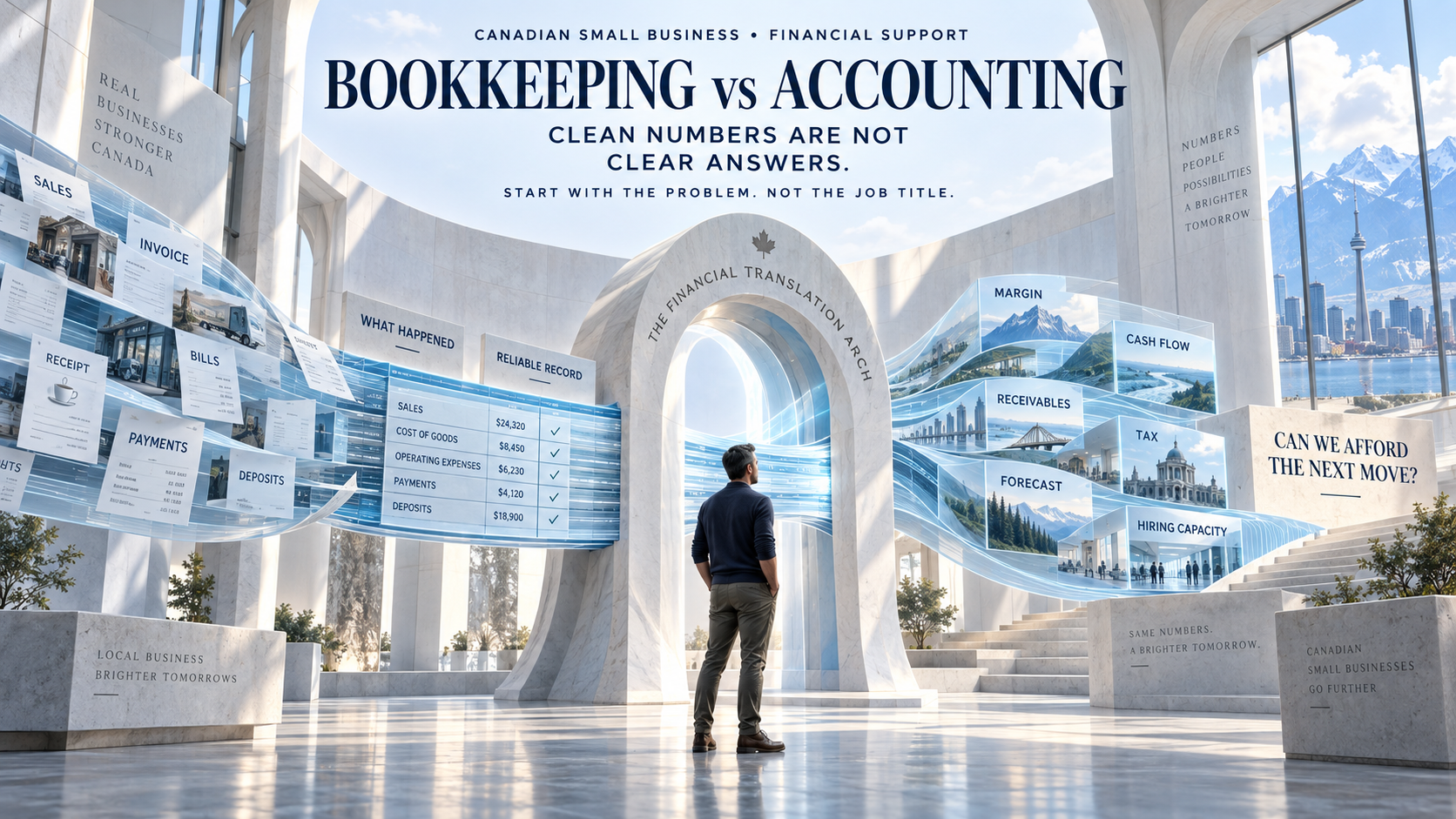
Your books can be perfectly organized and still fail to answer the question keeping you up at night.
Can we afford another employee? Why is cash tight when sales are up? How much tax should we expect? Which customers still owe us money?
Those questions do not all belong to the same financial job.
Bookkeeping keeps the financial record current and reliable. Accounting takes that record, tests what it means, connects it to tax and reporting obligations, and helps you use the numbers when a decision has to be made.
So the real bookkeeping vs accounting for a small business decision is not about choosing one job title over another.
It is about identifying what problem needs solving right now.
Key Takeaways
- Bookkeeping builds the record. It captures, categorizes and reconciles financial activity.
- Accounting interprets the record. It connects those numbers to reporting, tax, performance and business decisions.
- Good accounting cannot repair months of missing transactions without bookkeeping work first.
- Growing businesses often need both functions, but not necessarily in equal amounts or at the same time.
Forget the Job Titles for a Minute. What Problem Are You Trying to Solve?
Need clean transactions, reconciled accounts and up-to-date balances? That is mainly a bookkeeping problem.
Need to understand profitability, prepare a corporate tax return, assess cash flow or make a major financial decision? That moves into accounting.
Need both reliable records and useful interpretation? Your business needs the two functions working together.
This distinction matters because hiring based only on a title can create the wrong expectation. A bookkeeper may produce reports and spot unusual balances. An accountant may also perform bookkeeping. Service scopes overlap.
The better question is:
What financial responsibility needs an owner right now?
That is the question TaxRecon uses across its bookkeeping and financial-management support.
Use the 4R Money Test
Think about your financial process in four stages:
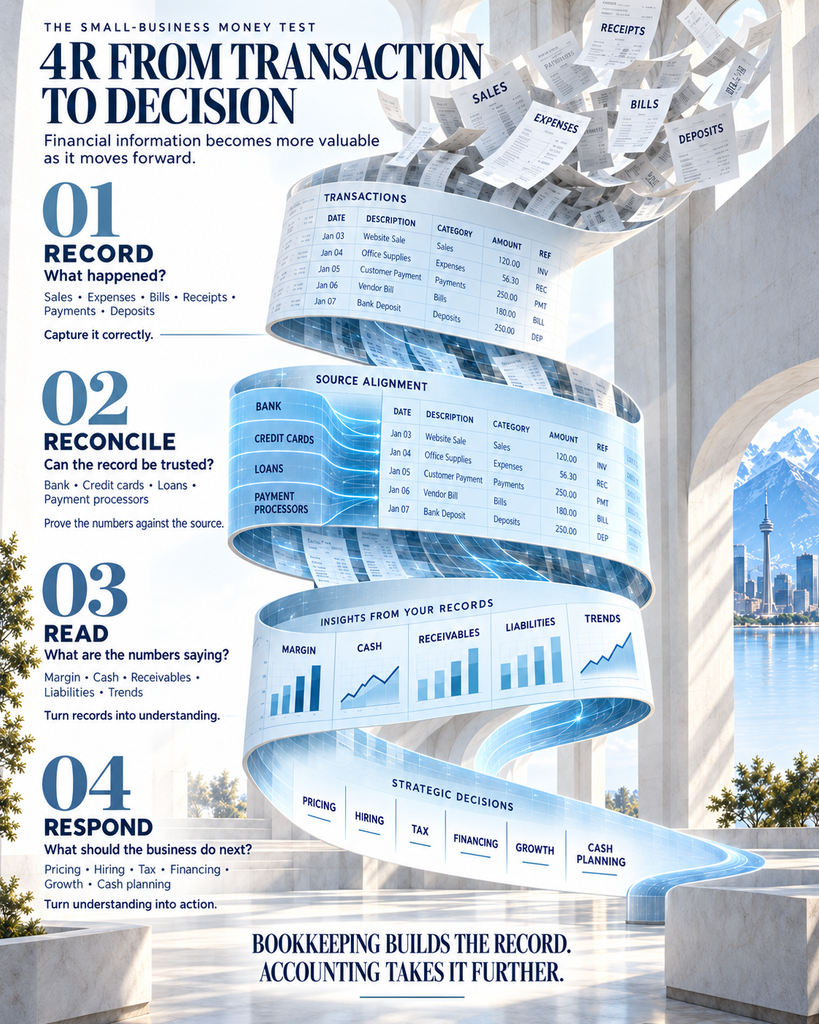
1. Record
Every sale, expense, payment, receipt, bill and deposit needs to enter the books correctly.
This is bookkeeping territory.
2. Reconcile
The numbers in your accounting system need to agree with bank accounts, credit cards, payment processors, loans and other records.
Still mainly bookkeeping.
3. Read
Someone now has to interpret what those records say.
Why did gross margin fall?
Why did cash decrease?
How much does the company owe?
What changed compared with last quarter?
This is where accounting becomes more important.
4. Respond
The final stage turns financial information into action.
Should you change pricing?
Can the company afford a hire?
Should cash stay inside the corporation?
What will year-end tax look like?
Does the business need financing?
That work can involve accounting, tax and business advisory.
Record → Reconcile → Read → Respond
Bookkeeping carries the first half. Accounting increasingly takes the lead in the second.
Bookkeeping vs Accounting: Which Tasks Go Where?
| Business need | Bookkeeping usually leads | Accounting usually leads |
| Record sales and expenses | ✓ | |
| Categorize transactions | ✓ | |
| Reconcile bank and credit-card accounts | ✓ | |
| Track receivables and payables | ✓ | |
| Maintain supporting records | ✓ | |
| Prepare routine management reports | ✓ | ✓ |
| Review financial performance | ✓ | |
| Interpret balance sheet problems | ✓ | |
| Forecast cash flow and budgets | ✓ | |
| Prepare or review tax filings | ✓ | |
| Tax planning | ✓ | |
| Support financing or major business decisions | ✓ | |
| Clean up books before year-end | ✓ | ✓ |
| Investigate unexplained account balances | ✓ | ✓ |
The line is not rigid.
Your supplied 2026 Xero source reaches the same core conclusion: bookkeeping focuses on recording and maintaining transactions, while accounting adds interpretation, reporting, tax work and financial analysis.
The important part for the business owner is not defending the line between the professions.
It is making sure nothing falls between them.
Why Does Bookkeeping Matter Beyond Tax Season?
Because your accountant can only work with the record that exists.
The Canada Revenue Agency states:
“You are required by law to keep records of all your transactions to be able to support your income and expense claims.”
You can read the CRA’s current business recordkeeping guidance.
Good records also make ordinary business questions easier to answer.
If accounts receivable are current, you can see who still owes money.
If bank accounts reconcile, cash reports become more dependable.
If expenses are classified consistently, comparing months becomes more meaningful.
If shareholder, payroll or GST/HST balances are wrong, those problems can travel into tax work later.
Bookkeeping is therefore not just preparation for an accountant.
It is the operating record the rest of the financial process depends on.
Why Does Accounting Matter If Your Books Are Already Clean?
Because clean numbers are not the same as understood numbers.
Imagine this:
Sales increased.
The bank balance decreased.
Your bookkeeping can confirm both facts.
Accounting asks why they happened together.
Perhaps receivables increased because customers are paying more slowly. Maybe inventory or operating costs rose. Perhaps tax, payroll or debt obligations consumed cash. The answer depends on the records.

This distinction is especially relevant in the current business environment. Statistics Canada’s August 31, 2026 business survey reported that 59.8% of Canadian businesses expected cost-related obstacles over the following three months. View Statistics Canada’s Q3 2026 business conditions release
When costs move, recording them accurately matters.
Understanding what they are doing to margin, pricing and cash flow matters just as much.
Which One Do You Need Right Now?
You probably need bookkeeping first when:
- Transactions are months behind
- Bank or credit-card accounts do not reconcile
- Receipts and invoices are scattered
- You cannot confidently state what customers owe
- GST/HST records do not match your books
- Your accountant keeps asking for corrected information
- QuickBooks or Xero contains balances nobody can explain
You probably need accounting when:
- Your books are current but the numbers still do not answer your questions
- You need a T2 corporate or more involved tax filing
- Profit and cash tell different stories
- You are planning a large purchase or expansion
- You need forecasting or budgeting
- Financing requires stronger financial information
- You need help interpreting margins, costs or business performance
You probably need both when:
Your records are incomplete and a tax, CRA, financing or business decision is already waiting.
That combination is common.
The first job is getting the numbers reliable. The second is deciding what those numbers mean.
What Does Working With Both Look Like?
The best arrangement feels less like two separate departments and more like one information chain.
During the month, bookkeeping keeps transactions, bank accounts, payables, receivables and related balances current.
At month-end, reconciliations confirm that the financial system agrees with source records.
Accounting can then review unusual movements, financial statements, tax balances and performance.
At year-end, cleaner books make tax preparation and review more straightforward.
TaxRecon’s live service model already connects these responsibilities through bookkeeping, financial reporting, tax filing, payroll, GST/HST and advisory support rather than treating each one as an isolated file.
That is the real advantage of combining the functions: the next person is not rebuilding what the previous person should have finished.
Can QuickBooks, Xero or AI Replace Either Role?
Software can remove a lot of repetitive work.
Bank feeds can import transactions. Rules can suggest categories. Invoices can be generated automatically. Documents can be stored electronically. Reports can appear instantly.
But instant reports do not automatically mean correct reports.
Someone still needs to decide:
- whether the transaction belongs to the business
- whether the category makes sense
- why an account will not reconcile
- whether a balance needs adjustment
- what a report means for the owner
- what should happen next
Software processes financial information.
People remain responsible for the judgment around it.
That is why TaxRecon also connects QuickBooks and Xero support with the accounting process rather than treating the platform itself as the answer.
Accountant, CPA, Bookkeeper: Do the Titles Tell You Enough?
Not always.
One weakness in many bookkeeping-versus-accounting articles is treating “accountant” and “CPA” as interchangeable.
In Ontario, the law specifically states that the CPA legislation does not prevent a non-member from practising as an accountant. However, public accounting and protected professional designations are subject to separate rules.
So do not choose support based only on a job title.
Ask about:
- qualifications
- actual service scope
- experience with your business type
- tax responsibilities they handle
- who reviews the work
- software familiarity
- how bookkeeping hands off into year-end and tax work
The question is not, “Which title sounds more senior?”
It is, “Can this person or firm handle the work my business actually needs?”
What Most Small Businesses Get Wrong
“I will organize everything at tax time.”
That turns bookkeeping into a cleanup project just when your tax work also needs attention.
Do this: reconcile throughout the year.
Not that: wait until the return deadline exposes every missing transaction at once.
“My software is reconciled, so the books must be right.”
A reconciled bank balance can still contain poor classifications, personal expenses, duplicate accounts or incorrect tax treatment.
“My accountant will fix the bookkeeping.”
They may be able to.
But paying for year-end analysis while that professional is first rebuilding the underlying records is not the same as having an efficient accounting process.
“I have a bookkeeper, so I do not need accounting.”
Clean records answer what happened.
They do not always answer what should I do next.
“I need to choose one forever.”
Business needs change.
A simple owner-operated business may do much of its own bookkeeping at first. More transactions, employees, GST/HST obligations, incorporation, financing or growth can change the level of support it needs.
Five Questions to Ask Before Hiring Anyone
1. What work will you actually perform?
Ask for tasks, not titles.
2. How often will my books be reconciled?
“Monthly bookkeeping” should have a clear operational meaning.
3. Who handles tax and CRA issues?
Do not discover the answer after a notice arrives.
4. What happens when the books contain a problem?
You want to know who investigates unexplained balances, missing records or prior-period errors.
5. How will the information help me run the business?
Financial records should eventually become useful information.
If your provider cannot explain the path from transactions to reports to decisions, the service may stop too early.
Where TaxRecon Fits
TaxRecon is built around the idea that bookkeeping, tax, payroll, compliance and business decisions affect one another.
Its Bookkeeping service covers transaction recording, reconciliation, QuickBooks and Xero, cash-flow reporting and financial statements.
When the question moves beyond recording into planning, profitability, budgets or financial decisions, Business Advisory connects those decisions back to the same financial records.
And when the books feed into a tax obligation, Tax Filing & CRA Compliance carries the information into the filing and compliance side.
One financial picture. Fewer loose ends.
Final Thoughts
Bookkeeping and accounting are not competing services.
Bookkeeping tells you what happened.
Accounting helps explain what it means and what needs attention next.
Your business may need one function more heavily today and the other tomorrow. What matters is that the record stays clean enough for the analysis to be trusted.
So when weighing bookkeeping vs accounting for a small business, start with the problem in front of you.
If the numbers are missing, organize them.
If the numbers are reliable but the answer is still unclear, interpret them.
If both problems exist, fix the financial process from the beginning instead of choosing between two job titles.
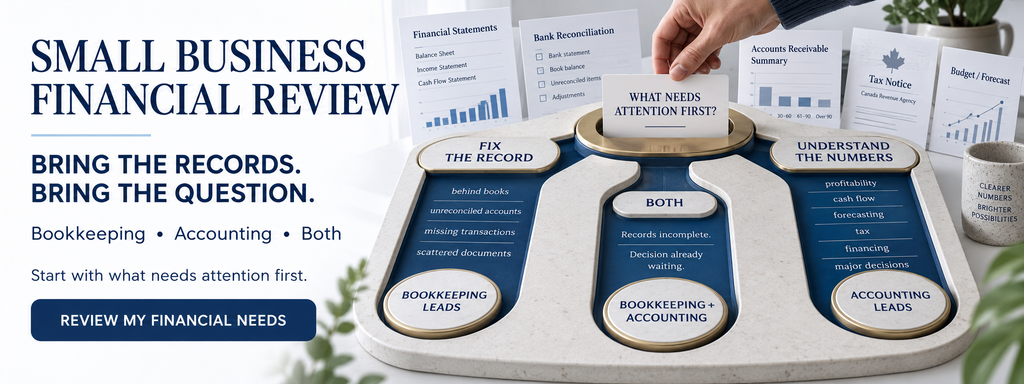
Need Bookkeeping, Accounting, or Both?
You do not need to diagnose the service before making contact.
Bring the records and the financial question you are trying to answer.
Book a free consultation with TaxRecon to identify what needs attention first and which level of support fits the situation.
Frequently Asked Questions
Do I need a bookkeeper or an accountant for my small business?
Choose bookkeeping when the immediate problem is recording, categorizing or reconciling financial activity. Choose accounting when you need interpretation, tax work, financial reporting or decision support. When the books are incomplete and a tax or business decision is already pending, you may need both.
Can an accountant also do bookkeeping?
Yes, some accounting firms provide both services. The question is whether the engagement includes recurring transaction recording and reconciliation or only year-end accounting and tax work. Ask about the exact scope so routine bookkeeping does not become an unexpected year-end cleanup.
Can a bookkeeper prepare taxes in Canada?
Some bookkeepers provide tax-related administrative services, but the scope varies widely. Complex corporate returns, tax planning, CRA matters and financial reporting may require deeper tax or accounting expertise. Choose based on the work involved rather than assuming every bookkeeper or accountant provides the same services.
Does QuickBooks or Xero replace a bookkeeper?
No. Software can automate transaction imports, invoicing, document collection and parts of reconciliation, but someone still needs to review classifications, investigate discrepancies and maintain reliable records. Automation reduces manual work. It does not remove financial judgment.
When should a small business add accounting support?
Accounting becomes more valuable when financial questions move beyond recordkeeping. Common triggers include incorporation, tax planning, cash-flow concerns, financing, expansion, changing margins, multiple revenue streams or a need for forecasts and stronger financial reporting.
Does an incorporated business need both bookkeeping and accounting?
Often, yes. The corporation needs reliable financial records throughout the year, while year-end financial statements, corporate tax, shareholder activity and business planning can require additional accounting work. The exact level of support depends on the complexity of the company.
Who should handle GST/HST, the bookkeeper or accountant?
Either may be involved depending on the service arrangement. Bookkeeping usually maintains the sales, purchases and tax records behind the return. Accounting or tax support may become more important when eligibility, unusual transactions, corrections, CRA correspondence or a more complex GST/HST position needs review.
Should I hire a CPA or is an accountant enough?
Match the qualification to the work. In Ontario, “accountant” and “CPA” are not interchangeable legal titles. Ask who will perform the work, what qualifications they hold, whether regulated public accounting is involved and whether their experience matches the financial problem you need solved.