
One difficult year does not always mean the tax paid in profitable years is gone for good.
If your corporation has a tax loss this year but paid corporate income tax in one or more of the previous three tax years, a corporate loss carryback in Canada may let you apply some or all of the current loss against earlier taxable income. CRA can then reassess those prior years and, where the calculation produces an overpayment, issue a refund.
The catch is that a loss on your profit-and-loss statement is not automatically the amount you can carry back.
You first need to determine the corporation’s tax loss, identify what type of loss it is, check whether earlier years contain income that the loss can legally offset, and decide whether using the loss now is better than saving it for future profitable years.
TaxRecon helps Canadian incorporated businesses connect the accounting records, T2 return, tax-loss balances, and planning decisions behind that calculation.
Quick Answer: A Canadian corporation can generally carry a current-year non-capital loss back three tax years or carry it forward up to 20 tax years. A net capital loss can generally be carried back three years but may only reduce taxable capital gains. Corporations request a loss carryback through T2 Schedule 4, Corporation Loss Continuity and Application.
Key Takeaways
- An accounting loss and a corporate tax loss are not always the same amount.
- Non-capital losses can generally be carried back three tax years and forward 20 years.
- Net capital losses can generally be carried back three years and forward indefinitely, but they normally offset taxable capital gains rather than operating income.
- A carryback creates a cash refund only when applying the loss reduces tax that was previously assessed and paid.
- You normally request the carryback on Schedule 4 rather than filing a complete amended T2 for each earlier year.
- Carrying a loss back is not automatically better than carrying it forward. The decision should consider prior tax paid, future profit expectations, available loss balances, and changes in the corporation.
First, Is Your Business Loss Actually a Tax Loss?
This is the point many basic loss-carryback articles skip.
Your income statement may show a $75,000 accounting loss.
That does not automatically mean your corporation has a $75,000 non-capital loss available for tax purposes.
The T2 calculation can adjust accounting income for items such as:
- Expenses That Are Not Fully Deductible For Tax
- Capital Cost Allowance
- Accounting Depreciation
- Taxable And Non-Taxable Amounts
- Capital Transactions
- Deductible Dividends
- Prior-Year Tax-Loss Claims
- Other Schedule 1 Adjustments
CRA’s current T2 guidance calculates the non-capital loss using net income or loss for income-tax purposes after the required tax adjustments, not simply the bottom line from the financial statements.
Why this matters before requesting a refund
Suppose your profit-and-loss statement shows a $100,000 loss.
If $20,000 of that amount relates to accounting entries that do not produce the same tax deduction, your usable tax loss may be different.
The opposite can also happen.
Tax deductions such as capital cost allowance may make the tax result lower than the accounting result.
Before thinking about the refund, verify the loss itself.
If the books contain unreconciled accounts, questionable expenses, old shareholder entries, or incorrect balances, TaxRecon’s previous guide to bookkeeping cleanup explains why the underlying records should be corrected before they drive another filing decision.
What Types of Corporate Losses Can Be Carried Back?
Not every loss follows the same rule.
For most small incorporated businesses, the two categories worth understanding first are non-capital losses and net capital losses.
| Loss Type | Common Source | Carry Back | Carry Forward | What It Can Generally Offset |
| Non-capital loss | Operating or business tax loss | 3 years | 20 years | Taxable income, subject to the applicable rules |
| Net capital loss | Capital losses exceeding capital gains | 3 years | Indefinitely | Taxable capital gains |
| Restricted farm loss | Restricted farming loss | 3 years | 20 years | Farming income, subject to restrictions |
| Limited partnership loss | Limited partnership activity | Generally no carryback | Indefinitely | Subject to limited-partnership rules |
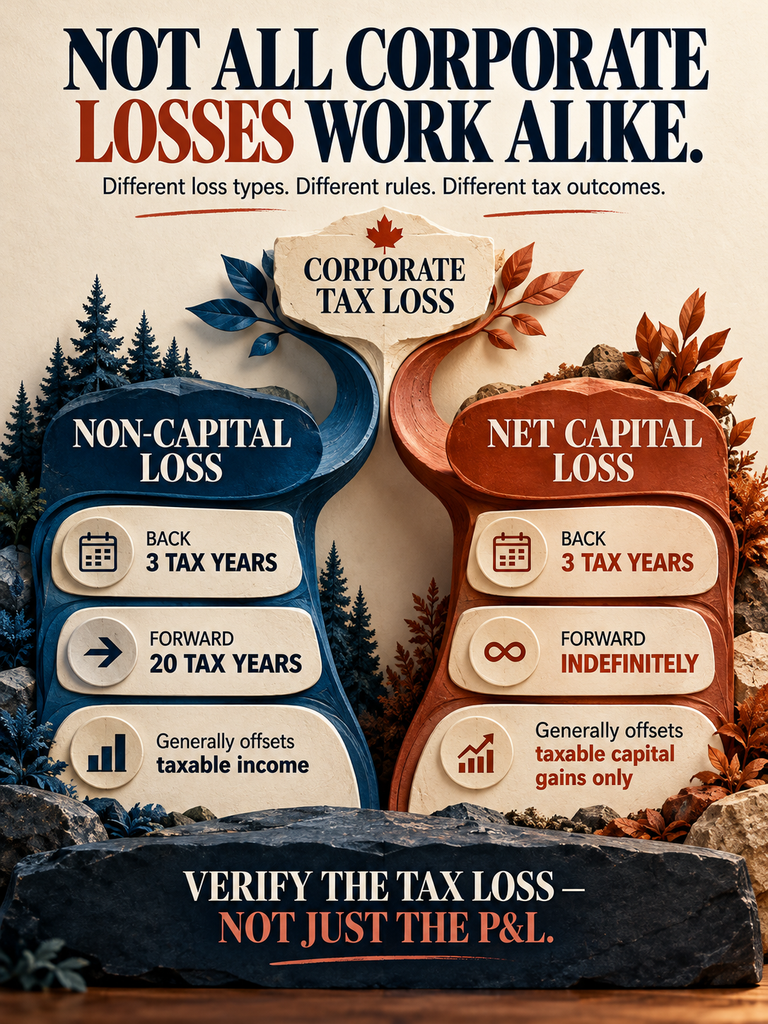
CRA’s current corporate tax guide confirms the three-year carryback period for non-capital and net capital losses.
For most ordinary operating companies, the first question is:
Did the corporation lose money from running the business, or did it lose money on a capital asset?
Those are not interchangeable.
How Does a Non-Capital Loss Carryback Work?
A non-capital loss commonly arises when the corporation’s deductible business losses and applicable tax adjustments exceed its income for the tax year.
CRA generally allows a current-year non-capital loss to reduce taxable income in the three preceding tax years. Any unused balance can generally remain available for up to 20 future tax years.
Illustrative Example
Assume an Ontario corporation has:
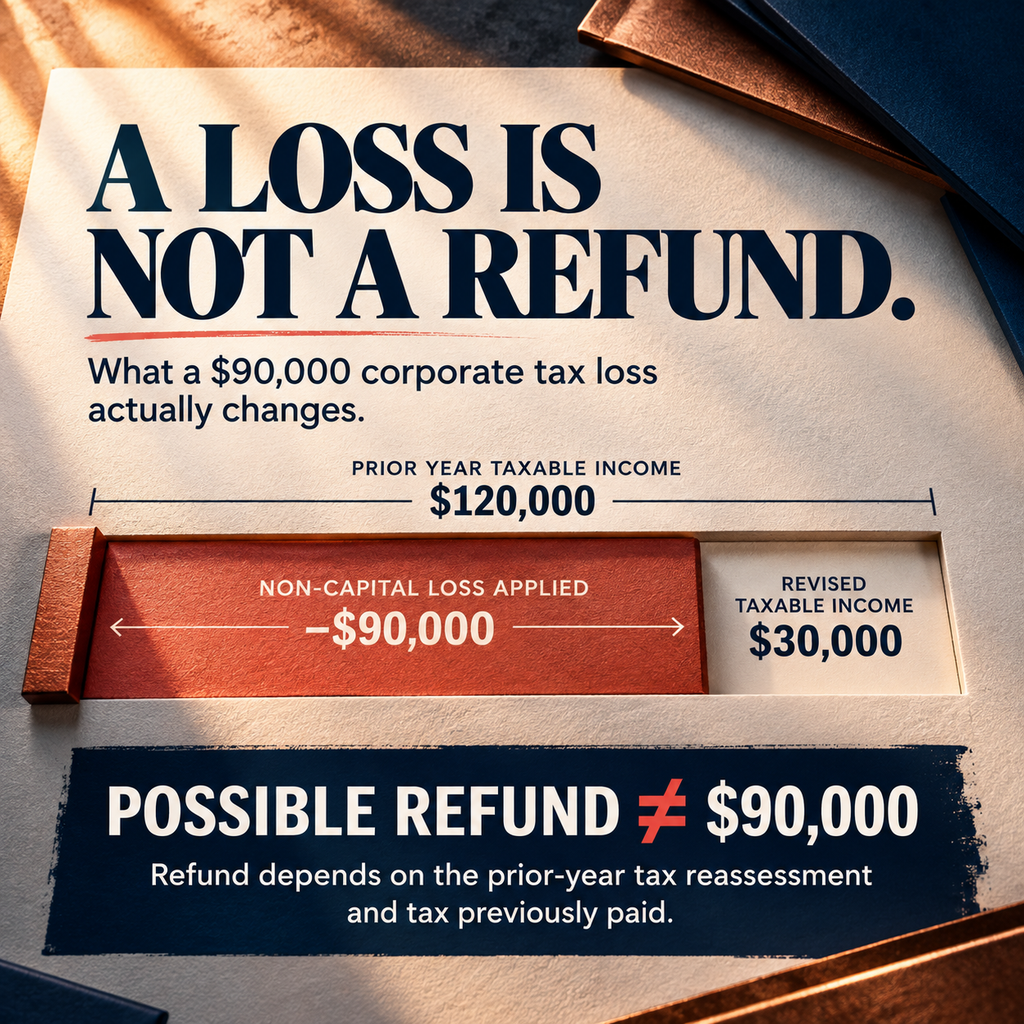
- 2026 non-capital loss: $90,000
- 2025 taxable income: $120,000
- 2024 taxable income: $40,000
- 2023 taxable income: $0
If the corporation applies the full $90,000 loss to 2025, its taxable income for that year could be reduced from:
$120,000 to $30,000
CRA would then reassess the 2025 corporate tax calculation.
If the corporation previously paid tax based on the original $120,000 taxable income, that reassessment may create a refund.
The refund is not automatically $90,000
The loss reduces taxable income.
It does not mean CRA sends back the amount of the loss.
The actual refund depends on factors such as:
- how much taxable income existed in the carryback year
- the corporate tax rate that applied
- taxes previously assessed
- credits and deductions used in that year
- whether another loss was already applied
- provincial or territorial tax calculations
- other T2 items affecting tax payable
Think of the loss as reducing the tax base, not becoming cash dollar-for-dollar.
What if the Loss Is Larger Than One Prior Year’s Income?
You do not necessarily lose the unused amount.
Suppose the corporation has a $150,000 non-capital loss, but the first year you want to use contains only $70,000 of taxable income.
The corporation may use part of the loss against that year and deal with the remaining balance according to the available carryback and carryforward rules.
CRA’s Schedule 4 tracks:
- The Loss Arising In The Current Year
- Prior Loss Balances
- Amounts Applied
- Amounts Carried Back
- Amounts Remaining For Future Years
That continuity matters.
A loss should not disappear from the tax records just because only part of it is useful this year.
How Is a Capital Loss Different?
A corporation can also lose money when it disposes of capital property for less than its tax cost.
That does not normally create the same kind of loss as an operating business loss.
A net capital loss is generally available to reduce taxable capital gains, not ordinary business income.
CRA permits corporate net capital losses to generally be:
- Carried Back Three Tax Years
- Carried Forward Indefinitely
Current 2026 capital-gains position
This area caused a great deal of confusion because a higher capital-gains inclusion rate had previously been proposed.
The federal government later decided not to proceed with that increase. Current 2026 federal guidance confirms that decision.
The CRA continues to administer the currently enacted one-half inclusion rate for ordinary capital gains and capital losses, subject to specific rules and exceptions.
Finance Canada: 2026 Federal Tax Expenditures and Current Capital-Gains Position
This matters because an older article built around the proposed two-thirds corporate inclusion rate can now give a Canadian corporation the wrong starting point.
Can You Carry a Capital Loss Back Against Business Profit?
Generally, no.
That is one of the most important distinctions in this topic.
Imagine the corporation had:
2025 business profit: $200,000
2026 net capital loss: $60,000
The corporation normally cannot simply carry the capital loss back and reduce the $200,000 of ordinary operating profit.
The prior year needs taxable capital gains against which the net capital loss can be applied.
Compare that with a qualifying non-capital loss, which has broader application against prior taxable income.
Simple decision rule
Operating tax loss → examine non-capital loss rules
Loss from capital property → examine capital-loss rules
Do not decide which rule applies only from the word “loss.”
Does Carrying a Loss Back Always Produce a Refund?
No.
A carryback only produces cash when it reduces tax that was actually assessed for a prior year.
A refund is more likely when:
- The Corporation Was Profitable In One Or More Of The Previous Three Years
- Taxable Income Was High Enough To Absorb The Requested Loss
- Corporate Tax Was Actually Payable
- The Tax Has Already Been Paid Or There Is An Account Credit
- No Other Loss Or Deduction Has Already Eliminated The Same Taxable Income
A cash refund may be small or nonexistent when:
- Prior Taxable Income Was Already Low
- Another Deduction Reduced The Tax
- The Corporation Paid Little Or No Tax
- A Prior Loss Was Already Applied
- The Loss Type Cannot Offset The Type Of Prior Income
- Cra Applies The Reassessment Against Another Outstanding Corporate Balance
That last point is worth remembering.
A reassessment can reduce prior corporate tax without necessarily producing the exact cash deposit you expected if the corporation has other amounts owing to CRA.
Carry Back or Carry Forward: Which Choice Is Better?
This is where the topic becomes a planning decision rather than a form-filling exercise.
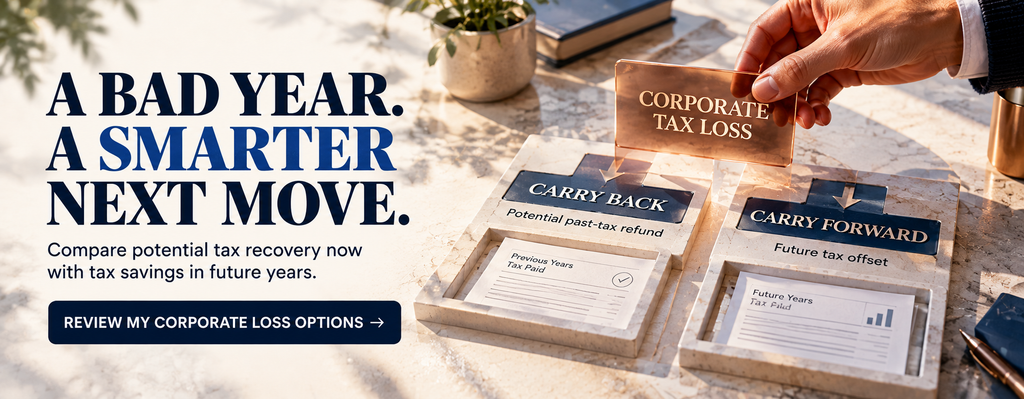
Carrying the loss back can give the corporation access to cash sooner.
Carrying it forward preserves the loss for profitable years that have not happened yet.
Neither is automatically better.
| Decision Factor | Carry Back | Carry Forward |
| Cash recovery now | Potentially strong | None immediately |
| Prior profitable years | Needed for meaningful recovery | Not required |
| Expected future profits | Less important | Very important |
| Future tax payable | Loss no longer available once used | Can reduce later taxable income |
| Cash-flow pressure | May support current liquidity | No immediate refund |
| Certainty | Uses known historical results | Depends on future profitability |
Ask these five questions before choosing
1. Did the corporation pay meaningful tax in the last three years?
If not, there may be little immediate benefit from a carryback.
2. How much taxable income exists in each available carryback year?
Do not assume the most recent year is automatically the best destination.
3. Is the corporation expected to return to profit soon?
A business expecting substantial future taxable income may place more value on preserving some loss.
4. Does the corporation need cash now?
A legitimate refund may have greater current value to a company managing a difficult year.
5. Has the corporation changed ownership or structure?
An acquisition of control, amalgamation, or wind-up can introduce special loss rules.
TaxRecon’s Business Advisory Services can connect this decision with cash flow, expected profitability, corporate structure, and the wider financial picture rather than treating the carryback as an automatic tax election.
What Is Schedule 4 and Why Does It Matter?
Corporations use T2 Schedule 4, Corporation Loss Continuity and Application to calculate and track corporate loss balances and request a loss carryback.
The schedule deals with several categories, including:
- non-capital losses
- capital losses
- farm losses
- restricted farm losses
- limited partnership losses
CRA: T2 Schedule 4, Corporation Loss Continuity and Application
For an ordinary operating corporation with a current non-capital loss, Schedule 4 records the loss and shows how much the company wants to apply to earlier years.
It also preserves the remaining loss balance for future periods.
Do You Have to Amend the Old T2 Returns?
Usually, you do not prepare and resubmit complete amended T2 returns simply to request the loss carryback.
CRA says a corporation can request the carryback using the applicable Schedule 4. The schedule can be filed with the return that reports the loss or forwarded separately to CRA. CRA then reassesses the affected prior year.
That process matters because the loss belongs to the current loss year, even though its tax effect reaches back to an earlier year.
Your prior accounting books do not suddenly become loss-year books.
CRA is changing the prior year’s tax assessment to reflect the later loss carryback.
What Should You Review Before Filing Schedule 4?
Use this six-step check.
Step 1: Confirm the books are reliable
Reconcile:
- Bank Accounts
- Credit Cards
- Loans
- Receivables
- Payables
- Payroll Liabilities
- GST/HST
- Shareholder Balances
A carryback built on a bad loss calculation can create a second filing problem.
Step 2: Calculate the tax loss
Start with the completed year-end accounting, then make the tax adjustments needed for the T2.
TaxRecon’s previous guide to T2 corporate tax returns in Canada explains how corporate tax filing starts with the records behind the return rather than with the T2 form alone.
Step 3: Identify the loss type
Is it:
- Non-Capital
- Net Capital
- Farm
- Restricted Farm
- Limited Partnership
- Another Special Category
Do not mix their application rules.
Step 4: Pull the prior three T2 assessments
Review:
- Taxable Income
- Corporate Tax Payable
- Prior Loss Applications
- Reassessments
- Carryforward Balances
- outstanding CRA balances
Step 5: Model carryback and carryforward options
Compare:
- Refund Available Now
- Loss Used
- Balance Remaining
- Expected Future Profit
- Any Ownership Or Structural Changes
Step 6: Complete Schedule 4 with the T2
The Schedule 4 numbers should reconcile with the corporation’s tax calculation and loss continuity.
What Most Business Owners Get Wrong
“The P&L shows a loss, so that is my carryback amount.”
Not necessarily.
The accounting loss must first be converted into the corporation’s income-tax result.
“CRA will refund the entire loss.”
No.
A carryback reduces earlier taxable income. The refund comes from the resulting reduction in prior tax.
“Every corporate loss works the same way.”
No.
A capital loss and non-capital loss have very different application rules.
“I should always carry the loss back because cash now is better.”
Not always.
Using the loss today means that portion will not remain available for a future year.
“I need to amend three old T2 returns myself.”
Not normally for the carryback request itself.
Schedule 4 tells CRA where the current loss should be applied, and CRA reassesses the prior year.
Do This, Not That
Do this: calculate the tax loss, review the previous three years, model the refund, then choose how much loss to apply.
Not that: see a negative number on the income statement and immediately request the maximum possible carryback.
When Can an Ownership Change Affect Corporate Losses?
Losses deserve extra review when there has been an acquisition of control.
CRA applies special rules to non-capital and capital losses after control of a corporation changes. In some circumstances, pre-acquisition business losses may remain usable only when specific continuity conditions are satisfied. Net capital losses can face stricter restrictions.
This becomes important when:
- The Corporation Was Sold
- A New Owner Acquired Control
- Share Ownership Changed Materially
- Corporations Amalgamated
- A Subsidiary Was Wound Up
- Losses Originated In Another Corporation
Do not apply the ordinary three-year carryback rule blindly when corporate ownership changed during the relevant period.
Can You See Existing Loss Balances With CRA?
Yes.
CRA says corporations can view non-capital loss balances through its View return balances service in My Business Account, while authorized representatives can access the information through Represent a Client.
That balance is useful, but it should still be reconciled with:
- Prior T2 Returns
- Notices of Assessment
- Notices of Reassessment
- Previous Schedule 4 Filings
- Acquisitions Or Reorganizations
- Losses Already Applied
CRA’s balance tells you what is currently recorded.
It does not replace reviewing how the number arose.
Illustrative Example: Loss This Year After Two Profitable Years
Consider a Canadian service corporation with these simplified results:
| Tax Year | Taxable Result |
| 2024 | $60,000 taxable income |
| 2025 | $130,000 taxable income |
| 2026 | $100,000 non-capital loss |
The corporation has two broad choices.
Option 1: Carry the 2026 loss back
It could request that some or all of the $100,000 loss reduce taxable income in a qualifying prior year.
If $100,000 is applied to 2025, that year’s taxable income could fall from:
$130,000 to $30,000
CRA would reassess 2025.
A refund may result based on the tax that was originally payable and the revised calculation.
Option 2: Carry the loss forward
The corporation could keep the loss available for qualifying future taxable income instead.
If 2027 becomes highly profitable, the unused loss may reduce future corporate taxable income.
Which option wins?
There is not enough information in those three numbers alone.
You would still want to know:
- The Actual Tax Paid In 2024 And 2025
- Other Deductions And Credits
- The Corporation’s Expected 2027 Profit
- Cash Needs Today
- Whether Ownership Changed
- Whether Another Loss Balance Already Exists
That is the analysis missing when carryback advice stops at “three years back, twenty years forward.”
When Professional Review Is Worthwhile
Consider a tax review before requesting the carryback when:
- The Loss Is Large
- Prior Years Used Different Tax Rates Or Deductions
- The Company Has Several Unused Loss Balances
- Capital Transactions Occurred
- Ownership Changed
- The Corporation Was Amalgamated Or Reorganized
- Prior T2 Returns Were Reassessed
- Bookkeeping Corrections Changed The Loss
- The Corporation Has Cra Debt
- Future Profit Is Expected To Rebound Sharply
- You Are Unsure Whether The Loss Is Non-Capital Or Capital
TaxRecon’s Tax Filing Services include T2 corporate return preparation and outstanding corporate filing work, with attention to the financial records supporting the return.
Final Thoughts
A bad year can still have tax value.
When a Canadian corporation reports a genuine tax loss after profitable years, a corporate loss carryback in Canada may turn part of that loss into a refund of tax paid earlier.
But the useful question is not only:
“Can we carry the loss back?”
It is:
“What type of loss do we actually have, how much prior taxable income can it offset, what refund would that produce, and is using it now better than keeping it for the future?”
Start with reliable books.
Calculate the tax loss correctly.
Review the previous three corporate tax years.
Then compare the immediate carryback benefit with the value of keeping some or all of the loss available for future years.
That produces a decision based on the corporation’s real numbers rather than a tax rule used in isolation.
Could This Year’s Loss Recover Tax Your Corporation Already Paid?
Do not stop at the negative number on the income statement.
Review the tax loss, prior T2 returns, Notices of Assessment, Schedule 4 balances, and the corporation’s expected next year before choosing where the loss should go.
TaxRecon can help connect those records and determine what needs to be prepared before a carryback request moves forward.
Frequently Asked Questions
How many years can a corporation carry a loss back in Canada?
A corporation can generally carry a current non-capital loss back to the three previous tax years. Unused non-capital losses can generally be carried forward for 20 tax years, subject to the relevant corporate loss rules.
Does a corporate loss carryback automatically create a refund?
No. A refund only arises when applying the loss reduces tax that was previously assessed. If the earlier corporation had little taxable income or little tax payable, the cash recovery may be small or zero.
Can a corporation carry a capital loss back against business income?
Generally, no. A net capital loss normally applies against taxable capital gains rather than ordinary operating income. It can generally be carried back three years and forward indefinitely.
What form does a corporation use to carry back a loss?
Corporations use T2 Schedule 4, Corporation Loss Continuity and Application, to calculate loss continuity and request applicable loss carrybacks.
Should a corporation carry a loss back or save it for the future?
It depends on the corporation’s prior tax paid, current cash needs, expected future profitability, available losses, corporate tax position, and any ownership changes. Compare both outcomes before using a large loss balance.