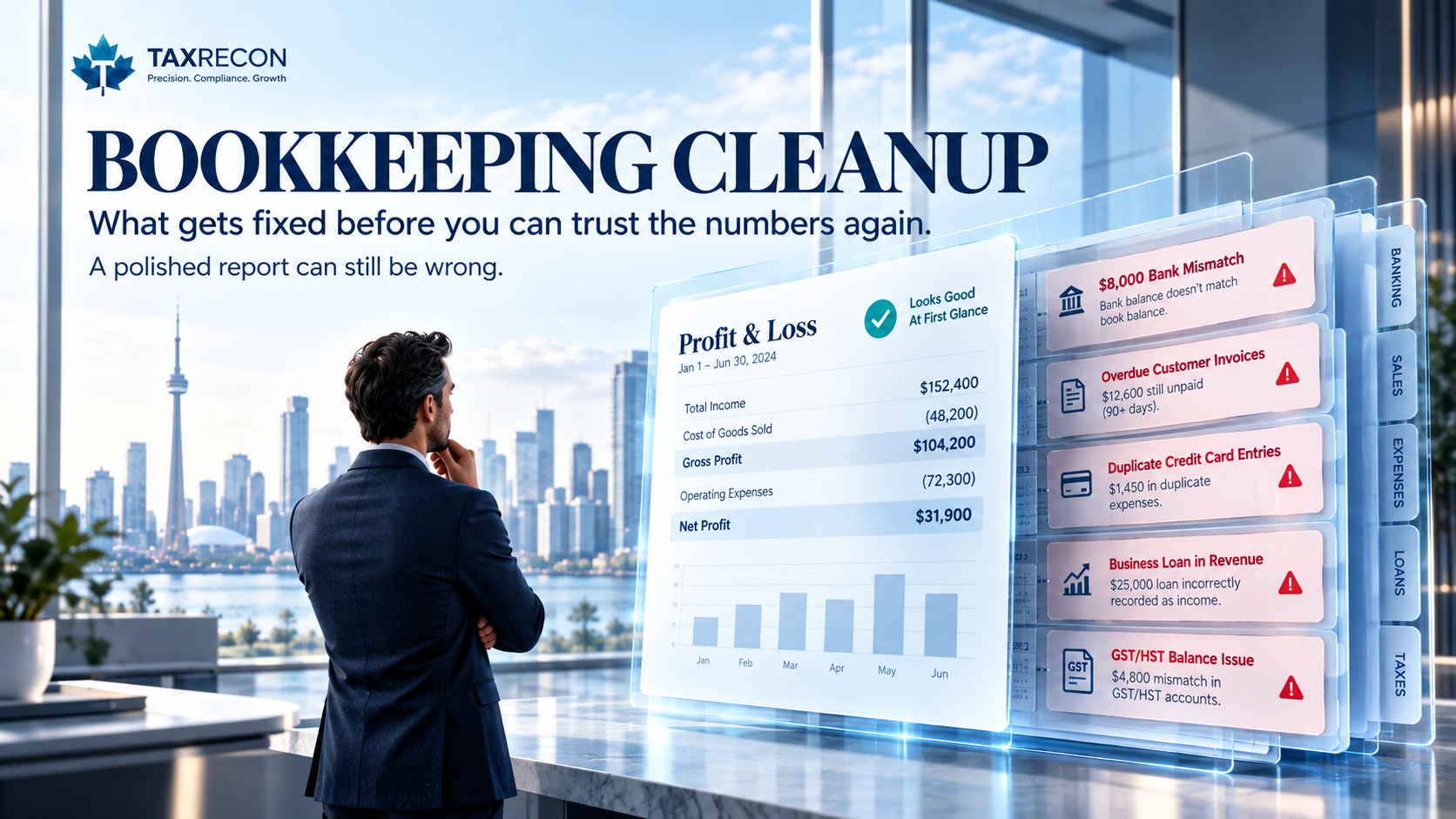
Your profit and loss can look polished and still be wrong.
The bank account may be out by $8,000. Old customer invoices may still show as unpaid even though the money arrived months ago. Credit-card payments may be recorded as expenses twice. A loan might sit in the books as revenue. GST/HST balances may no longer make sense.
That is when bookkeeping cleanup becomes different from simply entering a few missing transactions.
The real job is to find where the financial record stopped agreeing with the evidence, correct the underlying problems, and test whether the reports can be trusted again.
For businesses dealing with that situation, TaxRecon’s Bookkeeping Services cover historical cleanup, reconciliations and ongoing bookkeeping rather than simply adding more transactions to a file that already contains unexplained balances.
Key Takeaways
- Bookkeeping cleanup fixes incorrect or unreliable records. Catch-up bookkeeping mainly fills periods that were never completed.
- Reconciliation comes before trusting financial reports. Bank, credit-card, loan and processor balances need to make sense against outside records.
- Cleanup goes beyond categorization. It can involve duplicates, old receivables, payables, opening balances, owner transactions, assets and prior-period changes.
- Clean books should finish with a clear handoff: what was corrected, what remains unresolved and which issues belong to tax, payroll, GST/HST or another accounting responsibility.
What Does Bookkeeping Cleanup Actually Fix?
Bookkeeping cleanup is the process of finding and correcting financial records that are incomplete, duplicated, misclassified, unreconciled or inconsistent with supporting documents. The goal is not to make reports look tidy. It is to restore a financial record that can be traced back to bank activity, invoices, statements and other evidence.
Think of it as repairing the chain behind the numbers.
A report can only be useful when the transactions underneath it make sense.
That means a cleanup may touch:
- bank reconciliations
- credit-card reconciliations
- duplicate entries
- missing transactions
- incorrect categories
- transfers recorded as income or expenses
- customer balances
- supplier balances
- undeposited funds
- loan accounts
- fixed assets
- owner or shareholder transactions
- payroll-related balances
- GST/HST-related balances
- opening balances
- prior-period changes
QuickBooks’ current 2026 cleanup guidance follows a similar progression: review the file, gather financial records, reconcile accounts, classify transactions and review receivables, payables and other balance-sheet areas. See the 2026 QuickBooks bookkeeping cleanup guide
Cleanup, Catch-Up or Reconstruction: Which Problem Do You Actually Have?
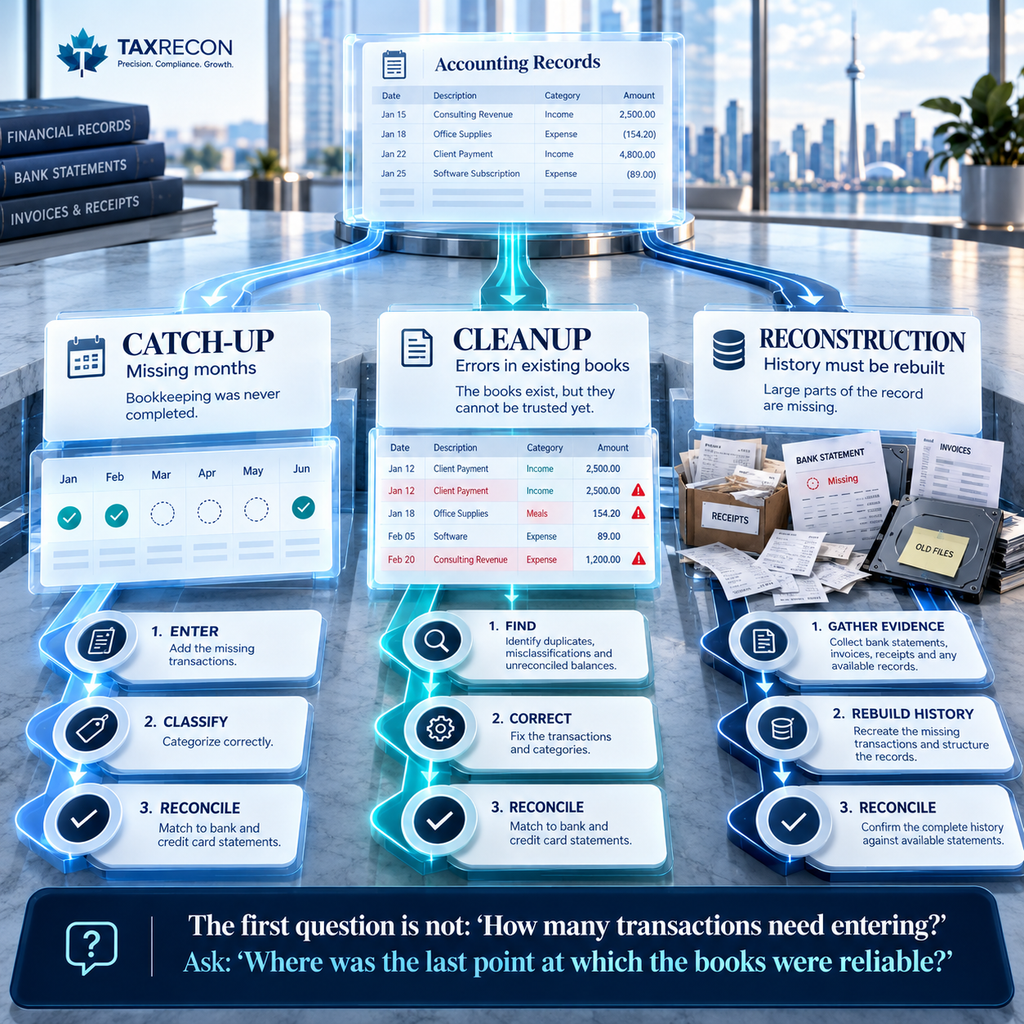
These terms are often mixed together, but they describe different work.
| Situation | What is wrong? | Main job |
| Catch-up | Months of bookkeeping were never completed | Enter, classify and reconcile the missing period |
| Cleanup | Transactions exist, but the books contain errors or unreliable balances | Find, correct and reconcile the problems |
| Reconstruction | Large parts of the financial record are missing | Rebuild the history from available evidence |
Many real files contain more than one.
A company might be four months behind and have an old credit-card balance that has been wrong since last year.
Finishing the missing four months without dealing with the old error carries the same problem forward.
That is why the first question should not be:
“How many transactions need entering?”
It should be:
“Where was the last point at which the books were actually reliable?”
The Five Proof Checks: How Clean Books Earn Back Your Trust
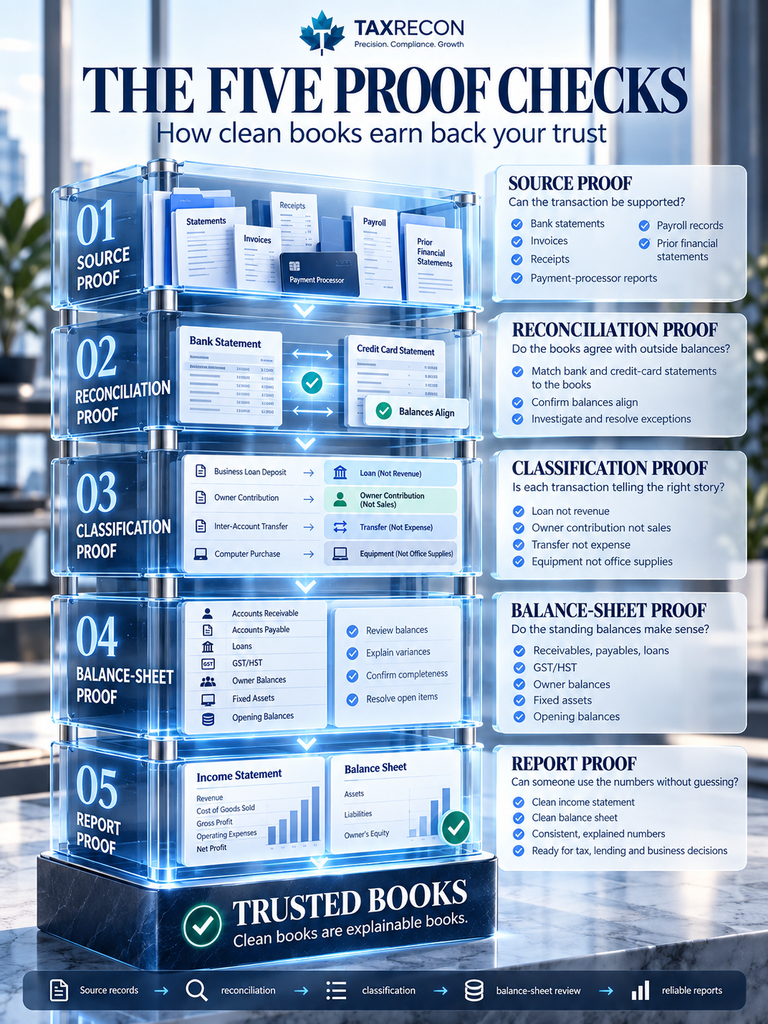
A useful cleanup can be tested through five layers.
1. Source Proof: Can the transaction be supported?
Start with what happened outside the accounting software.
That can include:
- bank statements
- credit-card statements
- sales invoices
- supplier bills
- receipts
- payment-processor reports
- loan statements
- payroll records
- prior financial statements
CRA’s recordkeeping guidance is direct:
“You are required by law to keep records of all your transactions to be able to support your income and expense claims.”
CRA also says business records generally need to be retained for at least six years from the end of the last tax year they relate to. Read CRA’s business-record guidance
Cleanup therefore cannot be based only on what QuickBooks or Xero currently displays.
The software record needs something behind it.
2. Reconciliation Proof: Do the books agree with outside balances?
Next, compare the accounting file with actual statements.
Bank accounts and credit cards deserve priority because they expose many other errors.
Suppose the bank statement ends at $42,600 while the accounting register shows $36,250.
Do not create a $6,350 adjustment simply to force the numbers together.
Find the cause.
It may be:
- a duplicated expense
- a missing deposit
- an uncleared payment
- the wrong statement date
- a transaction posted to another account
- a prior reconciled transaction that was changed
If your main warning sign is a bank mismatch, TaxRecon’s guide to QuickBooks bank balances not matching the statement walks through that problem separately.
3. Classification Proof: Is each transaction telling the right story?
A correctly recorded amount can still sit in the wrong account.
Common examples include:
- loan proceeds recorded as sales
- credit-card payments recorded as expenses
- owner contributions recorded as revenue
- equipment purchases buried inside office expenses
- transfers recorded twice
- personal purchases left inside operating expenses
- merchant fees missing from net deposits
These problems matter because financial reports group transactions by category.
If the categories are wrong, the totals can be technically balanced while still telling the wrong financial story.
4. Balance-Sheet Proof: Do the standing balances make sense?
This is where shallow cleanups often stop too early.
The profit and loss may look reasonable while the balance sheet still contains old problems.
Review:
- bank and credit-card balances
- accounts receivable
- accounts payable
- loans
- sales-tax balances
- payroll liabilities
- fixed assets
- accumulated depreciation where applicable
- owner or shareholder balances
- equity
- retained earnings
- opening balances
A balance should have an explanation.
An accounts receivable total of $85,000 means something very different if $50,000 consists of customer invoices that were actually paid last year.
5. Report Proof: Can someone use the numbers without guessing?
Only after the first four checks should the reports become the focus.
Run the income statement and balance sheet again.
Then ask:
- Does revenue look consistent with the sales records?
- Do expense movements have an explanation?
- Are customer balances real?
- Are supplier balances still outstanding?
- Does cash agree with reconciled accounts?
- Do loans agree with available lender statements?
- Are unusual negative balances explained?
- Does the opening position connect properly with the prior period?
Cleanup is finished when the numbers are explainable, not simply when the dashboard looks cleaner.
Why Reconciliation Comes Before Financial Analysis
Trying to interpret unreconciled books is like measuring with a ruler whose markings moved.
You may still get a number.
You just cannot place much confidence in it.
This matters when owners are already making decisions under financial pressure. Statistics Canada’s third-quarter 2026 business survey found that 59.8% of Canadian employer businesses expected cost-related obstacles over the following three months. View Statistics Canada’s Q3 2026 business conditions release
When margins, costs or cash are under pressure, an unreliable report can make a difficult decision even harder.
After the underlying records are dependable, TaxRecon’s Financial Management Services can use reporting, cash-flow information, budgets and forecasts for a different purpose: understanding what the numbers are showing and what deserves attention next.
That distinction matters.
Cleanup repairs the record. Financial management uses the repaired record.
One Messy File Can Hide Several Different Problems
Consider an illustrative Ontario service business.
The owner opens the year-to-date profit and loss and sees a healthy profit.
The bank account tells a different story.
Cleanup finds four issues:
- Two months of credit-card purchases were imported twice.
- Several customer payments were deposited but never matched to their invoices.
- A business loan was posted to revenue.
- Three owner-paid expenses were never entered.
The first issue overstated expenses.
The second left accounts receivable too high.
The third overstated revenue.
The fourth understated expenses and amounts owed back to the owner.
No single correction solves the file.
That is why bookkeeping cleanup is not a “find the one bad transaction” exercise.
The accounts interact.
What Most People Get Wrong About Bookkeeping Cleanup
“If the bank balance matches today, the books are clean.”
Not necessarily.
A current bank balance can match while historical reconciliations, receivables, payables or classifications remain wrong.
“The bank feed imported everything, so nothing is missing.”
Downloaded activity still needs review.
An imported bank line does not tell you whether it should be matched, categorized, excluded or connected with an existing invoice or bill.
“We can fix the profit and loss and ignore the balance sheet.”
That creates another incomplete cleanup.
Cash, loans, receivables, payables, tax balances and owner accounts live on the balance sheet.
“One journal entry can clear the difference.”
Sometimes an adjustment is valid.
An unexplained adjustment used only to make accounts agree can hide the original problem.
Do this: trace the difference to records and explain the correction.
Not that: post a round-number adjustment because the reconciliation screen needs to reach zero.
“Cleanup and accounting mean the same thing.”
They overlap, but they are not identical.
Bookkeeping cleanup repairs the underlying record. Broader accounting and tax work can use that record for financial statements, analysis or filings.
TaxRecon’s guide to bookkeeping vs accounting for a small business explains where those responsibilities separate.
What Should Be Reviewed Before Anyone Starts Fixing the File?
Good cleanup starts with diagnosis.
Your source material makes the same point: a provider should look at the books, statements and related records before deciding how large the cleanup is.
Use this five-step preparation process.
Step 1: Find the last period you trust
Locate the most recent reconciliation, year-end report or filed return that you believe reflects a reliable starting position.
Do not assume January 1 is automatically correct.
Step 2: Gather complete statements
Collect full bank, credit-card, loan and processor statements for the affected period.
Missing months create gaps in the trail.
Step 3: Preserve the existing accounting history
Avoid deleting entries, undoing reconciliations or rebuilding the chart of accounts before the review.
Wrong entries can still reveal what happened.
Step 4: List what already feels wrong
Write down known issues:
- balances that do not agree
- old invoices
- negative accounts
- duplicate expenses
- missing deposits
- tax balances that look unusual
- owner transactions that were never explained
This helps the reviewer find the highest-risk areas first.
Step 5: Separate cleanup from connected work
Payroll corrections, GST/HST filings, corporate tax returns and software migrations may depend on clean bookkeeping, but they are not automatically part of the cleanup engagement.
Define those boundaries before the work starts.
When Is a Cleanup Actually Finished?
“Everything looks better” is not a useful completion standard.
A stronger finish line looks like this:
| Area | What “finished” should mean |
| Bank accounts | Reconciled to agreed statement dates |
| Credit cards | Reconciled and unsupported items identified |
| Transactions | Duplicates and missing entries addressed |
| Categories | Material classifications reviewed |
| Receivables | Open balances tied to actual customer amounts |
| Payables | Outstanding supplier amounts reviewed |
| Loans | Balances connected with supporting statements |
| Owner activity | Contributions, withdrawals or related amounts identified |
| Balance sheet | Unusual balances explained |
| Reports | Income statement and balance sheet can be traced back to the cleaned records |
Some items may remain unresolved because information is unavailable.
That does not mean the provider should invent an answer.
The unresolved item should be documented and carried forward transparently.
Does Software Fix Messy Books by Itself?
Software can speed up the work.
It cannot decide every accounting question.
Bank rules can categorize recurring transactions. Feeds can import activity. Matching tools can connect payments with existing entries.
But automation can also repeat the same mistake hundreds of times when a bad rule is applied consistently.
QuickBooks‘ 2026 cleanup guidance specifically identifies disconnected integrations, automated-rule errors and surprising financial results as signs that a broader cleanup may be needed.
That is why automation should reduce repetitive work, not replace review.
Final Thoughts
Bookkeeping cleanup is not about making QuickBooks look neat.
It is about rebuilding enough trust in the financial record that the numbers can support the next job.
That starts with source records, moves through reconciliation and classification, and finishes with balance-sheet and report checks.
Some businesses need catch-up. Others need correction. Some need reconstruction plus both.
The useful question is not, “Are the books done?”
It is:
“Can every material number now be explained?”
When the answer becomes yes, bookkeeping cleanup has done what it was supposed to do.
For connected Canadian bookkeeping and accounting support, visit TaxRecon.
Ready to Find Where the Books Stopped Making Sense?
If your reports no longer agree with the records behind them, adding more transactions will not fix the underlying problem.
TaxRecon can review the current file, identify the periods and accounts that need attention, and define what belongs inside the bookkeeping cleanup before correction work begins.

Start with the records you already have and the last financial period you still trust.
Frequently Asked Questions
What is bookkeeping cleanup?
Bookkeeping cleanup is the process of reviewing and correcting records that contain errors, missing activity, duplicates, classification problems or unreconciled balances. The goal is to restore a financial record that agrees with supporting evidence and can produce reports that are useful for accounting, tax preparation and business decisions.
How do I know if my business books need cleanup?
Warning signs include bank accounts that will not reconcile, unexplained negative balances, very old receivables or payables, duplicate transactions, large uncategorized balances, unusual profit changes or reports you no longer trust. One isolated error may need a correction. Several connected problems can point to a wider cleanup.
Is bookkeeping cleanup the same as catch-up bookkeeping?
No. Catch-up mainly deals with bookkeeping that was never completed for earlier months. Cleanup deals with records that already exist but contain errors or unreliable balances. Many projects involve both, especially when a business is behind and the last completed period also contains problems.
How long does bookkeeping cleanup take?
There is no universal timeline. File condition, number of accounts, years involved, missing records, transaction volume and how quickly questions are answered all affect the work. Your source material also notes that client responsiveness can materially affect cleanup timing.
What records are needed for a bookkeeping cleanup?
Common records include bank statements, credit-card statements, loan statements, sales invoices, supplier bills, receipts, payroll information, payment-processor reports and prior financial statements. Existing QuickBooks or Xero access is also useful because it shows how transactions and balances were originally recorded.
Can QuickBooks automatically clean up my books?
No. QuickBooks can automate imports, rules, matching and parts of reconciliation, but accounting judgment is still needed when records conflict or transactions were treated incorrectly. Automation is useful for repetitive tasks. It cannot determine every loan, owner transaction, duplicate, historical balance or tax-related issue by itself.
Does bookkeeping cleanup include tax filing or GST/HST returns?
Not automatically. Cleanup repairs the underlying bookkeeping record. Tax returns, GST/HST filings, payroll corrections and CRA correspondence can depend on those records but may be separately scoped services. Confirm what is included before work begins so the cleanup and compliance responsibilities do not get mixed together.
Can old bookkeeping be corrected after a tax return has already been filed?
Yes, accounting records can still be reviewed and corrected. Whether a past tax return or other filing also needs to change depends on what the correction affects. The bookkeeping adjustment and any tax amendment should be considered separately rather than assuming every bookkeeping correction automatically changes a filed return.
How much does bookkeeping cleanup cost?
The price depends on the file rather than one universal rate. The number of periods, accounts, transactions, reconciliation problems, missing records and correction work all matter. A review before quoting is more useful than pricing cleanup solely by how many months are involved.
Can TaxRecon clean up an existing QuickBooks or Xero file?
Yes. TaxRecon’s bookkeeping service covers historical cleanup, reconciliation and QuickBooks or Xero bookkeeping support. The first step is establishing where the books stopped being reliable and which issues belong to bookkeeping versus tax, payroll, GST/HST or another accounting responsibility.