
Your T2 deadline has passed, the return is still unfinished, and you may not know whether the bigger problem is the filing, the tax balance, or both.
Start with this: filing late and paying late are two different CRA issues.
A late T2 can trigger a filing penalty based on unpaid tax. An unpaid corporate tax balance can also collect interest from its own earlier payment deadline. If CRA has already demanded the return, or the corporation has a history of late filing, the penalty can become much larger.
The best next step is usually not to wait until every problem feels resolved. Work out which deadline you missed, get the records into a filing-ready position, and deal with the outstanding balance separately.
TaxRecon supports incorporated businesses with corporate filings, overdue returns, CRA correspondence, and the accounting records behind them.
Quick Answer
For most corporations, the standard T2 late filing penalty in Canada is 5% of the unpaid tax that was due when the return had to be filed, plus 1% of that unpaid tax for each complete month the T2 remains late, up to 12 months.
A repeat late filer can face a higher formula when CRA’s specific conditions apply.
Tax owing can also collect interest separately. CRA’s current prescribed rate on overdue income tax for October 1 to December 31, 2026 is 7% annually. CRA fourth-quarter 2026 prescribed interest rates
Key Takeaways
- Your T2 filing deadline and corporate tax payment deadline are not the same date.
- The standard late-filing penalty starts at 5% of unpaid tax, then adds 1% for each complete month late, up to 12 months.
- Repeat late filing can increase the penalty to 10% plus 2% per complete month, up to 20 months, when CRA’s repeat-filer conditions are met.
- Interest on unpaid tax is separate from the late-filing penalty.
- If no tax was unpaid, the normal percentage-based late-filing formula may calculate to zero, but the T2 filing requirement still exists.
- Most corporations must now file T2 returns electronically.
- Filing sooner generally stops the monthly late-filing penalty from growing, even if the corporation cannot pay the full balance immediately.
First, Work Out Which Deadline You Actually Missed
This is where many business owners lose track of the problem.
A corporation can have a late payment before its T2 return is technically late.
T2 filing deadline
CRA generally requires the T2 Corporation Income Tax Return to be filed within six months after the corporation’s tax year-end.
For example:
| Corporate Year-End | General T2 Filing Deadline |
| December 31 | June 30 |
| March 31 | September 30 |
| June 30 | December 31 |
| September 30 | March 31 |
Corporate tax payment deadline
The corporation’s tax balance is generally due two months after year-end.
Certain qualifying Canadian-controlled private corporations can receive a three-month balance-due period when CRA’s conditions are met.
That means a December 31 corporation could have:
Tax balance due: February 28 or possibly March 31
T2 return due: June 30
So a company may file its T2 on time in June and still owe several months of interest because the tax itself should have been paid earlier.
Late Filing vs Late Payment: What Is the Difference?
| Problem | What Triggered It? | Main CRA Cost |
| T2 filed late | Return submitted after filing deadline | Late-filing penalty |
| Corporate tax paid late | Balance remains unpaid after balance-due day | Interest |
| Instalments paid late or short | Required instalments were missed | Instalment interest and possibly penalty |
| Required T2 filed using wrong method | Corporation did not follow mandatory e-file rule | Electronic-filing non-compliance penalty |
| CRA demand ignored | Return remains outstanding after CRA requires filing | Can contribute to higher repeat late-filing penalty |
This distinction should guide what you fix first.
How Is the Standard T2 Late Filing Penalty Calculated?
CRA states:
“If you file your return late, a penalty applies.”
The standard calculation is:
5% of unpaid tax due when the return was required to be filed
plus
1% of that unpaid tax for every complete month the return is late
for a maximum of 12 months.
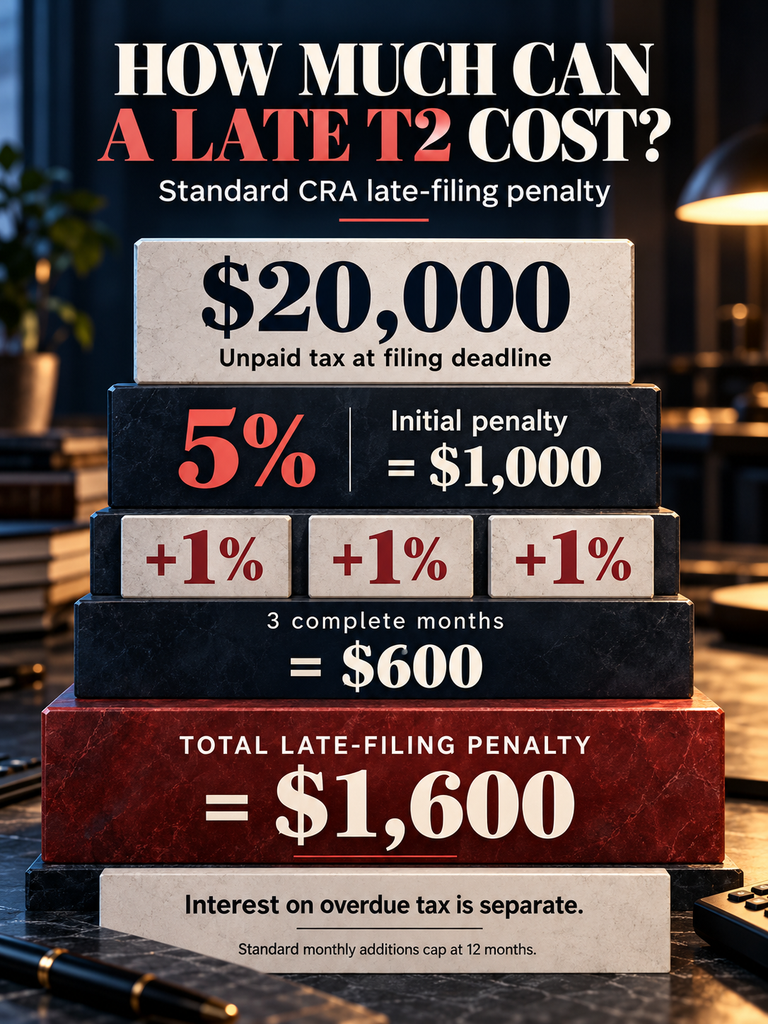
Example: $20,000 tax owing and T2 filed three months late
Suppose the corporation still has $20,000 of unpaid tax when its T2 filing deadline arrives.
The return is then filed three complete months late.
Initial penalty
$20,000 × 5% = $1,000
Monthly amount
$20,000 × 1% = $200 per complete month
Three months:
$200 × 3 = $600
Total late-filing penalty
$1,600
That does not include interest on the unpaid corporate tax.
The interest clock can begin earlier because the balance-due day usually falls before the T2 filing deadline.
What Happens if the T2 Is More Than 12 Months Late?
The standard monthly addition stops after 12 complete months.
Using the standard formula, the maximum regular late-filing percentage can therefore reach:
5% + 12% = 17% of the unpaid tax
That does not mean the rest of the problem stops growing.
Interest on the unpaid balance can continue.
CRA correspondence may also become more serious when the return remains outstanding.
When Does CRA Use the Higher Repeat Late-Filing Penalty?
The higher penalty does not apply merely because the same company once filed late.
CRA sets specific conditions.
The larger formula can apply when CRA:
- issued a demand to file the return under subsection 150(2), and
- assessed a failure-to-file penalty for the corporation in any of the previous three tax years.
When those requirements apply, the penalty becomes:
10% of unpaid tax
plus
2% of unpaid tax for every complete month late
for up to 20 months.
Why this matters
The difference becomes substantial.
Suppose $20,000 remained unpaid and the enhanced penalty applied for five complete months.
Initial amount:
$20,000 × 10% = $2,000
Monthly amount:
$20,000 × 2% × 5 = $2,000
Total:
$4,000
Again, interest would be separate.
This is why a CRA demand to file should not sit unanswered.
Does CRA Charge Interest on Top of the Late-Filing Penalty?
Yes.
The late-filing penalty and arrears interest are different charges.
CRA charges interest when corporate tax is not paid by the applicable payment deadline. The prescribed rate can change every quarter.
For the current quarter, October 1 through December 31, 2026, the CRA rate on overdue income tax is 7% annually. See CRA’s current 2026 overdue-tax interest rate
CRA applies interest to overdue amounts from the payment due date, not from the later T2 filing date.
Think of the problem as two clocks
Clock 1: Payment clock
Starts after the corporate tax balance-due day.
This creates interest on unpaid tax.
Clock 2: Filing clock
Starts after the T2 filing deadline.
This can create the failure-to-file penalty.
If both deadlines were missed, both clocks can be running.
What if the Corporation Owes No Tax?
This is an important exception to the way people talk about T2 penalties.
CRA calculates the standard late-filing penalty as a percentage of unpaid tax.
If the corporation genuinely has no unpaid tax, the normal percentage formula may produce $0.
But that does not mean the T2 becomes optional.
Resident corporations generally still have to file a T2 every tax year, even when no tax is payable. This includes inactive corporations, subject to CRA’s limited exceptions.
So the correct message is:
No tax owing can mean no amount under the standard percentage-based late-filing formula. It does not remove the filing obligation.
Other filing or compliance penalties may still matter depending on the circumstances.
Could You Face a $1,000 Electronic-Filing Penalty?
Yes, if the corporation is required to file electronically and does not comply.
For tax years starting after 2023, CRA generally requires corporations to file T2 returns electronically, with limited exceptions for certain insurance corporations, non-resident corporations, functional-currency filers, and section 149 tax-exempt corporations.
CRA states that the non-compliance penalty is $1,000.
This is separate from the usual late-filing penalty.
So a corporation should not react to an overdue return by mailing a paper return without first checking whether it is permitted to file that way.
Can You Use the T2 Short Return Because You Are Late?
Being late does not make a corporation eligible for the T2 Short Return.
Eligibility depends on the corporation’s tax position and CRA’s conditions.
A corporation may qualify when it is a CCPC throughout the year and has nil net income or a loss for tax purposes, but it must also satisfy CRA’s other requirements.
Those include conditions relating to:
- permanent establishments
- refundable tax credits
- taxable dividends
- reporting currency
- certain Ontario tax items
- section 34.2 amounts
A section 149 tax-exempt corporation can also fall within the eligible categories.
If the corporation does not meet all required conditions, it needs the regular T2.
Do not choose a T2 Short simply because it looks faster.
What Should You Do if Your T2 Is Already Late?
Use this order.
Step 1: Confirm the tax year and actual filing deadline
Start with the corporation’s fiscal year-end.
Then calculate the six-month filing date.
Do not assume every corporation follows June 30.
Step 2: Find out whether tax is still unpaid
Check:
- corporate tax instalments already made
- prior credits on the CRA account
- estimated tax for the year
- payments already sent
- CRA account balance where available
This tells you whether the late-filing percentage has a base to apply to.
Step 3: Get the books ready enough to file correctly
Do not hold the return indefinitely because the accounting file is messy.
At the same time, do not submit figures that nobody can support.
Review:
- bank reconciliations
- credit cards
- sales and receivables
- supplier bills
- payroll balances
- GST/HST balances
- shareholder accounts
- loans
- fixed assets
- retained earnings
- opening balances
If the records already exist but contain errors, TaxRecon’s guide to bookkeeping cleanup explains how unreliable balances should be traced and corrected before they flow into the return.
If months or years of bookkeeping were never completed, read how much catch-up bookkeeping costs in Canada to understand why transaction volume, missing records, accounts, and reconciliation work affect the catch-up process.
Step 4: File the overdue T2
Once the return can be prepared correctly, file it.
Waiting longer simply because you cannot pay everything at once does not improve the filing position.
Filing stops additional complete months from being added to the standard late-filing penalty calculation.
Step 5: Address the balance separately
Pay what the corporation can reasonably pay toward a valid balance.
Reducing the unpaid amount reduces the balance on which future interest continues to accumulate.
If the full debt cannot be paid at once, the CRA has processes for dealing with outstanding balances. TaxRecon’s CRA Compliance Services can help trace assessments, payments, filing periods, arrears, and the records behind the amount before the next compliance step is taken.
The Late T2 Recovery Order
When several things are wrong at once, use this sequence:
1. Identify
Which tax year is late?
2. Reconcile
Can the financial statements and tax balances be supported?
3. File
Submit the overdue T2 using the required filing method.
4. Pay
Reduce valid tax debt as quickly as the corporation reasonably can.
5. Respond
Deal with CRA notices, demands, or requests using the filing and payment information now available.
6. Prevent
Add the next year-end, payment deadline, instalments, and T2 filing deadline to one corporate tax calendar.
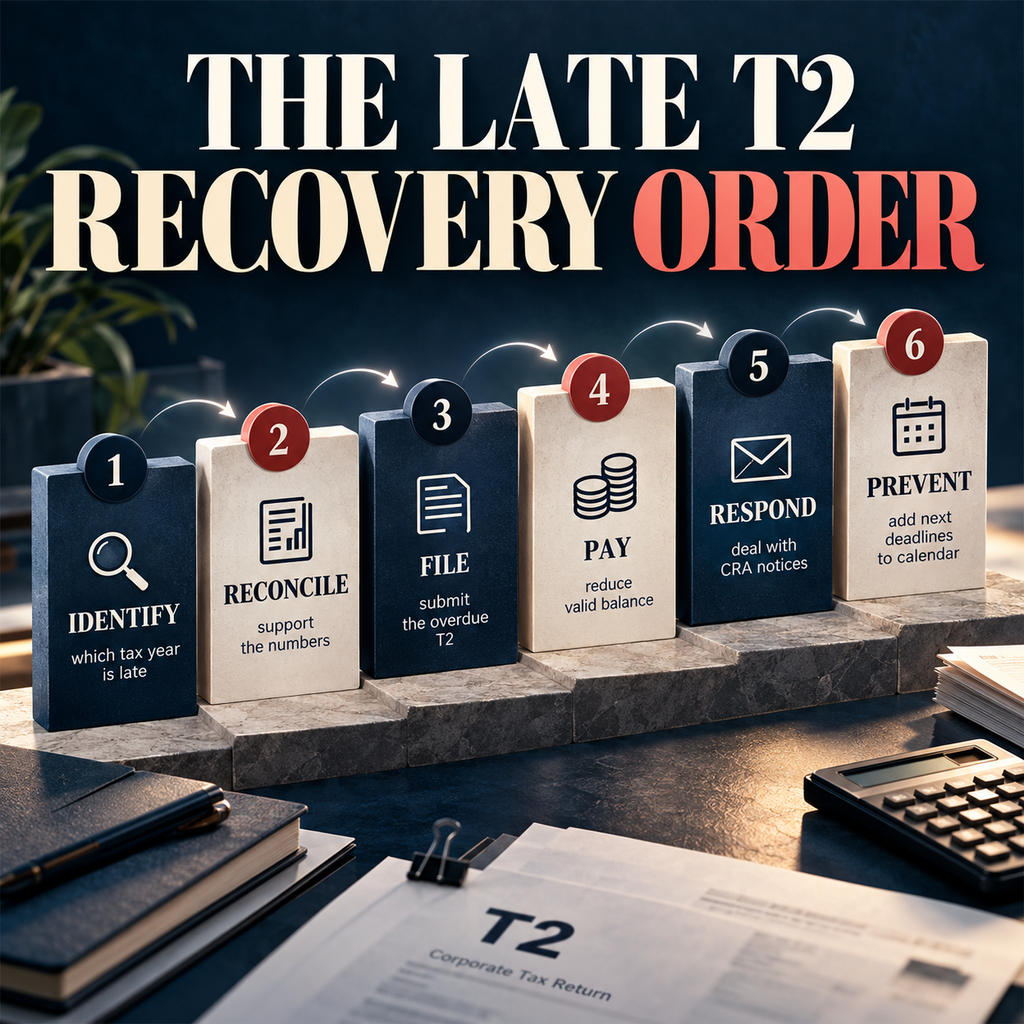
This order is more useful than trying to fix every CRA problem at the same time.
What if CRA Has Already Sent a Demand to File?
Read it carefully.
Check:
- corporation name and business number
- tax year involved
- requested filing
- response date
- CRA contact information
- whether another year is also outstanding
Do not assume the letter relates only to the latest corporate year.
Older missing T2 returns can affect the next filing, particularly when opening balances, losses, assessments, or payments carry between years.
TaxRecon’s Tax Filing Services specifically include T2 corporate returns and late or outstanding returns. The process starts by identifying which filing periods remain open and what records support them.
Can CRA Waive a T2 Penalty or Interest?
Sometimes, but relief is not automatic.
CRA’s taxpayer-relief provisions allow taxpayers to ask CRA to cancel or waive certain penalties and interest when circumstances support relief.
CRA gives examples such as:
- serious illness or accident
- natural or human-made disasters
- civil disruption
- certain CRA actions or delays
- financial hardship or inability to pay in qualifying circumstances
Each request is reviewed on its own facts.
You can apply through CRA’s online process or Form RC4288. CRA taxpayer relief: cancel or waive penalties and interest
Relief does not erase the tax itself
This distinction matters.
Taxpayer relief deals with qualifying penalties and interest.
It does not turn a valid corporate income-tax liability into zero.
Build the request around evidence
A stronger relief request normally explains:
- what happened
- when it happened
- how the circumstances prevented compliance
- when the corporation became able to act
- what steps it took once the problem could be addressed
- what documentation supports the explanation
Do not treat RC4288 as a generic “please remove the penalty” letter.
Common Mistakes That Make a Late T2 Worse
Waiting because the corporation cannot pay
Do this: file the return once it can be prepared properly.
Not that: keep the T2 unfiled until enough cash exists to pay the entire balance.
Filing and payment are separate responsibilities.
Counting six months as the tax payment deadline
The six-month period generally applies to the return.
The corporate balance may have been due two or three months after year-end.
Ignoring CRA letters
A demand to file can become important if the corporation later meets the conditions for CRA’s enhanced repeat late-filing penalty.
Filing a paper return because it feels faster
Most corporations now have mandatory electronic T2 filing requirements.
Guessing the numbers to stop the penalty
A fast but unsupported filing can create a second problem.
The T2 still needs defensible financial information behind it.
Cleaning only the income statement
Old loans, GST/HST balances, payroll liabilities, receivables, shareholder accounts, and retained earnings live on the balance sheet.
Those accounts can affect the return just as much as current-year expenses.
Assuming a nil year means no filing
Resident corporations generally still have to file T2 returns even when they owe no tax.
Illustrative Example: Filing Late and Paying Late at the Same Time
Consider an incorporated Ontario service business with a December 31 year-end.
Its T2 is due June 30.
The corporation calculates $20,000 of tax owing but has not paid the balance by its applicable balance-due date.
The books remain unfinished, and the corporation finally files the T2 on October 15.
Three complete months have passed after the June 30 filing deadline.
The standard late-filing penalty would be:
5% × $20,000 = $1,000
plus
1% × $20,000 × 3 months = $600
for a total late-filing penalty of:
$1,600
Interest on the $20,000 tax balance is a separate calculation and can date back to the earlier corporate payment deadline.
This is why the business should not look at the $1,600 penalty and assume it represents the entire CRA cost.
What Should You Give Your Accountant for an Overdue T2?
Start with:
- incorporation details
- corporate year-end
- prior T2 return
- previous Notice of Assessment
- current bookkeeping file
- bank statements
- credit-card statements
- loan statements
- accounts receivable
- accounts payable
- payroll records
- GST/HST information
- asset purchases and sales
- shareholder transactions
- corporate tax instalment records
- CRA letters
- proof of payments already made
If several tax years are overdue, organize them by year.
Do not combine three corporate years into one unsorted folder and expect the tax history to become clear on its own.
How to Prevent the Next T2 From Becoming Late
Once the overdue return is dealt with, build the next tax year around four dates.
Corporate year-end
This closes the reporting period.
Tax balance-due day
Usually two months after year-end, or three months for certain qualifying CCPCs.
Instalment dates
Monthly or quarterly where instalments are required.
T2 filing deadline
Six months after year-end.
Then work backward.
If the T2 is due June 30, do not begin year-end bookkeeping on June 20.
Set internal dates for:
- bank reconciliation
- missing-document collection
- shareholder review
- GST/HST reconciliation
- payroll reconciliation
- asset review
- draft financial statements
- tax estimate
- final return review
The filing deadline should be the end of the process, not the beginning.
Final Thoughts
A late T2 is easier to fix when you separate the problem into parts.
First, identify the actual filing deadline.
Second, find out whether tax remained unpaid.
Third, bring the corporate books to a point where the numbers can support the return.
Then file the T2 and deal with the CRA balance, interest, correspondence, or relief request that remains.
The T2 late filing penalty Canada rules are serious, but waiting usually gives you fewer options rather than more.
If the return is already overdue, the most useful question is no longer, “How did we miss it?”
It is:
“What can we put in order today so this filing stops getting older?”
Your T2 Is Late. Start With the Tax Year, Not the Panic.
Missing the deadline does not mean the corporation should stay stuck.
TaxRecon can review the overdue period, identify the records needed for the T2, separate filing issues from CRA balance issues, and help put the next required steps into a clear order.

Bring the year-end date, current books, previous return, CRA notices, and payment history. That is enough to start finding where the filing stands.
Frequently Asked Questions
What is the penalty for filing a T2 late in Canada?
The standard penalty is 5% of the unpaid tax due when the return had to be filed, plus 1% of that unpaid amount for each complete month the T2 is late, up to 12 months. CRA can apply a larger repeat-filer formula when its specific conditions are met.
Is there a T2 late-filing penalty if the corporation owes no tax?
The standard late-filing penalty is calculated from unpaid tax, so a corporation with no unpaid tax may have no amount under that formula. The corporation generally still has to file its T2, and other compliance rules can still apply.
Can I file my T2 now and pay CRA later?
You should generally avoid delaying the return solely because the corporation cannot pay everything immediately. Filing stops further complete months from being added to the standard late-filing penalty. Any valid unpaid tax balance remains subject to CRA’s payment and interest rules.
Can CRA remove a late T2 penalty?
CRA can cancel or waive qualifying penalties and interest through taxpayer relief when the circumstances support it. Approval is not automatic. The corporation should explain what prevented compliance, document the circumstances, and show what it did once it became able to address the problem.
Can TaxRecon help with an overdue corporate tax return?
Yes. TaxRecon’s tax filing scope includes T2 corporate returns and late or outstanding returns. When CRA correspondence or arrears are also involved, the filing can be reviewed alongside the relevant CRA account, records, assessments, and next compliance step.