
You registered for GST/HST, opened your CRA account, and now one question decides how often this responsibility comes back onto your calendar:
Do you file monthly, quarterly, or once a year?
The answer is not based only on preference.
Your GST HST filing frequency in Canada is mainly tied to the value of taxable supplies used in CRA’s reporting-period calculation. Smaller registrants are commonly annual filers, growing businesses can move to quarterly filing, and businesses above the highest threshold generally report monthly.
There is also some choice. Businesses assigned annual or quarterly filing may be able to elect a more frequent schedule when that works better for refunds, cash flow, or financial routines.
TaxRecon Canada helps Canadian businesses connect GST/HST filing with the bookkeeping and transaction records behind each reporting period.
Key Takeaways
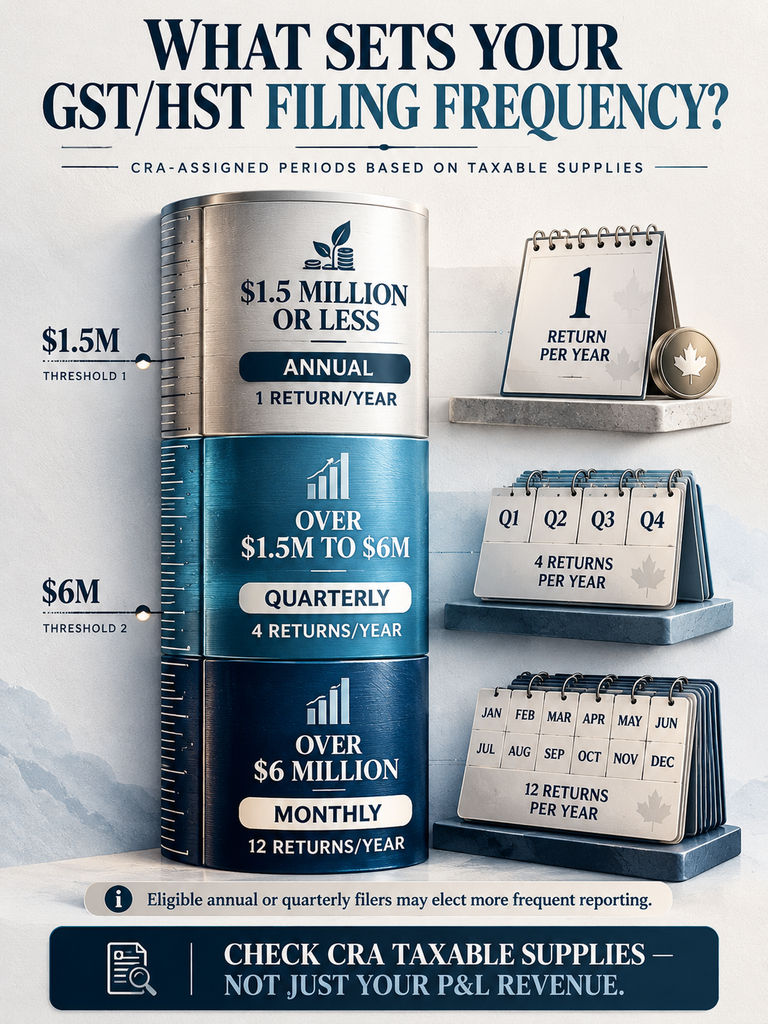
- CRA’s standard reporting bands are $1.5 million or less for annual filing, more than $1.5 million up to $6 million for quarterly filing, and more than $6 million for monthly filing.
- Annual and quarterly filers can sometimes choose to report more often. You generally cannot choose a less frequent period when your revenue requires more frequent filing.
- Monthly and quarterly GST/HST returns are generally due one month after the reporting period ends.
- Annual GST/HST returns are generally due three months after fiscal year-end, with a special deadline rule for certain individuals.
- Filing annually does not always mean paying GST/HST only once a year. Some annual filers must make quarterly instalments.
How Does CRA Decide Your GST/HST Filing Frequency?
CRA bases the reporting period mainly on the value of taxable supplies used in its threshold calculation.
The current bands are:
| Annual Taxable Supplies | Assigned Reporting Period | More Frequent Option |
| $1.5 million or less | Annual | Quarterly or monthly |
| More than $1.5 million up to $6 million | Quarterly | Monthly |
| More than $6 million | Monthly | None |
CRA’s current registrant guide says:
“When you register for the GST/HST, the CRA generally assigns an annual reporting period.”
A registrant can then choose a more frequent period where CRA’s rules permit it.
Review CRA’s current GST/HST reporting-period rules
The part many businesses miss is what CRA means by the revenue used for this calculation.
What Revenue Counts Toward the $1.5 Million and $6 Million Thresholds?
Do not simply copy the revenue figure from your income statement.
CRA’s reporting-period calculation generally includes taxable supplies made in Canada, including zero-rated supplies made in Canada and taxable supplies of associated persons.
CRA says not to include certain amounts, including:
- supplies made outside Canada
- zero-rated exports
- zero-rated financial services
- exempt supplies
- taxable sales of capital real property
- goodwill Canada
Why this distinction matters
Consider a business showing $1.8 million of total revenue in its accounting reports.
If a material part relates to revenue CRA excludes from the reporting-period threshold, you cannot automatically conclude that the company must become a quarterly filer.
The opposite problem can happen with associated businesses.
A company looking only at its own sales can underestimate its reporting-period threshold if CRA requires associated taxable supplies to be included.
Use the GST/HST threshold calculation, not a rough gross-revenue number.
What Are the Filing Deadlines for Monthly, Quarterly and Annual GST/HST Returns?
Frequency changes more than how often you prepare the return.
It also changes how often filing and payment dates appear during the year.
Monthly GST/HST filers
A monthly filer generally has to file the return and pay the balance within one month after the end of each reporting period.
If a monthly period ends July 31, the normal due date is August 31.
Quarterly GST/HST filers
Quarterly filers generally follow the same one-month rule.
If a quarterly period ends March 31, the normal filing and payment deadline is April 30.
Annual GST/HST filers
An annual filer generally files the GST/HST return and pays the balance within three months after fiscal year-end.
There is an important exception for individuals with business income who are annual filers and have a December 31 fiscal year-end. Their GST/HST return is generally due June 15, while the amount owing is due April 30.
Check CRA’s current GST/HST filing and payment deadlines
Deadline summary
| Filing Frequency | Return Due | Payment Due |
| Monthly | 1 month after period end | 1 month after period end |
| Quarterly | 1 month after period end | 1 month after period end |
| Annual, general rule | 3 months after fiscal year-end | 3 months after fiscal year-end |
| Annual individual with Dec. 31 year-end | June 15 | April 30 |
If a due date falls on a Saturday, Sunday, or CRA-recognized public holiday, CRA’s next-business-day rule can apply.
Does Annual Filing Mean You Only Pay CRA Once a Year?
Not always.
This is one of the biggest practical differences between filing annually and simply putting GST/HST aside until year-end.
An annual filer may have to make quarterly GST/HST instalments.
CRA currently says annual filers generally have to make instalments when:
- net tax for the previous fiscal year was $3,000 or more, and
- net tax for the current fiscal year is also $3,000 or more
The instalments are due within one month after the end of each fiscal quarter and are commonly based on one-quarter of the prior year’s net tax.
So this assumption can be wrong:
“I file annually, therefore I keep all the GST/HST until the annual return.”
You may still have four payments during the year.

New annual filers also need to watch this rule
A first GST/HST reporting period can be shorter than a full fiscal year.
CRA may annualize the net tax from that short period to determine whether instalments will be required in the next year.
That is especially relevant for businesses registering late in their fiscal year.
Which Filing Frequency Is Better for Cash Flow?
The assigned period answers what you are required to do.
It does not always answer what period is most practical when you have a choice.
Use three factors.
1. Your net GST/HST position
If you regularly collect much more GST/HST than you claim through input tax credits, annual filing can allow a larger liability to build before the return is filed.
That does not make annual filing wrong.
It does mean the money should be managed carefully rather than treated as operating cash.
If your business regularly receives refunds because eligible ITCs exceed tax collected, more frequent filing may bring those refunds into the business sooner.
2. Your bookkeeping routine
Quarterly filing can create a useful checkpoint.
Instead of discovering twelve months of GST/HST coding problems at year-end, you review:
- sales
- GST/HST collected
- purchases
- ITCs
- adjustments
- account balances
four times during the year.
Monthly filing creates even shorter review cycles, but it also creates twelve returns.
3. Your administrative capacity
More frequent reporting means more deadlines.
A monthly schedule may work well for a business with current books and a regular accounting process.
It may work badly for a company that struggles to close the books each month.
Annual vs Quarterly vs Monthly: Practical Comparison
| Question | Annual | Quarterly | Monthly |
| Number of returns per year | 1 | 4 | 12 |
| Administrative frequency | Lowest | Moderate | Highest |
| Refund access | Slowest in many cases | Faster | Fastest |
| Size of each reporting period | Largest | Medium | Smallest |
| GST/HST errors caught | Less often | More often | Most often |
| Best general fit | Smaller, organized businesses with manageable tax position | Growing businesses wanting regular checkpoints | Large businesses or businesses requiring frequent reporting |
| Can CRA require it? | Yes, within threshold | Yes, within threshold | Yes above $6M |
The number of returns should not be the only consideration.
Fewer returns can reduce filing work while increasing the amount of activity that must be reviewed at once.
Can an Annual Filer Choose Quarterly or Monthly Filing?
Yes, where the business qualifies.
CRA allows a registrant assigned an annual period to elect quarterly or monthly filing.
A quarterly filer can elect monthly filing.
The change can be requested through CRA’s online File an election service in My Business Account or Represent a Client, or by filing Form GST20, Election for GST/HST Reporting Period.
CRA Form GST20 and reporting-period changes
When might more frequent filing make sense?
It may be worth reviewing when:
- the business regularly expects GST/HST refunds
- ITCs are high relative to tax collected
- management wants more frequent reconciliation
- a growing company wants shorter filing cycles before CRA requires them
- annual GST/HST balances are becoming difficult to manage
- bookkeeping is already completed monthly
More frequent is not automatically better.
It works best when the accounting process can support the schedule.
Can You Move From Monthly Back to Quarterly or Annual?
Possibly, but a drop in revenue does not automatically move you to a less frequent reporting period.
CRA’s current account-change guidance says a monthly or quarterly filer can generally elect a less frequent period after 12 months when taxable supplies fall below the relevant threshold.
If you do not make the election, the existing reporting frequency can remain in place.
This catches businesses that assume CRA will automatically change monthly filing back to quarterly when revenue falls.
Do This, Not That
Do this: confirm the reporting period shown in CRA My Business Account before preparing the next return.
Not that: decide to file annually because your sales dropped and assume CRA already changed the account.
Your books can say one thing while the CRA account still expects another return.
Can Your Filing Frequency Change During the Year as Revenue Grows?
Yes.
This is another gap in many basic GST/HST filing guides.
A business does not necessarily wait until next January or the next fiscal year to move from annual to quarterly or monthly filing.
CRA provides rules that can change the reporting period during a fiscal year when taxable supplies cross the applicable thresholds.
For example, if an annual filer goes above $1.5 million but not above $6 million during its first fiscal quarter, CRA says quarterly reporting can begin on the first day of the second fiscal quarter.
Crossing $6 million can similarly trigger monthly filing based on CRA’s timing rules.
Growing businesses should therefore monitor the threshold during the year, not only at year-end.
Illustrative Example: The Business Has a Choice
Consider an Ontario consulting company with:
- $950,000 of taxable supplies used for CRA’s reporting calculation
- an annual reporting period
- current monthly bookkeeping
- significant software and subcontractor costs
- GST/HST refunds in several high-expense periods
At $950,000, the business is still within the normal annual threshold.
It does not have to become quarterly simply because quarterly filing feels common for a company of that size.
But it can compare its choices.
Staying annual
The company files one return.
That means less filing work, but eligible refunds may sit inside the annual reporting period longer.
Moving quarterly
The business files four returns.
That creates regular GST/HST reconciliation points and may bring refund claims forward.
Moving monthly
The company gets the shortest refund cycle but accepts twelve filing deadlines.
For this business, the real decision is not:
“Which period has the fewest returns?”
It is:
“How often do we want to close, reconcile, and settle our GST/HST position?”
Filing Frequency Does Not Change Your ITC Rules
Do not mix up how often you file with what you can claim.
Input tax credit eligibility depends on the purchase, commercial use, supporting records, registration status, and other CRA rules.
A monthly filer does not receive a broader ITC entitlement than an annual filer.
If the claim itself is the problem, TaxRecon’s previous guide to Input Tax Credits in Canada explains what businesses can claim and what records need to support the amount.
Filing Frequency Is Also Different From the Quick Method
A second common mix-up is assuming that annual, quarterly, or monthly filing determines whether you use the Regular Method or Quick Method.
It does not.
Your reporting period answers:
How often do you file?
Your GST/HST accounting method answers:
How is the net tax calculated?
Those are separate decisions.
TaxRecon’s comparison of the GST/HST Quick Method vs Regular Method explains the calculation side separately.
Keeping these decisions apart prevents a lot of unnecessary confusion.
What Most Businesses Get Wrong About GST/HST Filing Frequency
“Annual revenue means the total on my P&L”
Not necessarily.
CRA has its own taxable-supplies calculation for the reporting threshold.
“If CRA assigned annual filing, I have to remain annual”
Not always.
Eligible registrants can elect more frequent filing.
“Annual filing means no payments during the year”
Not always.
Annual filers meeting the $3,000 net-tax conditions can have quarterly installments.
“If revenue drops, CRA automatically moves me back”
No.
A less frequent period can require an election.
“We crossed $1.5 million, so we change next year”
Not always.
The timing of crossing the threshold during the fiscal year can move the reporting period sooner.
“Quarterly filing means quarterly bookkeeping”
That is risky.
A return is easier to prepare when the monthly books have already been reconciled.
TaxRecon’s Bookkeeping Services can help keep the sales, purchases, bank activity, and tax coding behind each return current.
Use This Five-Step GST/HST Frequency Check
1. Confirm what CRA currently expects
Check My Business Account or your latest GST/HST account information.
Do not begin with assumptions.
2. Calculate the reporting-period revenue correctly
Review Canadian taxable supplies, applicable zero-rated supplies, associated persons, and CRA’s exclusions.
3. Compare the threshold
Use the current CRA bands:
- $1.5 million or less
- more than $1.5 million up to $6 million
- more than $6 million
4. Review cash flow and refunds
Ask whether annual filing creates a large liability or delays recurring refunds.
5. Decide whether an election is useful
If you qualify and a shorter period works better, review GST20 or the CRA online election process before changing how you file.
This gives you a much stronger answer than choosing a schedule simply because another business uses it.
Why Filing Frequency Deserves Attention
The filing period may look like an administrative setting, but getting it wrong can turn into a real compliance problem.
CRA’s 2026–27 Corporate Business Plan, using its latest reported operational results, says the agency resolved more than 1.3 million delinquent GST/HST returns through its GST/HST delinquent filer program in 2024–25.
That figure does not mean those businesses chose the wrong reporting period.
It does show how large the overdue GST/HST filing problem is.
The safest routine is to know exactly which period CRA expects and close the books early enough to meet it.
Where TaxRecon Fits
GST/HST filing is rarely only about entering numbers onto a return.
The reporting period needs to agree with the CRA. Sales need to agree with the books. ITCs need support. Previous returns may affect the current balance.
TaxRecon’s GST/HST Filing Services cover reporting-period review, return preparation, ITC information, reconciliation, overdue periods, and CRA follow-up where those items form part of the work.
The goal is to know what period is due and what numbers belong in it before another filing is submitted.
Final Thoughts
The right GST/HST filing schedule starts with the CRA threshold, but it should not end there.
Businesses under $1.5 million are commonly assigned annual filing. Businesses above that level can move into quarterly reporting, while businesses above $6 million generally move to monthly filing. Eligible annual and quarterly filers may also choose to report more frequently.
Then consider the practical side.
How quickly do your books close? Do you usually remit tax or receive refunds? Will annual filing create a large cash commitment? Would quarterly filing make errors easier to catch?
The best approach to GST HST filing frequency Canada is to confirm what CRA requires first, then decide whether a permitted shorter reporting period gives your business a better routine.
Need to Confirm Your Next GST/HST Reporting Period?
If you are unsure whether CRA expects an annual, quarterly, or monthly return, start with the account rather than guessing from last year’s sales.
TaxRecon can review the reporting period, the bookkeeping behind it, and the next filing that needs attention so you know exactly what should happen next.
Frequently Asked Questions
How do I know if I am an annual, quarterly, or monthly GST/HST filer?
Check your CRA GST/HST account first. CRA generally assigns annual reporting at $1.5 million or less in taxable supplies, quarterly above $1.5 million up to $6 million, and monthly above $6 million. Elections and special rules can change the period.
Can I file GST/HST quarterly even if CRA assigned me annual filing?
Yes. An eligible annual filer can elect quarterly or monthly reporting. The election can be made online through CRA’s account services or with Form GST20.
Can a quarterly GST/HST filer switch to annual filing?
Possibly. CRA says a quarterly or monthly filer can generally elect a less frequent period after 12 months when taxable supplies fall below the required threshold. The change is not automatic.
When are monthly GST/HST returns due?
Monthly GST/HST returns and any balance owing are generally due one month after the reporting period ends.
When are quarterly GST/HST returns due?
Quarterly filers generally file and pay one month after the end of each fiscal quarter.
When is an annual GST/HST return due?
Most annual filers file and pay within three months after fiscal year-end. Individuals with a December 31 fiscal year-end generally have an April 30 payment deadline and June 15 filing deadline.
Do annual GST/HST filers have to pay installments?
Some do. When the applicable annual-filer net-tax conditions reach $3,000 or more, quarterly installments can be required during the following fiscal year.
Does GST/HST filing frequency depend on gross sales?
Not exactly. CRA uses a taxable-supplies threshold calculation that includes some amounts and excludes others. Associated persons can also affect the calculation.
Is monthly GST/HST filing better if my business normally gets refunds?
It can be useful because a shorter reporting period may allow refund claims to be filed sooner. You should weigh that cash-flow benefit against the work involved in preparing twelve returns each year.
Can TaxRecon review which GST/HST filing period my business should use?
Yes. TaxRecon can review the reporting period shown with CRA, the taxable-supplies threshold, bookkeeping position, previous returns, and whether a more frequent reporting election makes sense for the business.