You open your tax folder and find two documents carrying the same three characters: T3.
One belongs to the trust. The other belongs in the beneficiary’s tax records.
That small naming difference causes a lot of unnecessary confusion.
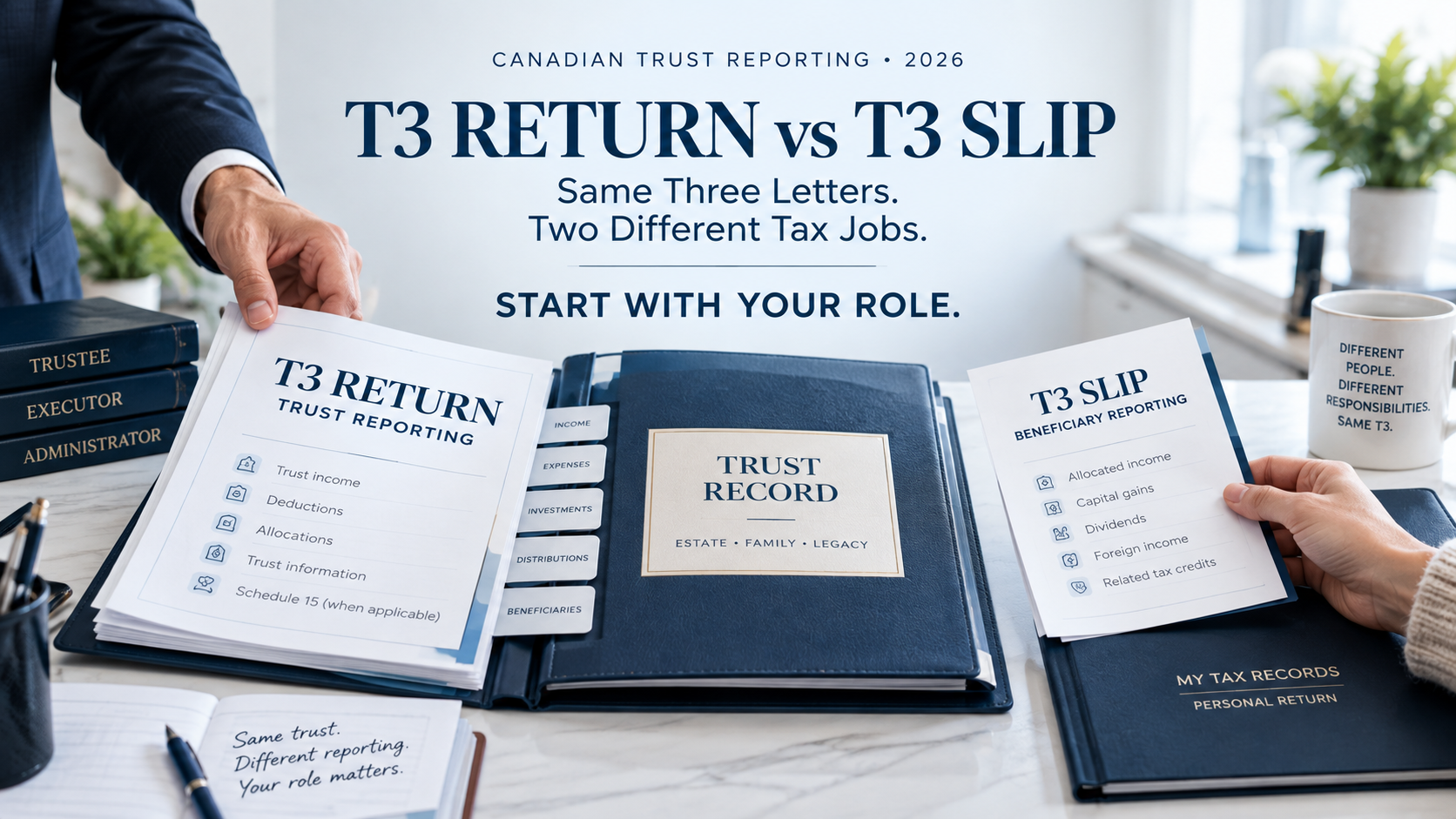
A T3 return is the trust’s own income tax and information return, usually prepared by the trustee, executor or administrator. A T3 slip reports income and other amounts that a trust allocated or designated to a beneficiary. If you are comparing a T3 return vs T3 slip, your first question should be: am I responsible for the trust, or did I receive income from it?
TaxRecon’s Tax Filing & CRA Compliance service connects that distinction to the trust’s actual records and CRA filing responsibilities.
Key Takeaways
- T3 return: filed for the trust when a filing obligation applies.
- T3 slip: issued to a beneficiary when reportable trust amounts are allocated or designated to them.
- A trust can have a T3 filing obligation without every beneficiary receiving a T3 slip.
- Current trust-reporting rules changed again in 2026, so old filing advice may no longer reflect the CRA’s current position.
What Is the Difference Between a T3 Return and a T3 Slip?
The easiest way to remember the difference is:
The return tells the CRA about the trust. The slip tells the beneficiary about amounts connected to them.
The CRA describes the T3 return in particularly clear language:
“A T3 return is both an income tax return and a general information return.”
The CRA T3 Trust Guide explains that the return reports the trust itself and information that can affect people connected with it, including beneficiaries and settlors.
The T3 slip has a different job.
Its formal name is the Statement of Trust Income Allocations and Designations. Trusts use it to identify beneficiaries and report amounts such as income and credits allocated or designated to them.
Your supplied filing source also separates these two processes: the trust return is prepared and filed as a return, while slips and summaries follow their own beneficiary-reporting workflow.
T3 Return vs T3 Slip at a Glance
| Question | T3 Return | T3 Slip |
| Official role | Trust income tax and information return | Beneficiary information slip |
| Main subject | The trust | Individual beneficiary |
| Usually prepared by | Trustee, executor, administrator or tax preparer | Trustee or administrator |
| Sent to CRA | Yes | Yes, with the T3 Summary |
| Sent to beneficiary | No | Yes |
| Can calculate trust tax | Yes | No |
| Reports beneficiary allocations | Yes, through related schedules | Yes, for the individual recipient |
| Schedule 15 may apply | Yes | No |
| Used on beneficiary’s T1 | Not directly | Yes |
| General deadline | 90 days after trust year-end | Same general 90-day period |
The documents work together, but they are not interchangeable.
Who Needs to File a T3 Return?
Current Canadian trust rules require more care than the old advice of “file only if the trust earned income.”
Some resident express trusts must file annually even when no income was earned, provided they do not fall within a listed-trust exception. Other trusts may have filing requirements because of tax payable, income allocations, capital transactions or other circumstances.
The CRA’s current Who should file a T3 return guidance should be checked against the trust’s exact facts.
This is where many older articles become unreliable.
The rules changed again in 2026
Bill C-15 received Royal Assent on March 26, 2026 and amended the trust-reporting regime.
For taxation years ending on or after December 31, 2025, additional exceptions can apply to certain trusts that meet specified conditions. Bare trusts also receive separate treatment.
For tax years ending after December 31, 2024 but before December 31, 2026, bare trusts are generally outside these reporting rules. Certain bare trusts can become subject again for taxation years ending on or after December 31, 2026.
So do not ask only:
“Is this a trust?”
Ask:
“What type of trust is it, what tax year are we filing, and does a current exception apply?”
Who Gets a T3 Slip?
A trustee generally prepares a T3 slip for each resident beneficiary to whom the trust allocated income during the year.
A slip can report several kinds of amounts, including:
- Canadian dividends
- Capital gains
- Other trust income
- Foreign income
- Related tax credits
- Certain capital distributions affecting the beneficiary’s adjusted cost base
The beneficiary then uses those amounts when preparing the appropriate personal or other tax return.
The current CRA guidance on when to prepare a T3 slip contains one detail worth remembering: when income allocated to a beneficiary is less than $100, the trustee does not generally have to prepare a T3 slip for that beneficiary. The beneficiary still needs to be notified because the income remains reportable.
That creates an important distinction:
No T3 slip does not automatically mean no taxable trust income.

Use the Three-Question T3 Check
When the paperwork gets confusing, use these three questions.
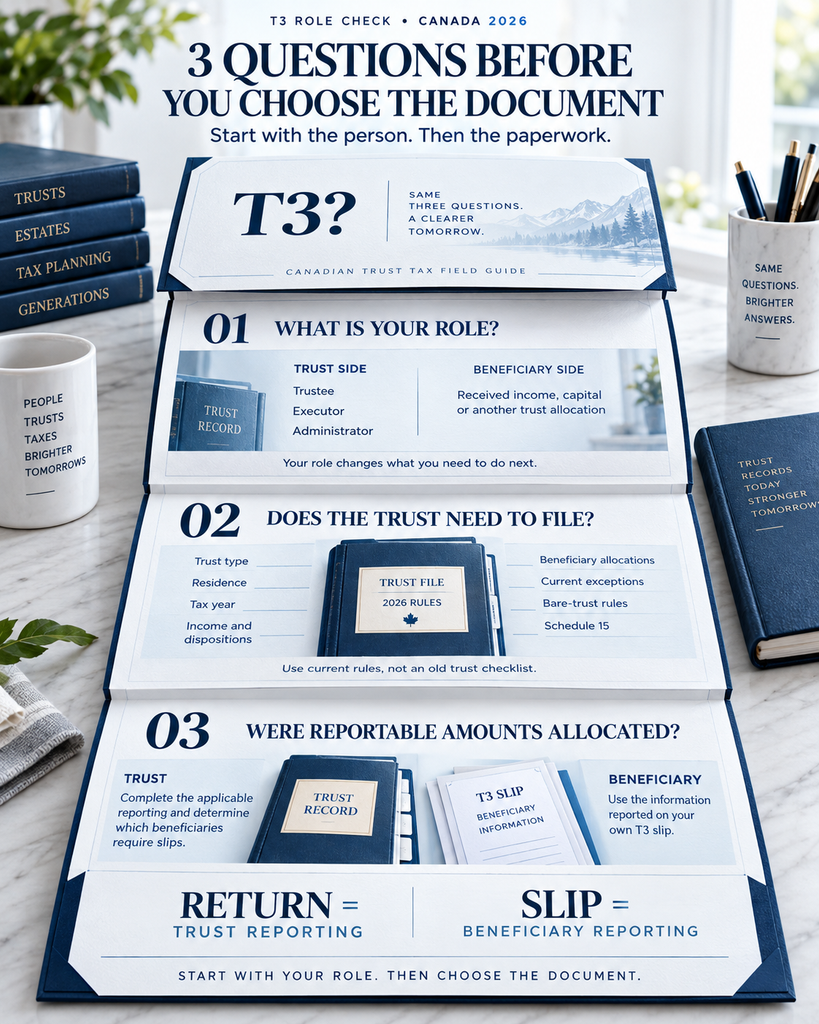
1. What is your role?
Trustee, executor or administrator:
Start with the trust’s filing requirements.
Beneficiary:
Start with the income or capital allocated to you and the slip you received.
2. Does the trust itself need to file?
Check:
- Trust type
- Residence
- Tax year
- Income and dispositions
- Beneficiary allocations
- Listed-trust exceptions
- Current bare-trust rules
- Schedule 15 requirements
3. Did the trust allocate reportable amounts to beneficiaries?
If yes, determine which beneficiaries require T3 slips and complete the related T3 Summary.
This order prevents a common mistake: starting with the slip before deciding whether the trust itself has a filing obligation.
What Does This Look Like in Real Life?
Consider a simple illustrative family-trust scenario.
The trust holds investments and earns income during the year. The trustees decide to allocate part of that income to an adult beneficiary.
Two different reporting jobs can arise.
On the trust side
The trustee reviews whether the trust must file a T3 return.
The return reports the trust’s income, deductions, relevant allocations and other required information. Schedule 15 may also apply if the trust falls within the beneficial-ownership reporting rules.
On the beneficiary side
The trustee prepares the appropriate T3 slip showing the beneficiary’s reportable allocation.
The beneficiary does not take the trust’s full T3 return and attach it to their personal tax return.
They use the information reported on their own T3 slip.
One trust, two tax documents, two different jobs.
What Is Schedule 15, and Does It Go on the T3 Slip?
Schedule 15 belongs to the trust-return side, not the beneficiary-slip side.
It is called Beneficial Ownership Information of a Trust and can require information about reportable entities connected with the trust.
Depending on the current rules and the type of trust, those entities may include trustees, beneficiaries, settlors and people able to exert control over trustee decisions.
The CRA updated its enhanced trust-reporting FAQ in June 2026 to reflect the amended filing rules.
That makes one workflow especially important:
Do this: determine the trust’s current filing and Schedule 15 obligations first.
Not that: assume receiving or issuing a T3 slip tells you whether Schedule 15 is required.
They answer different reporting questions.
When Are the T3 Return and T3 Slips Due?
The general rule is straightforward.
The T3 return must be filed no later than 90 days after the trust’s tax year-end. Any balance owing is generally due within the same period. Related T3 slips and the T3 Summary are also filed within the 90-day period.
For many trusts using a December 31 year-end, that puts the deadline near the end of March.
Graduated rate estates and certain other situations can have different year-end mechanics, so check the actual trust period rather than automatically assuming December 31.
The CRA trust filing deadline guidance provides the current rules.
One current CRA processing benchmark
For 2026-27, the CRA’s current service standard is to issue a notice of assessment within 17 weeks of receiving a complete T3 trust return, with a target of meeting that standard 95% of the time. That is a service target, not a promise that every return will finish within that period.
Do You File the T3 Return and T3 Slips the Same Way?
Not necessarily.
The CRA treats the T3 trust return and T3 information slips as separate filing streams.
The trust return can be filed through approved T3 EFILE methods when eligible. Tax preparers who prepare more than five T3 trust returns for payment are generally subject to mandatory electronic-filing requirements.
T3 slips have their own electronic-filing threshold. More than five information returns of the same type must be filed electronically. CRA Web Forms and Internet file transfer are available methods.
The beneficiary also needs their copy of the slip.
The CRA specifically says not to staple the T3 Summary and slips to the T3 trust return because they form a separate information-return process.
What Most People Get Wrong About T3s
Mistake 1: Calling every T3 document “the T3”
Ask which one.
A trust return and a beneficiary slip serve different purposes.
Mistake 2: Assuming receiving a T3 slip means you must file a trust return
Receiving a slip usually places you on the beneficiary side.
You generally use the slip when completing your own tax filing.
Mistake 3: Assuming no slip means no income
An allocation below the CRA’s slip threshold may still need to be reported even when no T3 slip was required.
Mistake 4: Assuming no trust income means no T3 return
Current trust-reporting rules can require certain trusts to file even when little or no income exists.
Mistake 5: Relying on a 2023 or 2024 bare-trust article
Trust-reporting legislation changed again in 2026.
Check the taxation year and current CRA rules before deciding whether a bare trust files.
Mistake 6: Treating Schedule 15 like part of the beneficiary slip
Schedule 15 deals with beneficial-ownership reporting for the trust.
It is not a box or attachment on someone’s personal T3 slip.
What Should You Do When You See “T3” on Your Tax Documents?
Step 1: Read the full document name
Look for either:
T3 Trust Income Tax and Information Return
or:
T3 Statement of Trust Income Allocations and Designations
That usually answers half the question immediately.
Step 2: Identify your role
Are you acting for the trust, or are you receiving a distribution or allocation from it?
Step 3: Confirm the tax year
Trust rules have changed several times, particularly around beneficial-ownership and bare-trust reporting.
Step 4: Check the trust’s filing obligation
Use the current CRA rules, not a prior-year checklist.
Step 5: Reconcile beneficiary allocations
Where T3 slips are needed, confirm the trust’s records agree with the amounts reported to each beneficiary.
Step 6: Keep both sides connected
The return, beneficiary allocations, slips, Summary and supporting records should tell the same story.
Where TaxRecon Fits
Trust reporting can become confusing because one tax year may involve the trust, several beneficiaries, beneficial-ownership information and separate filing methods.
That is exactly where connected tax work matters.
Through TaxRecon’s Tax Filing & CRA Compliance service, the starting point is identifying what the taxpayer is actually responsible for before treating every T3 document as the same filing.
TaxRecon is based in London, Ontario and supports Canadian businesses and individuals with tax filing, CRA compliance and related accounting work.
Final Thoughts
Three letters cause the confusion. Your role clears it up.
The T3 return belongs to the trust’s reporting process. The T3 slip communicates reportable trust amounts to a beneficiary.
Sometimes both are needed. Sometimes the trust has a return obligation but a particular beneficiary does not receive a slip. Current exemptions and 2026 trust-reporting changes can also alter the answer.
So when comparing a T3 return vs T3 slip, do not ask, “Which T3 form do I fill in?”
Ask, “Am I filing for the trust, reporting an allocation to a beneficiary, or reporting income I received?”
That question gets you much closer to the right document.
Need Help Sorting Out Your T3 Filing?
Knowing the difference between the return and the slip is the first step. The harder part can be deciding what the trust itself must report under the current rules.
Book a free consultation with TaxRecon to review the documents you already have and identify the next practical filing step.
Frequently Asked Questions
Is a T3 return the same thing as a T3 slip?
No. A T3 return is the trust’s income tax and information return. A T3 slip is an information document prepared for a beneficiary to report amounts allocated or designated to them. They share the T3 name, but they perform different tax-reporting jobs.
Who is responsible for filing a T3 trust return?
The trustee, executor, administrator or another authorized person generally handles the trust’s T3 filing. Whether a return is required depends on the trust type, residence, taxation year, current reporting rules and applicable exceptions.
Who receives a T3 slip?
A beneficiary may receive a T3 slip when the trust allocates or designates reportable income or certain other amounts to them. The slip tells the beneficiary what information needs to be considered when preparing their own tax return.
Does every trust need to file a T3 return?
No. Canadian trust reporting has expanded, but exceptions still exist. Current rules contain listed-trust exceptions and additional provisions for certain trusts and bare trusts. Review the trust’s actual type and tax year before deciding.
Do I need a T3 slip if my trust allocation is under $100?
The trustee generally does not have to prepare a T3 slip when income allocated to that beneficiary is less than $100. The beneficiary still has to be notified of the allocated income because it remains reportable.
When are T3 returns and T3 slips due?
The general deadline is no later than 90 days after the trust’s tax year-end. That period generally applies to the T3 return, related slips, summaries and any balance owing. Special year-end situations can affect the exact date.
Does a bare trust have to file a T3 for 2026?
Certain bare trusts become subject to trust-reporting requirements for taxation years ending on or after December 31, 2026. Bare trusts were generally relieved from these rules for tax years ending after December 31, 2024 and before December 31, 2026.
Can I file a T3 return and T3 slips electronically?
Yes, electronic options exist for both, but they follow different CRA filing processes and thresholds. T3 returns can use eligible EFILE methods, while T3 slips use the CRA’s information-return filing systems such as Web Forms or Internet file transfer.
What should I do if I received a T3 slip but do not manage a trust?
Treat yourself as the beneficiary or recipient first. Review the boxes on the slip and report the applicable amounts on your own tax return. Receiving a T3 slip does not by itself mean you are responsible for filing the trust’s T3 return.
Can TaxRecon help me work out which T3 filing applies?
TaxRecon’s tax and CRA compliance team can review the documents and filing context to identify what needs attention. You can book a free consultation with TaxRecon if you are unsure whether you are dealing with a trust return, beneficiary slip or wider trust-reporting requirement.