The expense can be completely legitimate and the GST/HST claim can still fail.
Your business may have paid the invoice. The purchase may appear correctly in QuickBooks. You may even have the receipt.
But if the purchase does not relate to commercial activities, the business was not entitled to the tax, or the document is missing information CRA expects, the input tax credit can become a problem when the return is reviewed.
That is the part of input tax credits Canada business owners need to understand before filing.
An ITC is not simply “GST/HST paid on an expense.”
It is GST/HST that a registered business is entitled to recover and can support.
TaxRecon’s GST/HST Filing Services connect the claim back to the purchase records, bookkeeping and filing period rather than treating every tax amount sitting in the accounting file as automatically recoverable.
Key Takeaways
- GST/HST registrants can generally claim ITCs only for purchases connected with their commercial activities.
- Paying GST/HST is not enough. The business also needs suitable supporting records before making the claim.
- CRA’s current documentation bands are under $100, $100 to $499.99, and $500 or more.
- Personal use, exempt activities, the Quick Method and special expense rules can reduce or remove an ITC.
What Is an Input Tax Credit in Canada?
An input tax credit lets a GST/HST registrant recover eligible GST/HST paid or payable on purchases used in its commercial activities. The business must meet CRA’s eligibility conditions, hold sufficient supporting evidence before claiming the credit, and make the claim within the applicable time limit.
CRA describes the basic idea this way:
“You recover the GST/HST paid or payable on your purchases and expenses related to your commercial activities.”
That wording matters because commercial activities sit at the centre of ITC eligibility.
You can review CRA’s current input tax credit guidance.
Taxable sales normally form part of commercial activities. Zero-rated sales can also form part of commercial activities, even though GST/HST is charged at 0%.
Exempt activities are different.
If an expense is used to make exempt supplies, the related GST/HST generally does not produce an ordinary ITC.
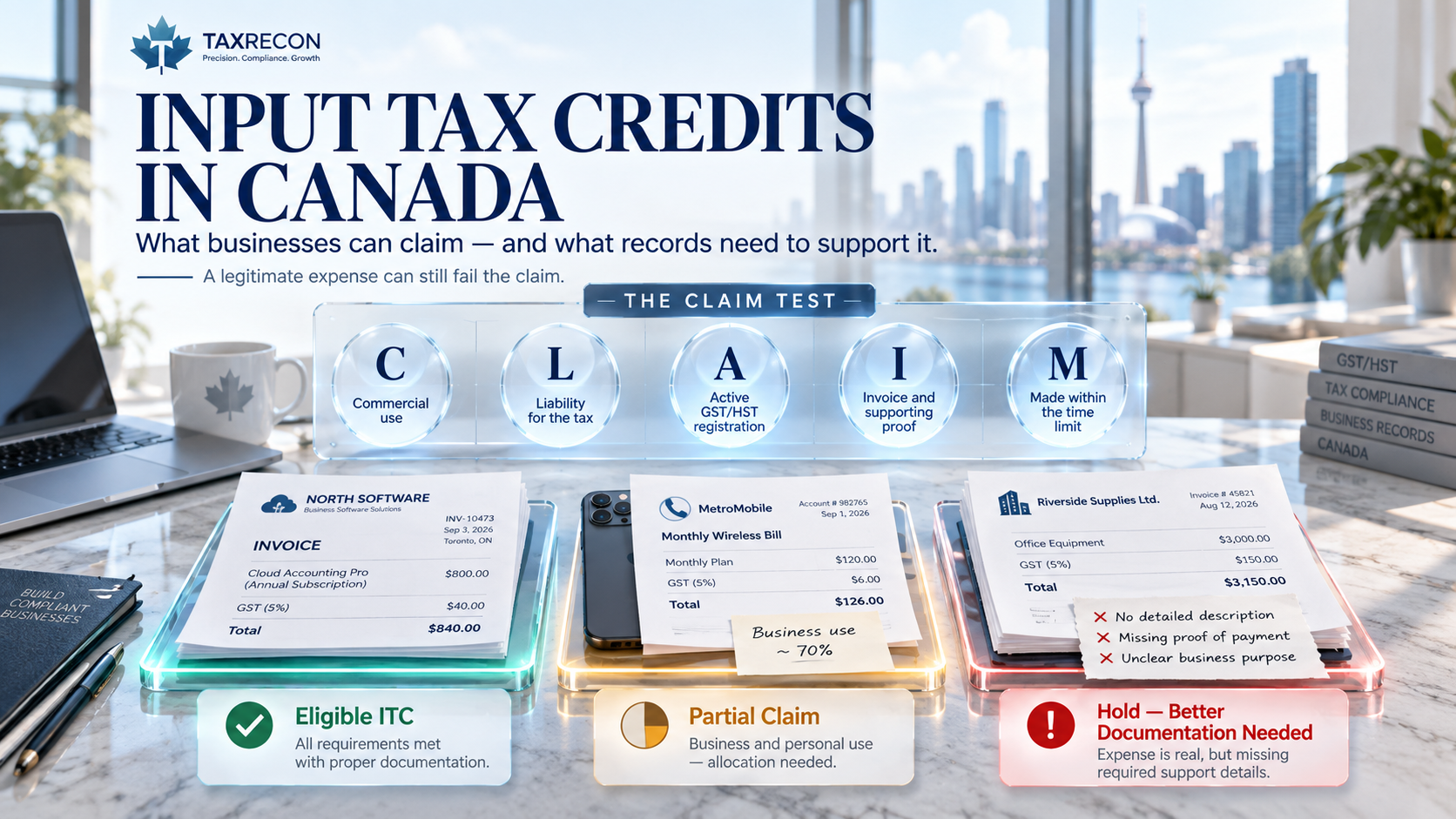
Use the CLAIM Test Before Putting GST/HST on the Return
Five checks can prevent most of the confusion.
C: Commercial use
Was the property or service acquired for your commercial activities?
If an expense is partly personal or supports exempt activities, the full tax amount may not belong in the claim.
L: Liability for the tax
Did your business actually pay, or become liable to pay, the GST/HST connected with the purchase?
A tax amount appearing somewhere in bookkeeping software does not settle that question by itself.
A: Active GST/HST registration
Were you a GST/HST registrant during the relevant reporting period when the tax was paid or became payable?
Registration status matters to the claim.
I: Invoice and supporting proof
Do you already hold the documentation CRA requires?
The paperwork needs to exist before the ITC is claimed.
M: Made within the time limit
Has the claim been made within the applicable ITC period?
Most registrants get a longer period than certain financial institutions and larger businesses, but ITCs cannot simply remain unclaimed indefinitely.
Commercial use. Liability. Active registration. Invoice. Made in time.
That is a much safer ITC check than seeing “HST” beside an expense and automatically claiming it.
Which Business Purchases Can Usually Support an ITC?
CRA lists several common categories that may qualify where the wider ITC conditions are met.
| Purchase or expense | ITC position to check |
| Business start-up costs | May qualify when the applicable conditions are met |
| Commercial rent | GST/HST can generally be considered where the space supports commercial activities |
| Office expenses | Tax on eligible business purchases may qualify |
| Fuel | Business-use portion may qualify |
| Delivery and freight | May qualify when related to commercial activities |
| Repairs and maintenance | Eligible business portion may qualify |
| Legal and accounting fees | GST/HST may qualify when tied to commercial activities |
| Telephone and utilities | Business portion may qualify |
| Motor vehicle expenses | Business use and specific vehicle rules matter |
| Travel | Eligible commercial-use amount may qualify |
| Meals and entertainment | Claim is subject to restrictions |
| Business-use-of-home costs | Specific eligibility and allocation rules apply |
The list is not permission to claim every receipt in those categories.
The use of the expense still matters.
A phone plan used partly for business and partly personally does not become 100% business merely because the invoice is paid from a company bank account.
Which Purchases Commonly Do Not Produce an ITC?
Several categories deserve a second look before filing.
CRA identifies examples such as:
- property or services bought for personal consumption or use
- purchases connected with making exempt supplies
- certain capital property
- memberships in clubs mainly providing recreation, dining or sporting facilities, unless acquired for resale in the ordinary course of business
Another obvious situation is where no GST/HST was charged in the first place.
Insurance, wages, certain financial services and many other payments do not suddenly produce an ITC merely because they are valid business costs.
That distinction is worth remembering:
Business expense does not automatically mean ITC-eligible expense.
Income-tax deductibility and GST/HST recovery are connected in some places, but they are not the same calculation.
What Records Does CRA Expect Before You Claim an ITC?
CRA’s current ITC documentation table changes the required information as the total sale gets larger.
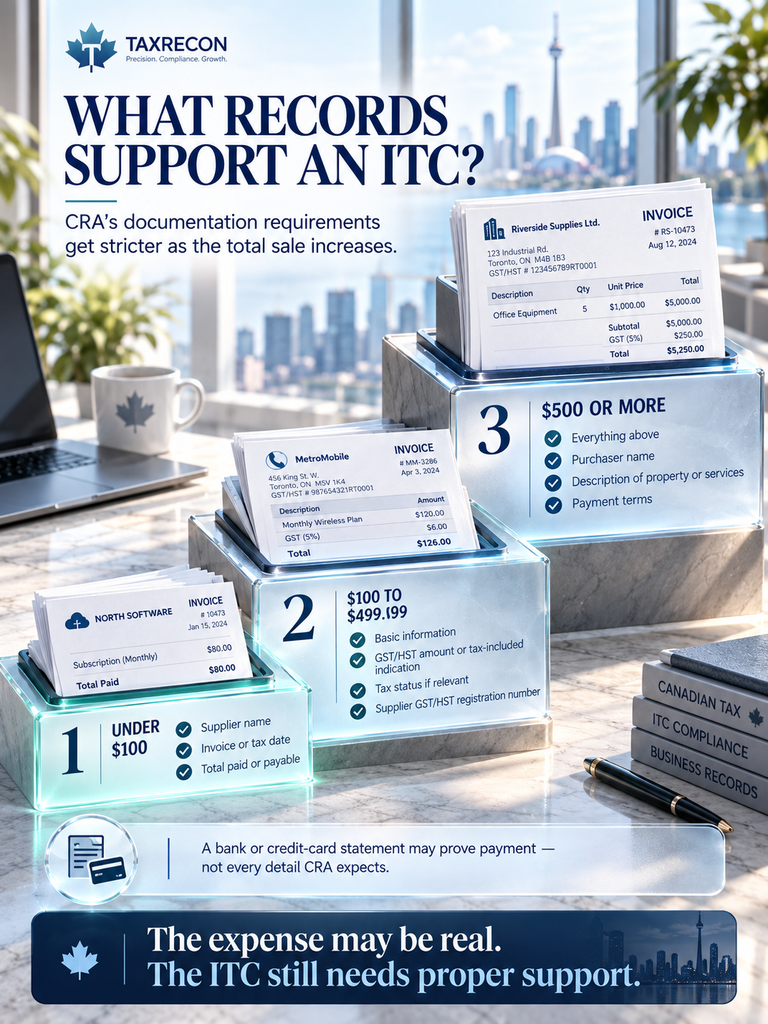
Current CRA documentation bands
| Total sale | Main information CRA currently expects |
| Under $100 | Supplier business/trading name, invoice or tax date, total paid or payable |
| $100 to $499.99 | Basic information plus GST/HST amount or tax-included indication, tax status where relevant, and supplier GST/HST registration number |
| $500 or more | Everything above plus purchaser name, description of property/services and payment terms |
These are the bands displayed on CRA’s current ITC page.
The $500 level is where many weak invoices become more visible.
Imagine a supplier sends your corporation a $1,130 invoice.
The invoice shows:
- supplier name
- date
- total
- HST amount
But it does not show the supplier’s GST/HST registration number, your business name or a useful description of what was purchased.
The expense may be real.
The bookkeeping entry may be correct.
The documentation still needs attention before you treat the ITC as properly supported.
A bank or credit-card statement is not always enough
A statement can prove that money moved.
It may not prove everything CRA expects about the underlying taxable supply.
That is why TaxRecon’s Bookkeeping Services connect transactions back to invoices, receipts, reconciliations and other supporting records instead of treating a downloaded bank line as the complete accounting evidence.
What Happens When an Expense Is Partly Business and Partly Personal?
Mixed use changes the calculation.
For ordinary operating expenses, the claim generally follows the portion used in commercial activities, subject to CRA’s specific percentage rules.
Suppose an Ontario business has an eligible operating expense containing $130 of HST and only 70% of the expense relates to commercial activities.
The business should not automatically claim the entire $130 merely because the company paid the bill.
The commercial-use rules need to be applied.
Capital property can work differently. Vehicles, equipment and real property can have separate percentage tests and change-in-use rules.
CRA’s current ITC calculation guidance also explains restrictions for meals and entertainment, employee reimbursements and other situations.
The practical rule is simple:
Do not use one ITC percentage for every type of expense.
Identify the property or service first, then apply the rule that belongs to it.
Why Does the Quick Method Change the ITC Answer?
Businesses using the GST/HST Quick Method need a different conversation.
Under the Quick Method, registrants generally do not claim ordinary operating-expense ITCs separately because the remittance-rate system is designed differently.
Certain purchases can still produce ITCs, including some qualifying capital purchases.
So this logic can be wrong:
“We paid HST on it, therefore we claim the HST.”
The accounting method comes first.
TaxRecon’s guide to GST/HST Quick Method vs Regular Method explains how an Ontario service business can compare the two methods using actual ITCs rather than broad expense percentages.
Why Bookkeeping and ITCs Need to Agree
ITCs eventually come from transactions sitting inside the books.
That makes bookkeeping errors GST/HST errors surprisingly quickly.
Common examples include:
- an expense entered twice
- net merchant deposits recorded without processing fees
- tax coded to a transfer
- HST claimed on a personal purchase
- an invoice recorded without its supporting document
- an expense moved to the wrong GST/HST code
- an old receipt claimed twice during a cleanup
- supplier credits not reflected in the return
Bank reconciliation does not prove ITC eligibility, but it helps establish whether the underlying transaction exists once, in the correct period, for the correct amount.
If bank activity itself does not agree with QuickBooks, TaxRecon’s guide to QuickBooks bank balances not matching the statement is the better starting point.
Why Small Documentation Problems Matter
Canadian businesses are already watching costs closely.
Statistics Canada’s August 2026 survey found that 59.8% of Canadian businesses expected cost-related obstacles over the following three months.
See the current Statistics Canada Q3 2026 business conditions release.
That does not change a single ITC rule.
It does make both sides of the problem worth taking seriously.
Missing a legitimate ITC can leave recoverable GST/HST unclaimed.
Claiming an unsupported ITC can create a different problem if CRA reviews the return.
The goal is not to claim the biggest number.
It is to claim the right number with the records behind it.
How Long Do Businesses Have to Claim an ITC?
Most registrants do not lose an eligible ITC simply because it was missed on the first possible GST/HST return.
CRA generally allows most registrants to claim an overlooked ITC on a later return, provided the claim falls within the applicable time limit.
For most registrants, that period is generally four years.
The period drops to two years for certain listed financial institutions and certain businesses that meet CRA’s larger-business conditions.
Do not translate “four years” into “I can deal with the receipt later.”
Older claims become harder to reconstruct when:
- supplier invoices disappear
- businesses close
- accounting systems change
- staff leave
- records move between bookkeepers
- nobody remembers the business purpose
The better habit is to deal with the ITC in the correct period while the evidence is still easy to retrieve.
Illustrative Example: The Expense Is Real, but Is the ITC Ready?
Picture a London, Ontario consulting company reviewing a quarterly GST/HST return.
Its accounting file contains three purchases.
Purchase 1: Commercial software
The subscription is used entirely for taxable consulting work.
The supplier invoice shows the required tax details.
This looks like a straightforward ITC candidate.
Purchase 2: Phone bill
The owner uses the phone for business and personal calls.
The business-use portion needs to be considered instead of automatically claiming all of the HST.
Purchase 3: Large supplier invoice
The company paid the invoice and recorded the expense correctly.
The document is missing information CRA expects at that invoice level.
Before filing, the company should obtain better supporting documentation rather than assuming the bank payment proves the ITC.
Same business.
Same GST/HST return.
Three different ITC decisions.
That is why good GST/HST filing happens transaction by transaction, not by applying one rule to an entire expense report.
What Businesses Most Often Get Wrong
“Every expense with HST gets an ITC”
No.
Registration, commercial use, documentation and other restrictions still matter.
“The credit-card statement proves the claim”
It proves the payment more readily than it proves the entire taxable supply.
Keep the invoice or other suitable supporting record.
“Personal use does not matter because the company paid”
Who paid the bill does not automatically decide the commercial-use percentage.
“The invoice is in QuickBooks, so the record is complete”
Accounting software stores data.
It does not make missing supplier information appear.
“We can claim it now and find the document later”
CRA expects sufficient documentary evidence before the ITC is claimed.
Do this: confirm eligibility and supporting documents before filing.
Not that: claim every GST/HST-coded transaction and wait to see whether CRA asks questions.
Use This Five-Step ITC Review Before Filing
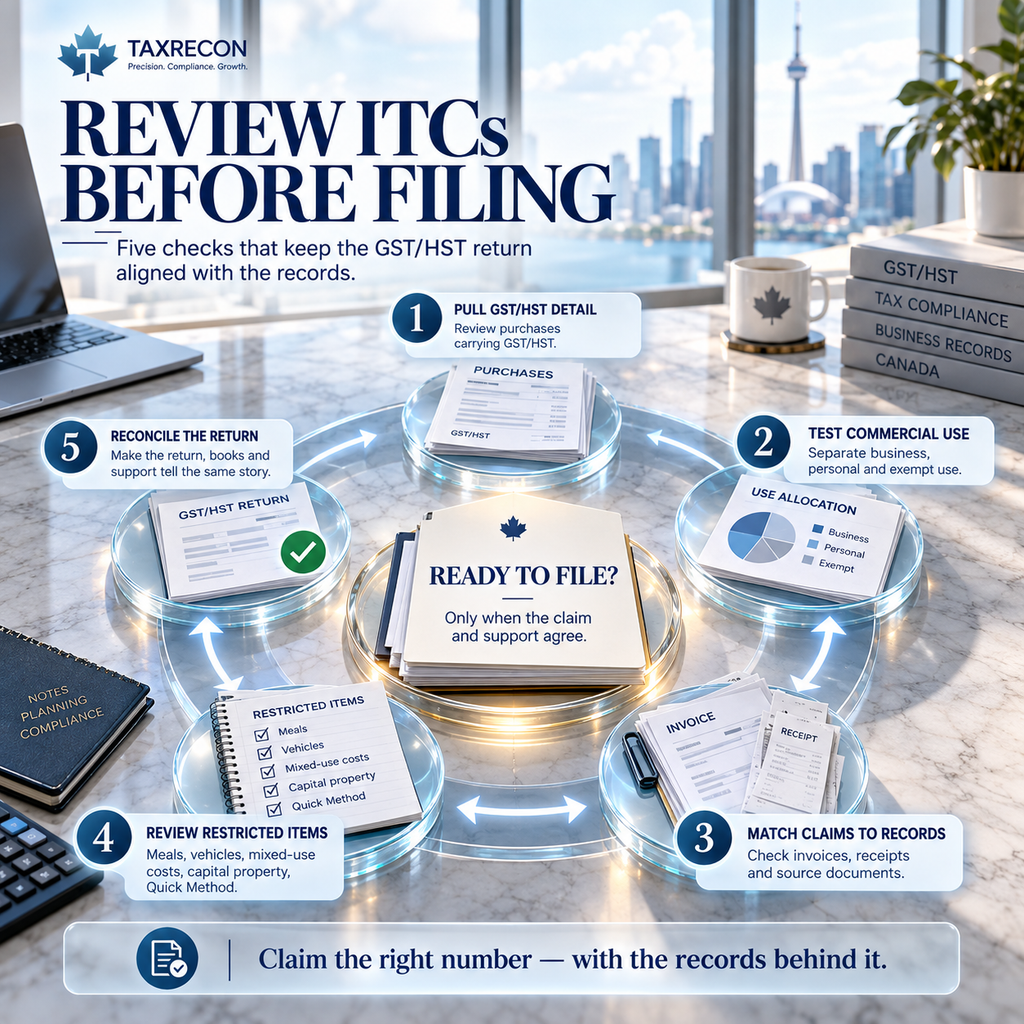
1. Pull the GST/HST detail from the books
Review purchases carrying GST/HST for the reporting period.
2. Test commercial use
Separate business activity from personal use and exempt activity.
3. Match material claims to supporting records
Check the invoice or other source document rather than relying only on the bookkeeping description.
4. Review restricted or unusual expenses
Look more closely at meals, vehicles, mixed-use costs, capital property and Quick Method treatment.
5. Reconcile the return to the accounting records
The GST/HST return, purchase ledger and supporting documents should tell the same financial story.
If they do not, investigate the difference before filing another return on top of it.
Where TaxRecon Fits
ITC problems rarely begin on the GST/HST filing screen.
They usually begin earlier, with an invoice, tax code, missing receipt, unreconciled account or misunderstanding about business use.
TaxRecon reviews GST/HST filing in that wider context: what the business paid, what the purchase was for, what the records show and what can actually be supported.
That approach matters most when returns are behind, ITCs look unusually high, supporting documents are incomplete or the bookkeeping and GST/HST account no longer agree.
Final Thoughts
Input tax credits are one of the most useful parts of Canada’s GST/HST system, but the claim needs more than a tax amount beside an expense.
Start with the purchase.
Ask whether it belongs to commercial activity, whether your business was entitled to the tax, whether the supporting document meets the current requirements and whether the claim is still within time.
Those checks make input tax credits Canada compliance much easier to defend.
The best ITC file is not the one claiming the most GST/HST.
It is the one where someone can open the records months later and clearly see why each material claim belonged on the return.
For connected bookkeeping, tax and GST/HST support, visit TaxRecon Canada.
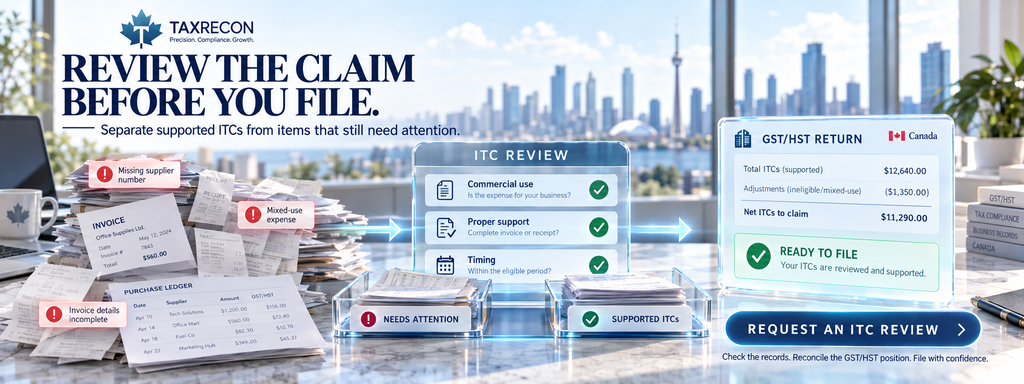
Need to Review Your ITCs Before the Next GST/HST Return?
If the return is approaching but the ITC total is difficult to trace back to invoices and business use, review the records before filing.
TaxRecon can help separate supported claims from items that need more information, reconcile the GST/HST position and identify what should be fixed before the next return is submitted.
Frequently Asked Questions About Input Tax Credits in Canada
Who can claim input tax credits in Canada?
GST/HST registrants may claim ITCs when they meet the CRA conditions for an eligible purchase or expense. The property or service must relate to commercial activities, GST/HST must have been paid or payable by the registrant, sufficient records must support the claim, and the applicable filing deadline must be met.
Can a business claim an ITC without a receipt?
Not simply because the transaction appears in the bank account. CRA requires sufficient documentary evidence before an ITC is claimed. The acceptable support can include invoices, receipts, contracts and other qualifying business records, but the required information depends on the transaction and circumstances.
What information does CRA require on an invoice for an ITC?
The required information increases with the transaction value. CRA’s current bands are under $100, $100 to $499.99, and $500 or more. Higher-value purchases require additional details, including the supplier’s GST/HST registration number and, at $500 or more, purchaser and transaction information.
Can I claim GST/HST on business meals?
Only the allowable amount should be claimed. Meals and entertainment are subject to special restrictions, and the standard treatment often limits the recoverable GST/HST rather than allowing the entire tax amount. Different rules can apply in particular situations, so the expense type and circumstances should be reviewed before filing.
Can I claim an ITC on an expense that is partly personal?
Only the eligible commercial-use portion may be available in many mixed-use situations, and specific rules apply to different types of property. Capital property and vehicles can follow rules that differ from ordinary operating expenses, so do not apply one simple personal-use percentage to every purchase.
Can a business claim ITCs on purchases used to make exempt supplies?
Generally, purchases used to make exempt supplies do not produce ordinary ITCs because exempt activities are not commercial activities for this purpose. Businesses carrying on both taxable and exempt activities may need to allocate expenses so only the eligible commercial portion feeds into the ITC calculation.
Can a business using the Quick Method still claim ITCs?
Yes, but not in the same way as a business using the Regular Method. Quick Method users generally cannot claim ordinary operating-expense ITCs separately, while certain capital purchases can still qualify. The business should identify its GST/HST accounting method before reviewing individual expense claims.
How far back can I claim missed input tax credits?
Most registrants generally have four years under the CRA’s ITC time-limit rules. Certain listed financial institutions and businesses meeting specified conditions face a two-year limit. The exact deadline is tied to reporting periods, so older ITCs should be checked rather than assumed to remain available.
Does TaxRecon review ITC supporting documents before GST/HST filing?
TaxRecon’s GST/HST service includes reviewing available purchase information and supporting records when ITCs form part of the return. The scope can also include GST/HST reconciliation where the filing numbers do not agree with bookkeeping or prior returns.
Can TaxRecon help if my bookkeeping and ITC totals do not agree?
Yes. The first step is identifying whether the difference comes from missing transactions, coding, documentation, reconciliation or the GST/HST filing itself. Bookkeeping and GST/HST are separate responsibilities, but TaxRecon can connect the two when the underlying records affect the return.