
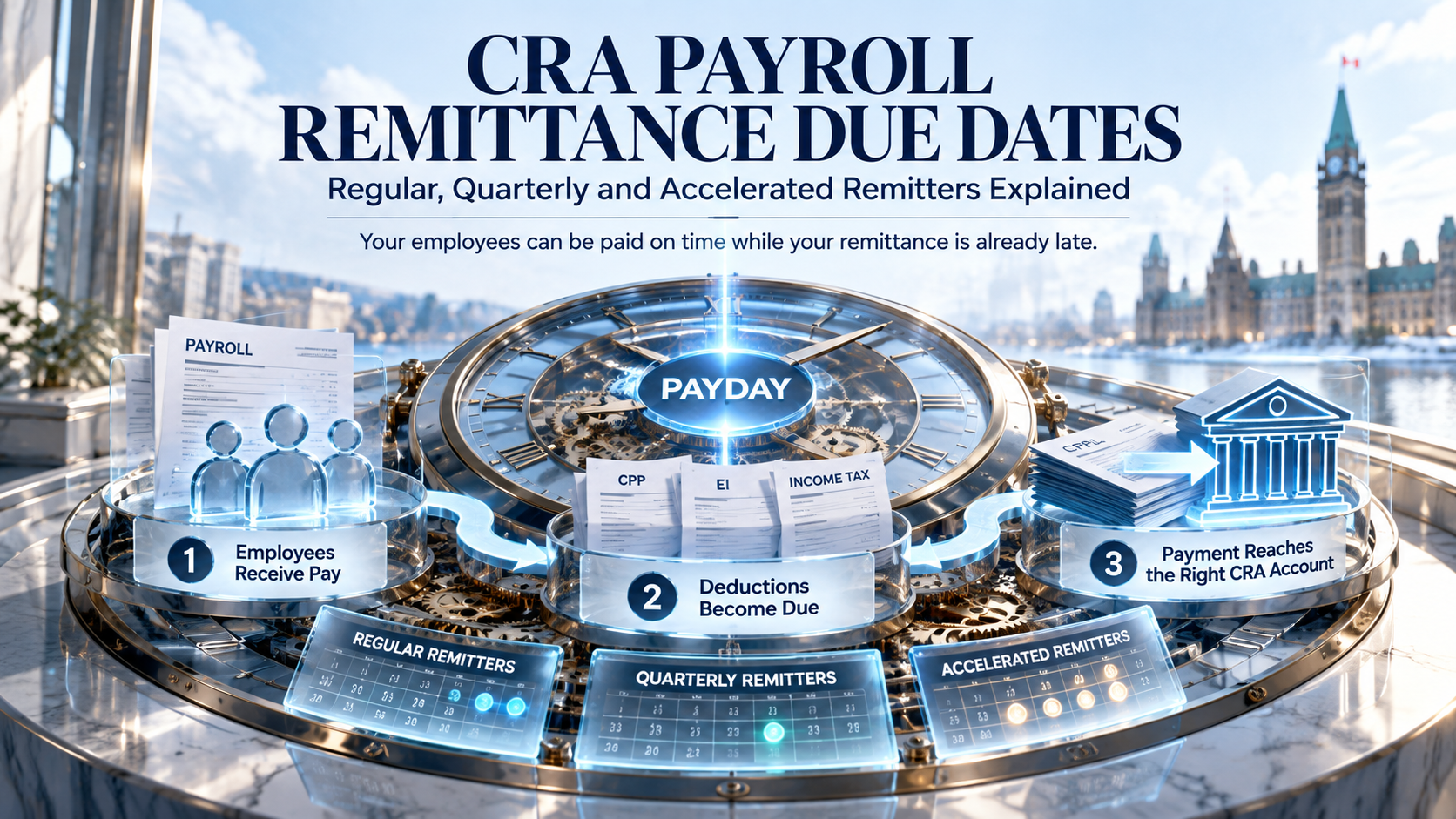
Your employees can be paid on time while your CRA remittance is already late.
Payroll remittance due dates depend on your remitter type and when you paid your employees. Regular remitters usually remit by the following month’s 15th. Eligible quarterly remitters pay after each calendar quarter. Accelerated remitters have shorter deadlines that can arrive within the same month.
The mistake is treating “payroll completed” as one event.
There are three separate checkpoints: employees receive their pay, the payroll deductions become due, and the payment reaches the right CRA account.
TaxRecon’s payroll services connect those checkpoints with the payroll records, employer contributions and year-end reporting behind them.
Key Takeaways
- Confirm your remitter type first. Your number of employees does not determine the deadline.
- Use the actual payday. The period employees worked may belong to a different month.
- Quarterly remitting requires eligibility. A small payroll alone does not establish quarterly status.
- Check the payment’s effective date. Scheduling a transfer is not always the same as paying on time.
Find Your Payroll Remittance Due Date
Start with your current CRA payroll account information, then match your remitter type to the table.
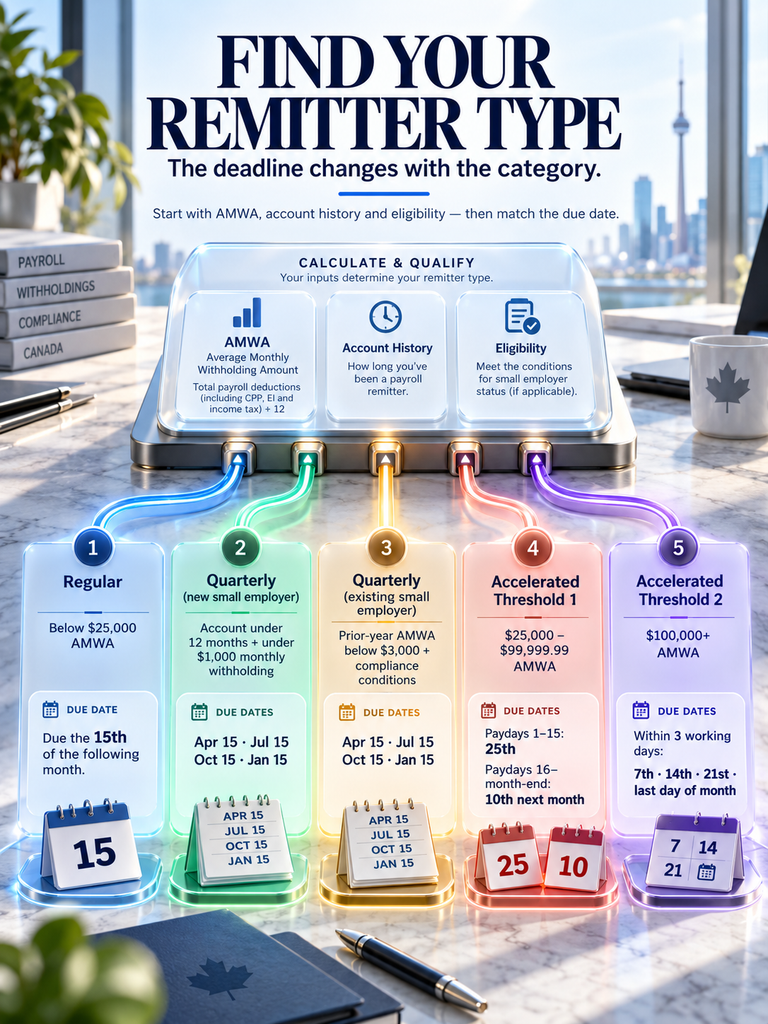
| Remitter type | Main qualification to check | Remittance deadline |
| Regular | Average monthly withholding amount below $25,000, unless another category applies | The 15th of the month after the month employees were paid |
| Quarterly: new small employer | Payroll account open for less than 12 months, monthly withholding below $1,000 and required compliance conditions | April 15, July 15, October 15 and January 15 |
| Quarterly: existing small employer | Applicable prior-year AMWA below $3,000, account-history and compliance conditions | April 15, July 15, October 15 and January 15 |
| Accelerated: threshold 1 | AMWA from $25,000 to $99,999.99 | Paydays from the 1st–15th: the 25th of that month. Paydays from the 16th–month-end: the 10th of the following month |
| Accelerated: threshold 2 | AMWA of $100,000 or more | Within three working days after each remitting period ends: the 7th, 14th, 21st and last day of the month |
These are the standard categories. Confirm any CRA instructions specific to your account. The CRA’s payroll remittance due-date guidance also explains weekend adjustments, nil remittances and special situations.
Which Number Determines Your Remitter Type?
The key figure is usually your average monthly withholding amount, or AMWA, from two calendar years earlier.
For the general 2026 classification, that means looking at 2024. For 2027, the general lookback is 2025.
The calculation is:
Total required payroll remittances for the reference year ÷ number of months requiring a remittance, up to 12
Use the required remittance amounts, including applicable employer CPP and EI contributions. Do not substitute gross wages, employee take-home pay or only the amounts you happened to send.
For example, required remittances of $36,000 across 12 months produce an AMWA of $3,000. That is below the regular-remitter ceiling, but it is not below the $3,000 quarterly threshold.
CRA normally reviews payroll accounts each November and notifies employers in writing when their remitter type changes. Multiple payroll accounts and associated corporations can affect the calculation, so do not assess one account in isolation.
Why headcount is a poor shortcut
A business can keep the same employees while wages, bonuses and required deductions change.
Statistics Canada reported that average weekly earnings increased 3.4% year over year in June 2026, in its August 27, 2026 payroll employment release.
That national result does not change your CRA classification. It does show why “we still have the same team” is not a substitute for checking your actual withholding history.
Can Your Business Remit Quarterly?
Quarterly remitting has two different entry routes.
New small employers
If your payroll account has been open for less than 12 months, you may qualify when your monthly withholding amount stays below $1,000 and you meet the required compliance conditions.
That is a monthly test, not a quarterly allowance.
Eligible new small employers do not have to apply separately. However, confirm that you meet the conditions and follow any CRA notice assigning a different frequency.
Existing employers
Established small employers need to meet the applicable AMWA test, have sufficient payroll-account history and maintain a perfect compliance record.
That record extends beyond sending payroll payments on time. Payroll deductions, remittances, T4-type returns and relevant GST/HST obligations can all matter.
Existing employers who qualify receive written notification. If you believe you now qualify, request a CRA review rather than simply stopping your monthly remittances. The CRA Employers’ Guide explains the eligibility and review process.
One Payday Can Produce Four Different Deadlines
The work period does not set the remittance clock. Payday does.

The CRA Employers’ Guide states that remittance due dates are based on:
“when an employee is paid for their services (payday)”
This matters whenever payroll crosses a month-end or a remitting-period boundary.
Consider an illustrative employer paying wages on Friday, September 18, 2026, for work completed earlier in September.
| Employer’s confirmed remitter type | How that payday fits the schedule | Due date |
| Regular | September payroll | October 15, 2026 |
| Eligible quarterly | July–September quarter | October 15, 2026 |
| Threshold 1 | September 16–30 remitting period | October 13, 2026 |
| Threshold 2 | September 15–21 remitting period | September 24, 2026 |
Why October 13 for threshold 1? The standard October 10 deadline falls on a Saturday, and Monday, October 12 is Thanksgiving, a CRA-recognized holiday.
For threshold 2, count three working days after September 21: September 22, 23 and 24. The count starts after the remitting period ends, not automatically after the employee’s payday.
The same payroll payment can therefore create very different deadlines. Copying another business’s calendar is not a reliable control.
Your Remaining 2026 Regular-Remitter Calendar
For regular remitters, these dates cover payroll paid during the final months of 2026.
| Month employees are paid | Remittance due date |
| September 2026 | Thursday, October 15, 2026 |
| October 2026 | Monday, November 16, 2026 |
| November 2026 | Tuesday, December 15, 2026 |
| December 2026 | Friday, January 15, 2027 |
November’s date moves because November 15 falls on a Sunday.
For eligible quarterly remitters, the July–September quarter is due October 15, 2026, and the October–December quarter is due January 15, 2027.
These dates apply the standard CRA rules. Check recognized holidays and any account-specific instructions before authorizing payment.
December payroll does not wait for T4 filing season. Its remittance deadline follows your remitter category even though the annual information return comes later.
What Amount Goes With the Deadline?
The remittance is not your employees’ net pay, and it is not simply the tax withheld.
For ordinary payroll outside Quebec, the total generally includes:
Income tax withheld + employee CPP and EI deductions + applicable employer CPP and EI contributions
Use the actual payroll calculation for the employees and payments involved. Ownership status, age, pensionable employment, insurable employment and other circumstances can change individual deductions.
TaxRecon’s guide to the 2026 Ontario payroll deduction tables addresses the calculation side, including year-to-date deduction checks.
Keep the two questions separate:
How much must we remit? comes from payroll calculations.
When must we remit it? comes from the remitter category and payday.
Quebec employers also have separate provincial payroll obligations. A CRA remittance does not settle amounts payable to Revenu Québec.
Does Scheduling a Payment on the Due Date Count?
Not necessarily. The effective payment date depends on the method.
CRA’s published treatment includes:
| Payment method | Timing point to check |
| Online or telephone banking | The date the financial institution credits CRA |
| Payment at a financial institution | The date stamped on the remittance voucher |
| CRA My Payment | Generally the same business day, or the following business day |
| Pre-authorized debit | The scheduled negotiable date |
| Third-party payment provider | The provider’s processing and effective-payment rules |
| Mailed payment | The date CRA receives it |
Online banking and CRA My Payment are different services. Do not assume their cut-offs or processing rules are interchangeable.
Threshold 2 employers also have specific financial-institution remittance requirements. Confirm an acceptable payment route rather than assuming every method works for every remitter.
Before sending money, check the payroll program account. It combines your nine-digit business number with RP and a four-digit reference, such as RP0001.
A payment intended for payroll should not accidentally go to the GST/HST or corporation-income-tax account.
Keep Three Dates, Not One Reminder
A useful payroll control records:
Employee payday → CRA due date → payment’s effective date
Add the amount, payroll account and confirmation reference beside them.
This is more dependable than a calendar reminder labelled “Pay CRA” because it shows which payroll created the obligation and whether the payment met it.
Use this five-step routine:
- Confirm the remitter category. Check the CRA account and current notices.
- Group payroll by actual payment date. Include relevant bonuses and off-cycle payments.
- Reconcile the amount. Compare employee deductions and employer contributions with the payroll liability.
- Authorize payment early enough. Account for the chosen method’s cut-off and processing time.
- Confirm the account entry. Match the payment evidence to CRA’s payroll-account activity and retain the record.
If the bank withdrawal does not match the accounting entry, TaxRecon’s guide to QuickBooks bank balances not matching the statement can help investigate the bookkeeping difference.
A bank reconciliation and a CRA-account check serve different purposes. Completing one does not replace the other.
What Happens When There Is No Payroll?
Do not leave an active payroll account unexplained.
If you made no source deductions for the relevant remitting period, report a nil remittance by the deadline for your remitter type. Tell CRA when deductions are expected to resume.
For seasonal businesses, that may mean providing an expected restart date rather than letting each quiet period look like a missing payment.
Do not report nil merely because cash is unavailable. If you made source deductions during the period, the remittance obligation still needs to be addressed.
Closing the business is different again. A business that stops operating generally has a final-remittance deadline within seven calendar days, rather than its ordinary monthly or quarterly date. Other business changes can also trigger special rules.
Already Late? Separate the Payment Problem From the Record Problem
First establish what happened.
Was the payment never authorized? Did the bank process it later than expected? Was the amount wrong? Did it reach another CRA program account?
Check the payroll period, amount, bank evidence and CRA account before creating another payment that could duplicate money already sent.
Where a genuine shortfall exists, address it promptly and contact CRA when payment arrangements or clarification are needed.
The standard late-remittance penalty percentages are:
| Delay | Standard penalty percentage |
| One to three days | 3% |
| Four or five days | 5% |
| Six or seven days | 7% |
| More than seven days, or no remittance | 10% |
The penalty base matters. CRA generally applies this penalty only to the portion exceeding $500, unless the failure was knowing or amounted to gross negligence.
The 20% penalty is not automatic for every second mistake. It applies to a second or subsequent assessment in the same calendar year when the failures were made knowingly or under circumstances of gross negligence. Interest can also apply and compounds daily.
When an unexplained balance or notice is already involved, TaxRecon’s CRA compliance services can help trace the account, period, payments and supporting records.
Three Assumptions Worth Removing From Your Payroll Process
“We are small, so the 15th must be our deadline.”
Size is not the test. Check your actual remitter category, including the effect of associated corporations.
“The software says payroll is complete.”
That may confirm calculations or employee payments. Check whether the engagement also includes sending source deductions to CRA, whether funding succeeded and which deadline the provider uses.
“We will clear everything up with the T4s.”
Annual reporting does not replace periodic remittances. Waiting for T4 preparation can leave deductions unpaid long after their original due date.
Do this: assign responsibility for calculation, payment authorization and confirmation.
Not that: assume “payroll handled” means all three happened.
Final Thoughts: The Deadline Starts With Payday
Payroll remittance due dates become easier to manage when you stop treating them as one recurring calendar entry.
Start with the actual payday. Apply the confirmed remitter category. Then choose a payment method that reaches the right payroll account on time.
The strongest control is not another reminder. It is a record showing what was due, when it was due and how you confirmed payment.

Bring your latest payroll summary, CRA remitter information and any unexplained balance to TaxRecon for a payroll review. Establish what needs attention before the next pay run carries the same uncertainty forward.
Frequently Asked Questions
If I pay employees every two weeks, do I remit every two weeks?
Not automatically. Employee pay frequency and CRA remitting frequency are separate. A regular remitter can pay employees biweekly but remit the month’s deductions by the following month’s 15th. An accelerated remitter groups those paydays into its applicable remitting periods.
Do bonuses follow a different remittance deadline?
Generally, a bonus joins the remitting period containing its payment date. The withholding calculation may differ from ordinary wages, but that does not create a separate annual payment deadline. Include the bonus in the relevant payroll totals and use your confirmed remitter schedule.
Can I pay CRA earlier than required?
Yes. CRA accepts remittances more frequently than your assigned schedule requires. Paying early does not, by itself, change your remitter classification. Keep a running reconciliation so partial or frequent payments add up to the full amount required for the period.
Can I request a lower remittance frequency?
Yes, where you meet the relevant conditions. Eligible regular remitters can request a quarterly-status review. Accelerated remitters may request a review when the previous year’s AMWA would support a lower frequency. Continue following the applicable schedule until the change is confirmed.
Do I need a paper PD7A before making a payment?
No. A missing paper statement does not extend the deadline. Electronic payment options do not require you to wait for a mailed voucher. Confirm the correct payroll account, remitting period and payment instructions before proceeding. PD7A statements remain useful for checking account activity.
Must payroll payments over $10,000 be electronic?
Generally, payments or remittances exceeding $10,000 must be electronic unless the payer cannot reasonably pay electronically. Separate threshold 2 requirements can also apply. Confirm both the permitted method and the effective payment date before sending a large remittance.
Does outsourcing payroll remove my responsibility for remittances?
No. Using a provider does not eliminate the employer’s responsibility. Confirm who calculates deductions, who releases funds, who submits the remittance and who checks that it reached CRA. The service agreement should make those responsibilities clear rather than relying on the phrase “full-service payroll.”
Can TaxRecon help when payroll and CRA show different totals?
Yes. TaxRecon can review the payroll calculations, employer contributions, remittance history and relevant CRA records within the agreed engagement. Start with the affected period, latest payroll summary, payment confirmations and any CRA notice so the difference can be traced rather than guessed.