Your corporation made no sales, issued no invoices, and may not have touched its bank account all year. It would be reasonable to wonder why a corporate tax return is still necessary.
For most Canadian resident corporations, the answer is simple: the T2 filing requirement does not disappear because the business stopped operating or earned no income.
The Canada Revenue Agency specifically includes inactive corporations among the corporations that must file a T2 return for every tax year, even when no tax is payable.
That distinction matters if you incorporated a business that never launched, stopped operating but kept the corporation open, paused between contracts, or simply assumed “no income” meant “no return.”
At TaxRecon, corporate filings are reviewed in the context of the records and CRA position behind them, rather than treating a T2 as an isolated form.
Key Takeaways
- An inactive Canadian resident corporation generally still has to file a T2 return every tax year.
- Having no revenue does not automatically mean your corporation has no filing requirement.
- A T2 is generally due within six months after the corporation’s tax year-end.
- A truly inactive corporation with no balance-sheet or income-statement information may have a simpler filing than an active corporation.
- Leaving the corporation open means the annual T2 filing obligation normally continues until the corporation is properly dissolved.
- If old inactive years were never filed, deal with the missing years in order rather than waiting for another CRA notice.
Does an Inactive Corporation Have to File a T2 in Canada?
Yes. Most resident corporations in Canada must file a T2 Corporation Income Tax Return for every tax year even if the corporation was inactive and no tax is payable.
CRA lists inactive corporations directly within its corporate filing requirements. The main resident-corporation exceptions include tax-exempt Crown corporations, Hutterite colonies, and corporations that were registered charities throughout the year.
CRA’s T2 guide states the rule even more directly:
“Even if a corporation is inactive … it has to file a return.”
See CRA’s T2 guidance for inactive corporations
The key point is that the filing obligation is generally connected to the corporation’s continued legal and tax existence, not simply to how much revenue it earned.
That is different from the way many business owners think about personal tax filings.
Once you incorporate, the corporation becomes its own taxpayer. A quiet year does not make the corporation disappear.
What Does “Inactive Corporation” Actually Mean?
CRA describes an inactive corporation on the T2 as one that has not operated during the tax year.
That makes an important distinction.
No revenue does not always mean inactive
Suppose the corporation earned $0 but still had:
- bank fees
- accounting fees
- software subscriptions
- professional fees
- loan activity
- shareholder transactions
- interest
- asset purchases or sales
- GST/HST activity
- payroll activity
You should not automatically treat that corporation as a completely dormant, zero-activity company simply because revenue was nil.
There may still be financial information to report.
Truly inactive may be much simpler
CRA says an inactive corporation that remained inactive throughout the tax year and has no balance-sheet or income-statement information to report does not have to attach T2 Schedules 100, 125, and 141. CRA will still accept those schedules if they are filed.
That is one of the useful differences between a genuinely inactive corporation and a corporation that simply had a bad or quiet year.
Inactive, Zero Revenue, or Operating at a Loss: They Are Not the Same
Business owners often use these terms interchangeably.
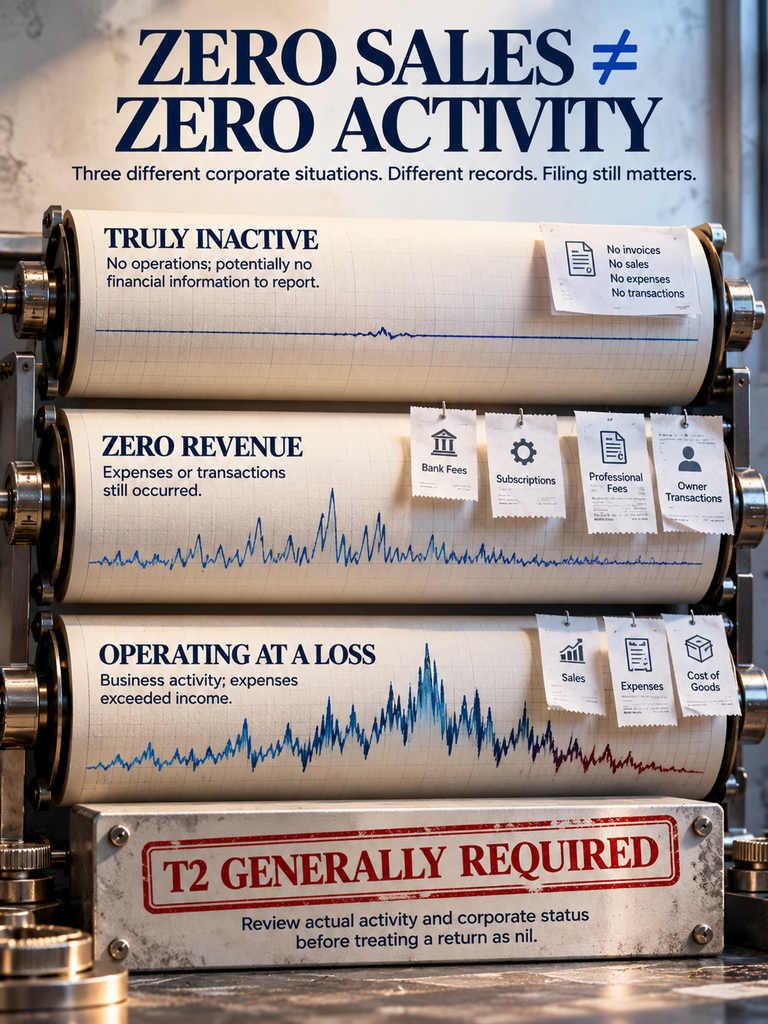
They should not.
| Situation | What Happened During the Year? | T2 Filing Position |
| Truly inactive corporation | No operations and potentially no financial activity to report | T2 still generally required |
| Zero-revenue corporation | No sales, but expenses or transactions may exist | T2 required and financial information may still need reporting |
| Loss corporation | Business operated but expenses exceeded income | T2 required |
| Corporation between contracts | Little or no revenue but the corporation still exists and may have costs | T2 generally required |
| Newly incorporated but never launched | Corporation legally exists even though business never started | T2 generally required for its tax year |
| Permanently dissolved corporation | Corporation has legally ended | Final corporate filing rules apply |
The practical lesson is simple:
Do not decide whether you need a T2 by looking only at revenue.
Start with whether the corporation still legally exists and what actually happened during its tax year.
What Is a “Nil T2 Return”?
People often search for a “nil T2” or “zero corporate tax return.”
Those phrases are useful shorthand, but they can create the impression that CRA has a completely different tax return specifically for dormant companies.
It does not.
You are still dealing with a T2 Corporation Income Tax Return.
What changes is the financial information, schedules, and tax calculations required based on the corporation’s circumstances.
For a company that truly had no operations, no income, and no financial statement information to report, the filing can be much simpler.
For a company that had no sales but still paid bills, held assets, owed money, had shareholder balances, or used a bank account, the return may require more information.
That is why “my corporation made zero dollars” is not enough information to decide how the return should be prepared.
When Is an Inactive Corporation’s T2 Due?
The normal corporate filing deadline still applies.
A T2 return is generally due within six months after the end of the corporation’s tax year. CRA T2 Corporation Income Tax Guide
Common examples
| Corporate Year-End | T2 Filing Deadline |
| December 31 | June 30 |
| March 31 | September 30 |
| June 30 | December 31 |
| August 31 | End of February |
If the due date lands on a Saturday, Sunday, or CRA-recognized public holiday, CRA’s normal next-business-day rules can apply.
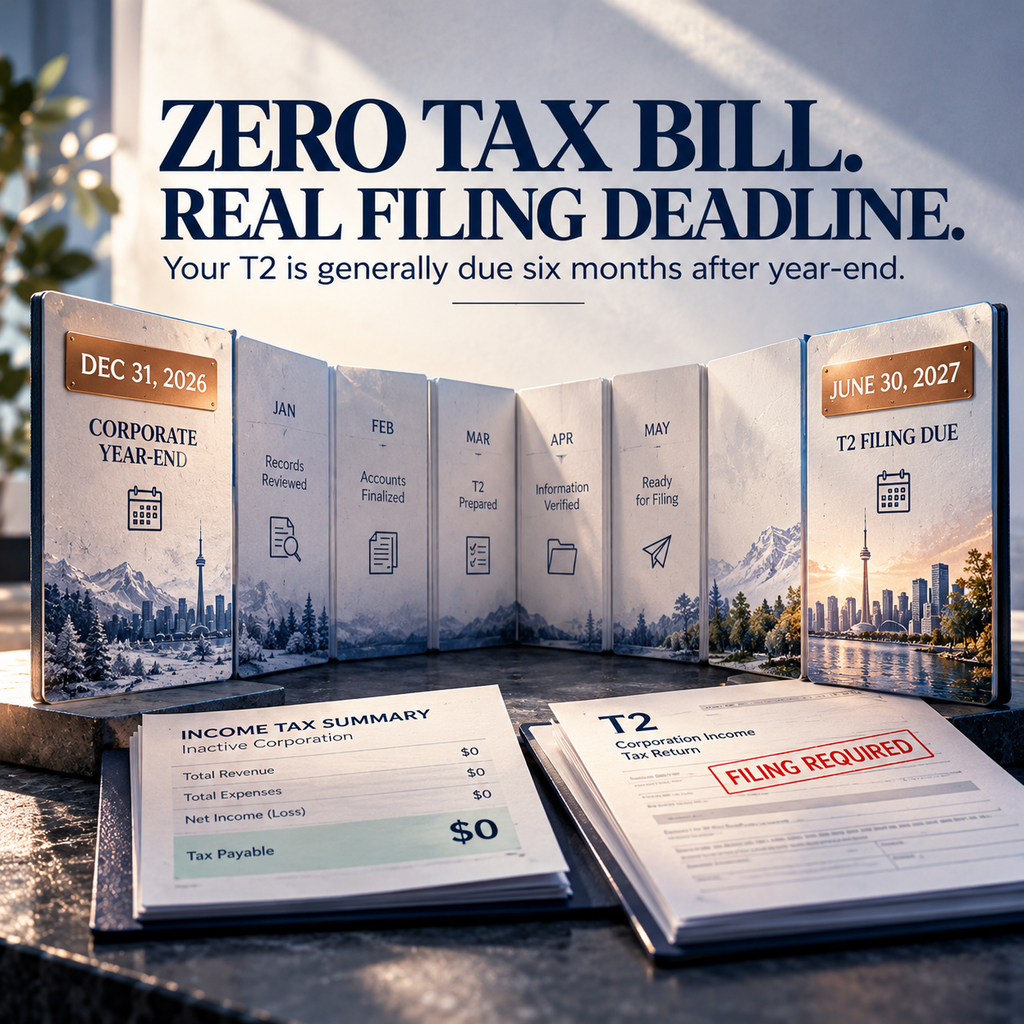
Your filing deadline and payment deadline are different concepts
An inactive corporation with no tax payable may have nothing to pay.
That does not cancel the filing deadline.
This is one reason business owners get caught. They think:
“There is no tax bill, so nothing is due.”
The return can still be due even when the tax payable is zero.
How Does an Inactive Corporation File Its T2?
For tax years starting after 2023, corporations generally have to file T2 returns electronically, subject to CRA’s listed exceptions. CRA currently identifies exceptions for certain insurance corporations, non-resident corporations, corporations reporting in functional currency, and corporations exempt from tax under section 149.
CRA also states that a corporation required to file electronically can face a $1,000 non-compliance penalty if it does not follow the electronic-filing requirement.
This is separate from the standard late-filing penalty calculation.
There is also a useful current CRA service metric for businesses filing properly:
CRA’s current service pledge is to process 95% of electronically filed T2 corporation income tax returns within 45 days.
That is the one current processing statistic worth knowing here because it relates directly to how T2 returns are now normally submitted.
What Happens If an Inactive Corporation Does Not File Its T2?
Not filing is still non-compliance, but the penalty discussion needs more care than many articles give it.
The normal late-filing penalty depends on unpaid tax
CRA’s standard corporate late-filing penalty is:
- 5% of unpaid tax due on the filing deadline
- plus 1% of that unpaid tax for each complete month the return is late
- up to 12 months
That means if a genuinely inactive corporation has no tax payable, you should not automatically assume the standard late-filing formula itself creates a large dollar penalty.
The formula is based on unpaid tax.
But “no standard late penalty” does not mean “no problem”
The T2 is still legally required.
Other consequences can arise depending on the circumstances, including:
- CRA correspondence or a demand to file
- unresolved corporate tax years
- difficulty bringing future filings up to date
- electronic-filing penalties where applicable
- delays when trying to dissolve or close the corporation
- complications when CRA records do not match the corporation’s actual status
- separate compliance issues if GST/HST, payroll, information returns, or other program accounts remain open
This is where many competitor articles overstate one side or the other.
The accurate position is:
No tax owing may reduce the normal late-filing penalty exposure, but it does not remove the T2 filing obligation.
What If the Corporation Has Been Inactive for Several Years?
Start with the oldest unfiled year.
Do not prepare only the latest return and assume the older periods will sort themselves out.
A sensible catch-up process is:
1. Confirm every missing corporate tax year
List the corporation’s year-end for each period and determine which T2 returns CRA still expects.
2. Confirm whether each year was really inactive
One year may have had no activity.
Another may contain bank fees, professional expenses, shareholder activity, or transactions that mean it should not be treated as a completely nil year.
3. Gather the records that still exist
Useful records can include:
- prior T2 returns
- Notices of Assessment
- corporate bank statements
- incorporation documents
- bookkeeping reports
- shareholder balances
- asset or loan records
- GST/HST information
- CRA correspondence
4. Reconstruct unclear years before filing them
If old transactions exist but the books cannot be trusted, do not guess.
TaxRecon’s guide to bookkeeping cleanup explains how unreliable balances, owner transactions, missing records, loans, and prior-period problems should be traced before financial reports are relied upon.
If the problem is several months or years of bookkeeping that was never completed, the guide to catch-up bookkeeping costs in Canada explains what makes historical accounting work more involved.
5. File the missing returns in sequence
The opening position for one year can depend on the closing position from the previous year.
Working from oldest to newest makes that chain easier to follow.
What Records Do You Need for an Inactive Corporation T2?
A truly inactive corporation may need far less information than an active operating company, but you should still be able to support the corporation’s status.
A practical starting file includes:
- legal corporation name
- business number
- incorporation date
- corporation tax year-end
- previous T2 return, if one exists
- latest Notice of Assessment
- confirmation of whether the corporation had a bank account
- bank statements for the period, where applicable
- details of any expenses
- details of assets and liabilities
- shareholder loan or owner-balance information
- GST/HST account status
- payroll account status
- any CRA letters
- dissolution documents if the corporation has already been legally dissolved
The purpose is not to produce paperwork for the sake of it.
The purpose is to answer one question clearly:
Was the corporation genuinely inactive, or did financial activity occur that belongs on the return?
What Most Business Owners Get Wrong
“No sales means I do not need a T2.”
Wrong.
A resident corporation generally still files even if it was inactive and no tax is payable.
“I never used the corporation, so CRA will close it automatically.”
Do not rely on that assumption.
A corporation can continue to exist legally even when nobody is trading through it.
“Zero revenue means a zero-activity return.”
Not necessarily.
You may still have expenses, bank activity, assets, liabilities, shareholder transactions, or tax accounts.
“If no tax is owing, nothing can go wrong.”
The normal late-filing penalty is based on unpaid tax, but the corporation still has a filing obligation and can develop other compliance issues.
“I can just dissolve it and forget the old returns.”
Dissolution does not automatically erase historical filing responsibilities.
Outstanding corporate periods should be identified before assuming the file is finished.
Do This, Not That
Do this: confirm the corporation’s legal status, year-end, actual activity, and missing filings before preparing the return.
Not that: decide the company is “inactive” simply because no invoices were issued.
Should You Keep the Corporation Inactive or Close It?
That depends on whether you expect to use it again.
Keeping it may make sense if:
- you expect to restart business activity
- the corporation still holds assets
- contracts may resume
- the structure still has a business purpose
- closing and recreating the corporation would cause unnecessary work
But keeping the corporation means continuing to deal with the responsibilities that come with its existence.
That can include annual corporate tax filing and any other accounts that remain open.
Closing it may make sense if:
- the business will not restart
- the corporation serves no remaining purpose
- assets and liabilities can be properly dealt with
- outstanding tax and compliance matters can be completed
Do not confuse stopping business activity with legally dissolving the corporation.
They are different events.
Does an Inactive Corporation Still Need GST/HST or Payroll Returns?
Possibly, depending on which CRA program accounts remain open and what activity occurred.
Your T2 corporation income tax account is separate from:
- GST/HST
- payroll
- import/export accounts
- other CRA program accounts
Making the corporation inactive for business purposes does not automatically close every CRA account.
For example, a corporation may stop trading but still have an open GST/HST reporting obligation until the registration is properly dealt with.
The same principle applies to payroll accounts.
That is why the final review should look beyond the T2.
When Does an Inactive Corporation Need More Than a Simple Nil Return?
A straightforward inactive filing can become more involved when the corporation has:
- previous unfiled T2 returns
- old assets or liabilities
- bank transactions
- investment income
- shareholder loans
- expenses despite zero sales
- a loss carried from an earlier period
- GST/HST issues
- payroll accounts
- CRA correspondence
- a dissolution in progress
- accounting records that do not agree with previous filings
When those issues exist, the question is no longer simply:
“Can someone file a zero return?”
It becomes:
“What does the corporation’s actual financial and compliance history require?”
TaxRecon’s Tax Filing Services cover T2 corporate returns, including situations where older returns or incomplete records need to be put in order before another filing moves forward.
If CRA has already contacted the corporation about outstanding returns, notices, balances, or another compliance issue, CRA Compliance Services can help connect the notice with the filing periods and records behind it.
A Simple Inactive-Corporation Filing Check
Before deciding the return is a straightforward nil T2, work through these five questions:
1. Does the corporation still legally exist?
If yes, do not assume the tax filing obligation ended simply because operations stopped.
2. Did anything happen financially during the tax year?
Check bank activity, expenses, assets, liabilities, shareholder transactions, interest, payroll, and GST/HST.
3. Is the corporation actually inactive or simply unprofitable?
A loss-making business is not the same as a dormant company.
4. Are older T2 returns missing?
If yes, identify the oldest outstanding period first.
5. Are other CRA accounts still open?
Corporate income tax is only one part of the compliance picture.
This five-question check helps separate a genuinely simple inactive return from a corporation that needs broader cleanup.
Final Thoughts
An incorporated company does not stop having tax responsibilities simply because it stopped making money.
For most Canadian resident corporations, an inactive corporation T2 Canada filing is still required every tax year while the corporation continues to exist, even if the company had no operations and no tax payable.
The filing may be simple when the corporation was genuinely inactive. It becomes more complicated when “inactive” really means zero revenue but bank transactions, expenses, assets, shareholder balances, GST/HST accounts, or older unfiled years still exist.
Start by confirming the corporation’s tax year, legal status, actual financial activity, and filing history.
Once those four pieces are clear, you can determine whether you are dealing with a straightforward inactive T2 or a wider corporate compliance issue.
Need to Bring an Inactive Corporation Up to Date?
If your corporation stopped operating but the T2 filings did not stop with it, start by identifying the outstanding tax years and what actually happened in each one.
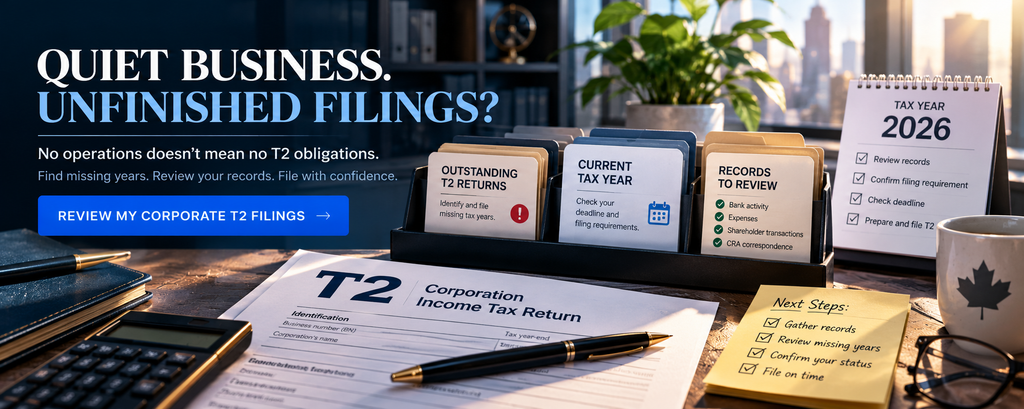
TaxRecon can review the available records, establish which corporate returns remain outstanding, and help prepare the filing work that fits the corporation’s actual position.
Frequently Asked Questions
Does a corporation with no income have to file a T2 in Canada?
Yes. A resident Canadian corporation generally has to file a T2 return every tax year even when it earned no income and owes no corporate tax. The main question is whether the company remains a corporation subject to the filing requirement, not simply whether it made sales.
Is a nil T2 a different CRA tax return?
No. “Nil T2” is a common shorthand for a T2 return where little or no activity and tax is being reported. It is still a T2 Corporation Income Tax Return rather than a separate CRA return created only for dormant companies.
Does an inactive corporation need financial statements?
Not always in the same form as an active business. CRA says corporations inactive throughout the year with no balance-sheet or income-statement information to report do not have to attach Schedules 100, 125, and 141, although CRA will accept them if filed.
Can I skip the T2 if my corporation never opened a bank account?
Generally, no. Having no corporate bank account may support the fact that little or no activity occurred, but it does not by itself remove the filing requirement while the resident corporation continues to exist.
How late can an inactive corporation file its T2?
The normal deadline is six months after the corporation’s tax year-end. If the return is already overdue, it is usually better to identify and file the missing period rather than waiting for another year or CRA correspondence to add to the backlog.
Will CRA charge a late-filing penalty if the corporation owes no tax?
CRA’s normal corporate late-filing penalty is calculated from unpaid tax, so a corporation with no unpaid tax may not generate a dollar amount under that standard formula. Filing is still legally required, and other compliance consequences or penalties may apply depending on what occurred.
What if my corporation was inactive but still paid accounting or bank fees?
That financial activity should be reviewed before calling the filing completely nil. Zero revenue does not necessarily mean zero financial information. The expenses, bank activity, assets, liabilities, and other transactions should be considered when preparing the T2.
Do I still file if I plan to use the corporation again later?
Yes, if the corporation remains subject to Canada’s T2 filing rules. Temporarily pausing operations does not normally suspend the annual corporate tax-return requirement.
Can TaxRecon file an overdue inactive corporation T2?
TaxRecon’s corporate tax filing scope includes T2 returns and late or outstanding tax returns. The starting point is to identify the unfiled years, confirm the corporation’s activity in each period, and determine whether the records are sufficient for filing.
When should I get professional help with an inactive corporation?
Professional review becomes more useful when several years are missing, the corporation had transactions despite no sales, CRA has contacted you, the records are incomplete, or you are preparing to dissolve the company and want to understand what filings remain outstanding.