“If a trust exists, file a T3” is no longer a safe rule for 2026–2027.
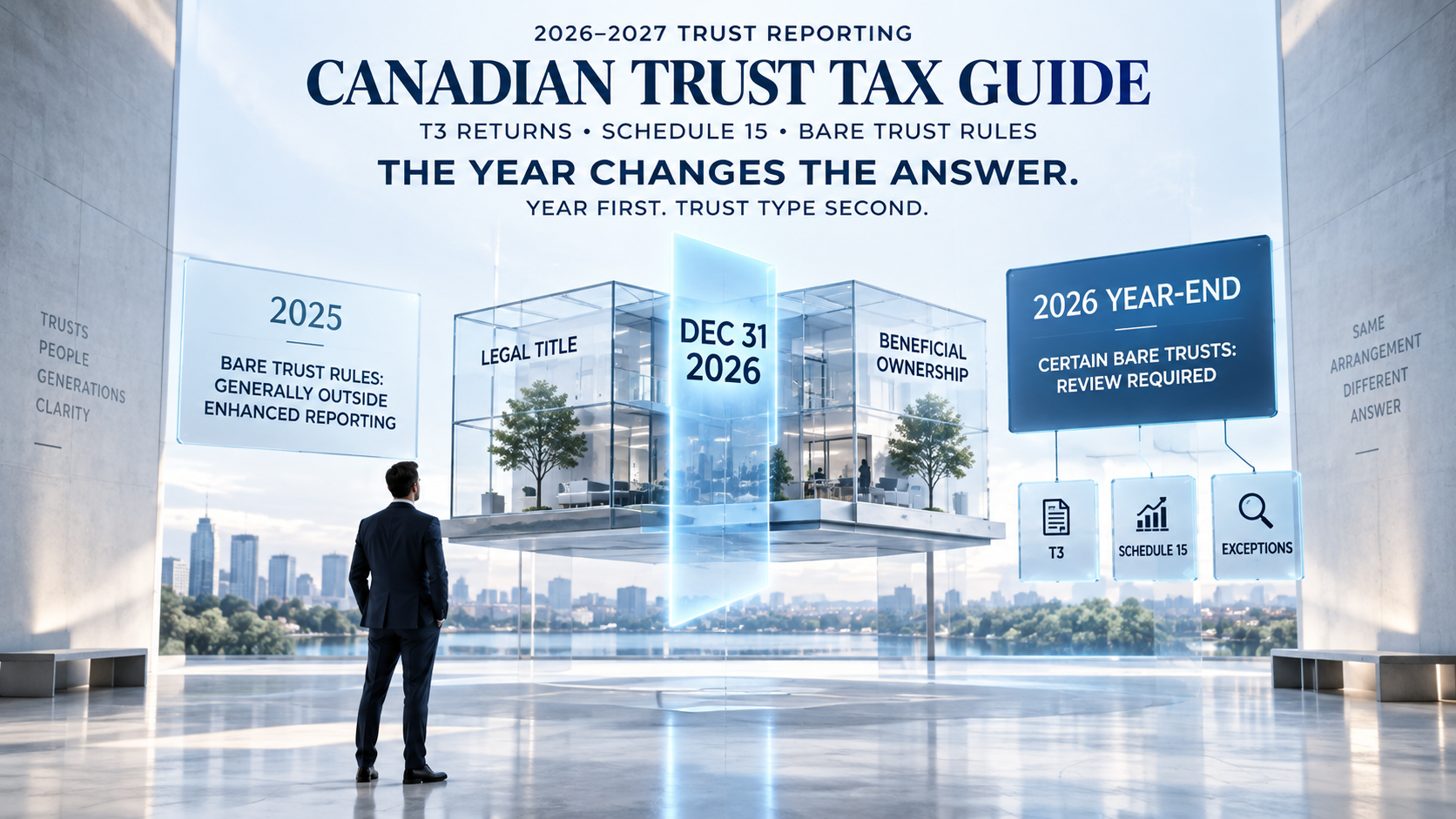
Canada’s trust-reporting rules now depend heavily on which taxation year you are dealing with, what kind of trust exists, whether a listed-trust exception applies, and, for bare trusts, whether the arrangement falls inside the rules taking effect for 2026 year-ends.
That changes the first question completely.
Do not begin with, “Did the trust earn income?”
Begin with, “What kind of trust is this, and which year am I filing?”
This Canadian trust tax guide walks through that decision in the order a trustee, executor, family or business owner actually needs it.
Key Takeaways
- Bare trusts generally do not file under the enhanced rules for 2024 or 2025.
- Certain bare trusts come back into the reporting regime for taxation years ending on or after December 31, 2026.
- Many resident express trusts that are not listed trusts can have annual T3 and Schedule 15 obligations even with no income.
- The $50,000 and $250,000 exceptions are not simple year-end balance tests.
- A December 31, 2026 trust that must file generally faces a March 31, 2027 deadline.
If the terms settlor, trustee and beneficiary are still new to you, TaxRecon’s earlier guide, Navigating the Basics of a Trust in Canada, provides the basic terminology. For the separate question of beneficiary slips, see T3 Return vs T3 Slip: What Is the Difference and Which One Do You Need?.
The Rule Changed by Year. Start Here.
Reading an old trust article without checking its date is now risky.
Here is the timeline that matters:
| Taxation year | What trustees need to know |
| 2023 | Enhanced trust reporting began. CRA gave broad administrative relief to bare trusts unless it specifically requested a filing. |
| 2024 | Bare trusts were removed from the enhanced filing requirement for that year. Listed-trust rules were also revised. |
| 2025 | Bare trusts remain outside the enhanced rules. New statutory amendments expand certain listed-trust exceptions. |
| 2026 year-end | Certain bare trusts become “reportable bare trusts,” subject to specific exceptions. |
| 2027 filing season | Trusts with a December 31, 2026 year-end generally assess their new 2026 obligations and, where required, file by March 31, 2027. |
CRA’s June 2026 guidance says bare trusts are not subject to these reporting rules for taxation years ending on or after December 31, 2024 and before December 31, 2026. It also confirms that certain bare trusts become subject to the rules for taxation years ending on or after December 31, 2026.
Read the CRA’s current enhanced trust and bare-trust reporting FAQ
That timeline is the backbone of the filing decision.
Use the Four-Gate Trust Check
Instead of asking one oversized question, move through four gates.
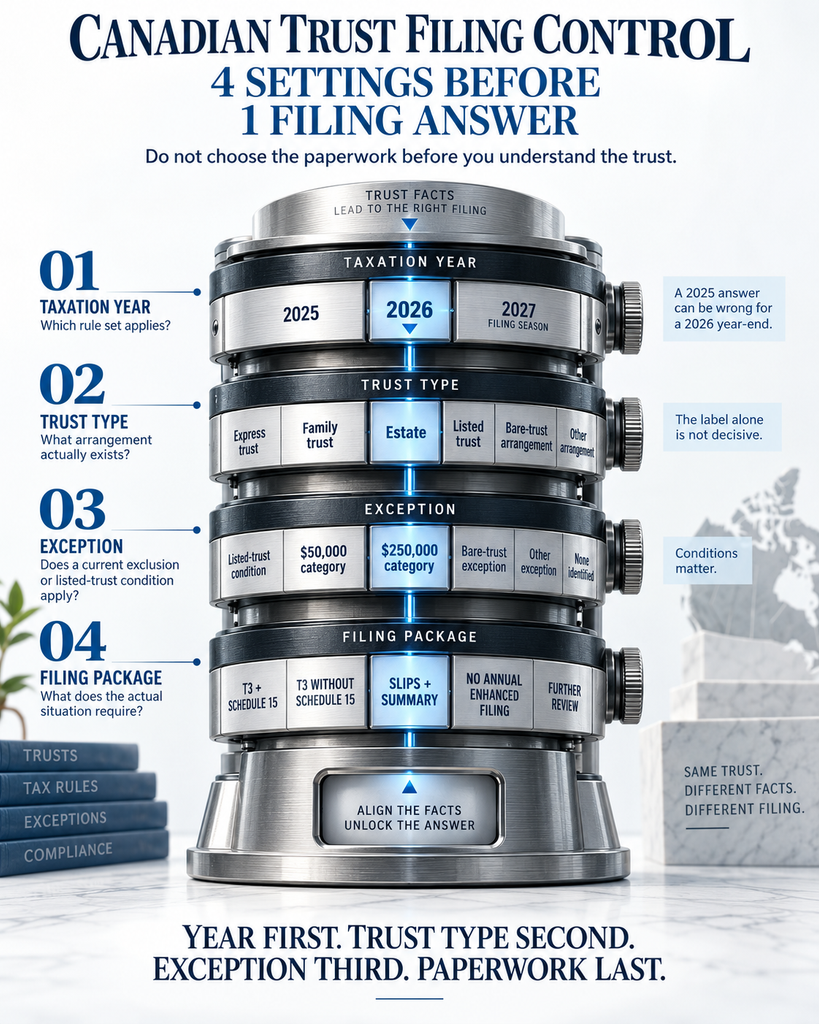
Gate 1: Which taxation year are you reviewing?
This determines which version of the reporting rules applies.
A 2025 answer can be wrong for a December 31, 2026 year-end.
Gate 2: What kind of trust or arrangement is it?
You may be dealing with:
- an express trust
- a family trust
- an inter vivos trust
- a testamentary trust
- a graduated rate estate
- a listed trust
- a bare-trust arrangement
- another ownership arrangement that may or may not legally create a trust
The label people use casually is not always decisive.
Gate 3: Does a listed-trust or bare-trust exception apply?
This is where asset values, relationships, asset types and the legal arrangement start to matter.
Gate 4: What must actually be filed?
The answer could involve:
- a T3 return
- Schedule 15
- beneficiary T3 slips
- a T3 Summary
- or, in some cases, no annual filing under the enhanced rules
That four-step order prevents a common mistake: deciding the form before deciding the legal and tax status of the arrangement.
What Is a T3 Trust Return?
The T3 Trust Income Tax and Information Return reports a trust’s income-tax and information-filing position to the Canada Revenue Agency. Some trusts file because they have income, tax, gains or distributions. Under the enhanced reporting rules, certain resident express trusts also file annually even when they have no income.
That final point is what changed the conversation.
Current CRA guidance says a resident or deemed-resident express trust that is not a listed trust generally files annually, even when it has no income. Listed trusts can still have a T3 filing obligation when other filing triggers occur.
This is why “the trust made no money” is no longer enough information to answer the filing question.
Where Does Schedule 15 Fit?
Schedule 15 is called Beneficial Ownership Information of a Trust.
Think of the T3 as reporting the trust’s tax and filing position, while Schedule 15 adds the people-and-control layer.
For trusts subject to the enhanced disclosure rules, Schedule 15 generally asks for information about reportable entities such as:
- trustees
- settlors
- beneficiaries
- controlling persons
- applicable partnerships
A controlling person can include someone who has the ability, through the trust terms or another agreement, to influence trustee decisions concerning trust income or capital.
CRA also expects identifying information about reportable entities, which can include names, addresses, residence information and tax identification information.
What if the beneficiary is not known yet?
Some trust documents define beneficiaries as a class, such as future grandchildren.
Where a beneficiary’s identity is not known or cannot be established with reasonable effort, the CRA allows the filer to provide sufficiently detailed information describing the class so that it can later be determined whether a person belongs to it.
That is very different from simply leaving the beneficiary section blank.
Does Every Trust That Files a T3 Need Schedule 15?
No.
This distinction matters.
Listed trusts do not generally file Schedule 15, even when another filing trigger means they still need to file a T3 return.
A trust can therefore be:
- required to file a T3 with Schedule 15;
- required to file a T3 without Schedule 15; or
- outside the annual filing requirement, depending on its circumstances.
That is why treating “T3 required” and “Schedule 15 required” as the same question can produce the wrong answer.
The $50,000 Rule Is Not Just a Year-End Balance Test
One of the most useful listed-trust exceptions concerns smaller trusts.
For taxation years ending on or after December 31, 2024, a trust may fall into the listed-trust category where the total fair market value of its assets does not exceed $50,000 throughout the taxation year. CRA guidance says this version of the exception no longer restricts the trust to the narrower asset list that applied to 2023.
The words throughout the year matter.
Suppose a trust holds $70,000 in July but only $40,000 by December 31.
Looking only at the year-end statement can give you the wrong answer.

CRA also says the fair market value used for these rules must be supportable. Trustees should retain the records or valuation information used to reach that figure.
What About the $250,000 Exception?
Another listed-trust category can apply where the trust stays at or below $250,000 throughout the year, but this rule carries extra conditions.
Among other requirements, the trustees generally need to be individuals, the beneficiaries must satisfy specified individual and relationship rules, and the trust must hold only asset types permitted by the legislation.
The $250,000 figure is therefore not a general exemption available to every family trust below that value.
A trust can fail the exception because of:
- who the trustees are
- who the beneficiaries are
- the relationship between them
- the type of asset held
- or the value exceeding the threshold at any point during the year
That is a much better review than simply checking the December 31 balance sheet.
What Changed for Bare Trusts in 2026?
This is where the most outdated Canadian trust content currently sits.
Bill C-15 received Royal Assent on March 26, 2026. The enacted changes confirm that bare trusts do not have the enhanced T3 and Schedule 15 requirement for taxation years ending in 2025, while certain bare trusts become subject for taxation years ending on or after December 31, 2026.
See the CRA’s April 2026 summary of the enacted trust-reporting changes
CRA’s wording is careful:
“Certain bare trusts are subject to the trust reporting rules.”
That word certain matters.
Not every arrangement that someone casually calls a bare trust will automatically file.
What is a bare trust in plain language?
For income-tax purposes, CRA describes a bare-trust arrangement as one where the trustee can reasonably be viewed as acting as agent for all beneficiaries in dealings with the trust property.
Typically, the trustee has little independent authority, acts on the beneficiary’s instructions, and primarily holds legal title.
Think about the difference between these two concepts:
Legal owner: the name appearing on legal title.
Beneficial owner: the person or entity that actually enjoys the benefits and bears the economic interest in the property.
When those are different, there may be a trust question worth reviewing.
What Might a Reportable Bare Trust File?
Where a bare trust falls within the new 2026 reporting regime and is not otherwise required to file an income-tax return, the CRA recognizes that much of the ordinary T3 return may not be relevant.
Current CRA guidance provides a shortened filing approach focused on identification information and Schedule 15. Income, capital gains and capital losses relating to the trust property generally continue to be reported by the beneficial owner.
This is an important distinction.
The purpose of the bare-trust filing is largely transparency about ownership and control. It does not automatically move the underlying property’s income onto a separate bare-trust tax calculation.
Three Situations That Look Similar but Can Produce Different Answers
| Situation | What should be checked first? |
| Family trust held no more than $40,000 throughout 2026 | Test the $50,000 listed-trust exception, then check whether another T3 filing trigger applies |
| Family trust held $180,000 of assets | Test every condition of the $250,000 exception, including trustees, beneficiaries, relationships and asset types |
| Corporation holds legal title to property while another company has the full beneficial interest | Determine whether the arrangement is a bare trust, whether the 2026 reportable-bare-trust rules apply, and whether an exception is available |
These are illustrations, not filing conclusions.
The trust documents and facts still control the answer.
When Is a 2026 T3 Return Due?
The general filing rule is 90 days after the trust’s tax year-end.
For a trust with a December 31, 2026 year-end, that generally produces a filing deadline of:
March 31, 2027
The trust’s related T3 slips and summaries generally follow the same 90-day timing. Any balance owing is also generally due within that period.
Check the CRA’s current T3 filing-deadline guidance
Graduated rate estates can have non-calendar taxation years, so executors should work from the estate’s actual year-end rather than automatically using December 31.
Why Missing Schedule 15 Is Not a Minor Clerical Error
The filing obligation includes more than submitting a T3 jacket.
Where Schedule 15 is required, missing or incomplete beneficial-ownership information can mean the trust has not met its filing requirements.
For a late trust with no unpaid tax, CRA guidance describes an alternative late-filing penalty of $25 per day, from a minimum of $100 to a maximum of $2,500.
Where a non-listed trust knowingly, or under circumstances amounting to gross negligence, fails to file or makes a false statement or omission, a separate penalty can equal the greater of $2,500 and 5% of the highest fair market value of trust property during the year.
The practical lesson is not to panic over penalties.
It is to document why you concluded a return or Schedule 15 was, or was not, required.
The Pre-2027 Trustee File
Do not wait for March to start collecting this information.
Trust and ownership documents
- trust deed and amendments
- will or estate documents where relevant
- bare-trust or nominee agreements
- title documents
- records showing legal and beneficial ownership
People and control information
- trustees
- settlors
- beneficiaries
- controlling persons
- partnerships where relevant
- addresses and residence information
- tax identification information
Financial information
- investment and bank statements
- income records
- capital transactions
- distributions
- prior T3 returns
- previous Schedule 15 filings
- T3 beneficiary slips
Exception support
Keep evidence supporting any exception you rely on, particularly:
- fair market value
- asset types
- trustee and beneficiary relationships
- periods during which property was held
A clean file makes the filing decision easier to defend later.
What Should Trustees Do Before the 2026 Year-End?
- List every trust and nominee arrangement you are responsible for.
- Separate legal title from beneficial ownership.
- Identify the exact taxation year under review.
- Test the listed-trust conditions rather than relying on trust income alone.
- Review possible bare-trust arrangements before December 31, 2026.
- Collect Schedule 15 information early if the trust is likely to need it.
Legal questions deserve legal review. CRA itself notes that determining whether an arrangement creates a trust is a question of fact and law.
Tax advice can address the filing consequence. A lawyer may need to address the underlying legal relationship.
Where TaxRecon Can Help
Once the legal nature of the arrangement is clear, the filing work still has to connect the trust documents, tax year, ownership information, income and beneficiary records.
TaxRecon’s Tax Filing & CRA Compliance service can support the tax-return and CRA-compliance side when a T3, Schedule 15 or related trust filing needs attention.
Business owners using trusts or nominee arrangements alongside corporations may also need the financial and tax consequences reviewed in the wider business picture. TaxRecon’s Business Advisory service covers that financial decision-making side, while legal trust questions should remain with qualified legal counsel.
What Happens After a T3 Is Filed?
For 2026–2027, CRA’s current service standard is to issue a notice of assessment within 17 weeks of receiving a complete T3 trust return, with a target of meeting that standard 95% of the time. That is a service standard, not a promise that every return will be completed within 17 weeks.
View the CRA’s current 2026–2027 service standards
That is the one external performance statistic used in this guide.
Final Thoughts
Trust reporting in Canada has become a year-by-year filing decision, not a rule you can learn once and reuse forever.
For 2025, bare trusts generally remain outside the enhanced reporting regime.
For taxation years ending on or after December 31, 2026, certain bare trusts return.
Meanwhile, resident express trusts, listed trusts and Schedule 15 each follow their own conditions.
The strongest way to use this Canadian trust tax guide is simple:
Year first. Trust type second. Exception third. Filing package last.
If those four answers are clear, the paperwork becomes much easier to get right.
For broader Canadian tax and accounting support, visit TaxRecon Canada.

Frequently Asked Questions
Does every family trust have to file a T3 return in 2026?
No. Many resident express trusts have an annual T3 filing obligation, but listed-trust exceptions can change the result. Review the trust’s assets, fair market value, trustees, beneficiaries and other filing triggers before assuming every family trust must file.
Does a trust need a T3 return if it earned no income?
It can. A resident express trust that is not a listed trust can have an annual T3 filing requirement even with no income. This is one of the major differences between the enhanced reporting rules and the older activity-based approach.
Do bare trusts need to file for the 2025 taxation year?
Generally, no under the enhanced trust-reporting rules. CRA confirms that bare trusts are outside those rules for taxation years ending on or after December 31, 2024 and before December 31, 2026.
Do bare trusts need to file for 2026?
Some do. Certain “reportable bare trusts” become subject for taxation years ending on or after December 31, 2026, subject to statutory exceptions. Do not assume every bare trust files or that every bare trust remains exempt.
Who must be reported on Schedule 15?
Schedule 15 generally requests information about trustees, settlors, beneficiaries and controlling persons. Partnerships can also be reportable entities under the current rules. Specific beneficiary-reporting exceptions can apply in certain situations.
Is every trust under $50,000 exempt?
No. The $50,000 listed-trust rule depends on the total fair market value not exceeding the threshold throughout the year. Even a listed trust can still have a T3 filing obligation when another filing trigger applies.
Does every trust under $250,000 qualify for the higher exception?
No. The $250,000 category contains additional requirements covering trustees, beneficiaries, relationships and permitted asset types. The amount alone does not decide the result.
What is the deadline for a December 31, 2026 trust?
The general T3 deadline is 90 days after the trust’s tax year-end. For a December 31, 2026 year-end, that normally means March 31, 2027. Special year-end rules can apply to some estates and trusts.
What happens if Schedule 15 is filed incomplete?
An incomplete Schedule 15 can mean the trust has not satisfied its filing obligation. Penalties can apply, and more serious penalties can arise where failures or omissions are made knowingly or under circumstances amounting to gross negligence.
When should I review a possible bare-trust arrangement?
Before the 2026 year-end is the better time. Start by comparing legal ownership with beneficial ownership, locating any written agreements, identifying the parties and reviewing whether the new reportable-bare-trust rules or an exception could apply.