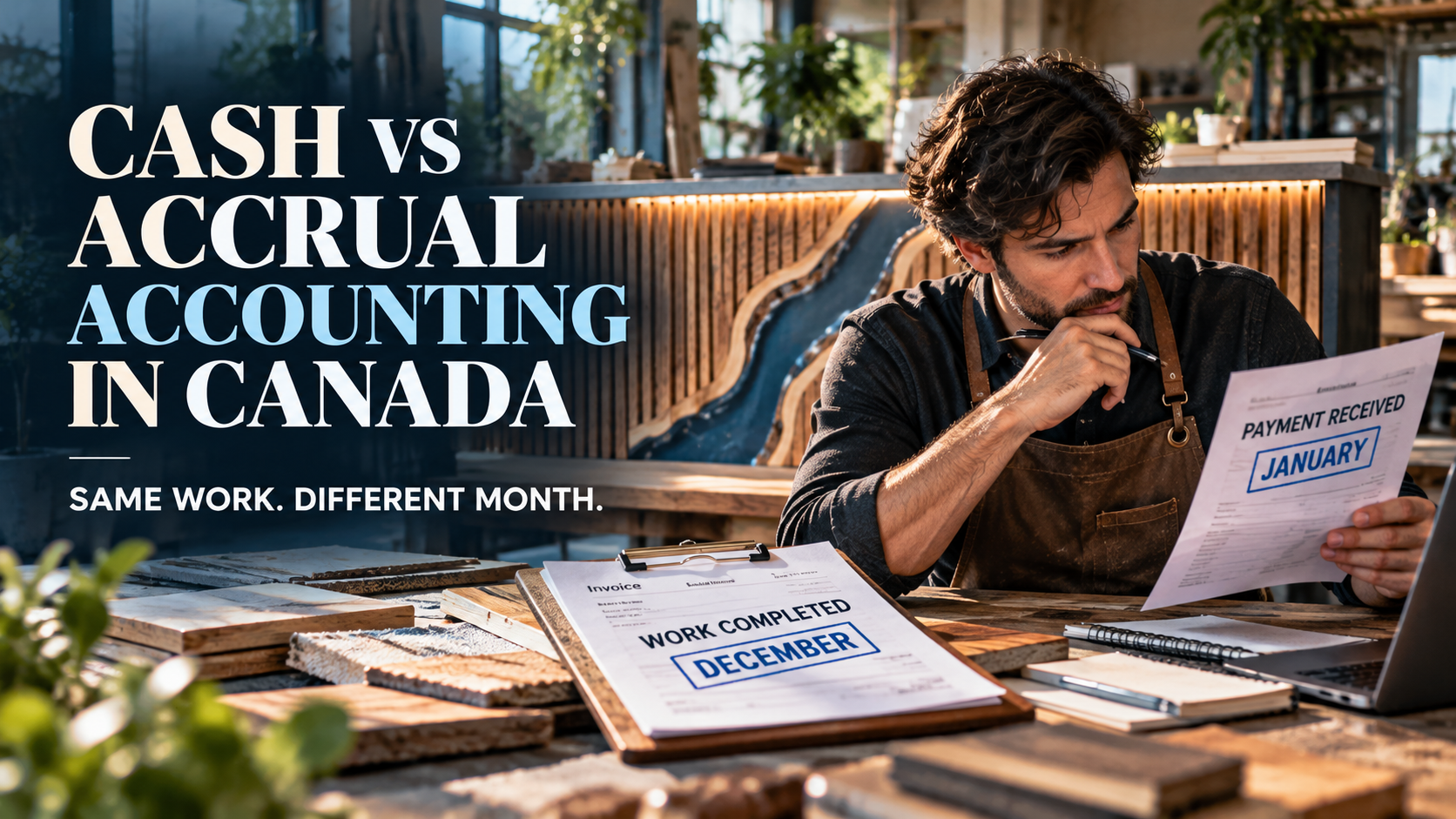
Your customer pays in January for work you finished in December.
Which month should the income appear in?
Your bank account says January. Your invoice says December. Your accounting software might show either, depending on which reporting option you selected.
But the Canada Revenue Agency (CRA) has its own rules, and choosing the simpler-looking method does not necessarily make it the correct one.
That is where the question of cash vs accrual accounting in Canada becomes more than a bookkeeping preference.
Both methods record business activity, but they recognize income and expenses at different times. That difference affects your financial statements, outstanding customer invoices, year-end reporting and, in some situations, your taxable income.
For most Canadian businesses, accrual accounting is the required method for reporting business income. Cash accounting remains available for certain qualifying activities.
Understanding the distinction can save you from treating a reporting setting as a tax decision.
Key Takeaways
- Accrual accounting is generally required by the CRA for Canadian business income, including most sole proprietorships and ordinary incorporated businesses.
- Cash accounting is permitted for qualifying farming, fishing and self-employed commission activities. Being a freelancer or small business does not automatically make you eligible.
- Accrual accounting records earned income and incurred expenses, even when customers or suppliers have not yet been paid.
- GST/HST has separate reporting rules. Choosing a cash-basis profit and loss report does not automatically change when sales tax must be reported.
What Is the Difference Between Cash and Accrual Accounting?
The difference is when a business recognizes income and expenses. Cash accounting generally records income when payment is received and expenses when paid. Accrual accounting records income when earned and expenses when incurred, regardless of when money changes hands. In Canada, the method permitted for income tax reporting depends on the applicable CRA rules.
Consider a contractor who completes a project on November 25, sends the invoice on November 28 and receives payment on December 20.
The work is finished in November. The money arrives in December.
Each accounting method tells that story differently.
Cash Basis Accounting: Follow the Payment
Under cash basis accounting, the contractor records the income in December, when payment arrives.
The same general timing applies to eligible business expenses: they are recognized when paid, subject to exceptions such as prepaid expenses and other applicable tax rules.
The appeal is easy to understand. Money comes in, income appears. Money goes out, an expense appears.
For qualifying businesses, this can simplify income tracking.
However, it also leaves an important question unanswered: how much work has the business completed but not yet collected?
An unpaid invoice may represent earned revenue, yet it will not appear in a basic cash-basis income report.
Accrual Basis Accounting: Follow the Economic Activity
Under accrual basis accounting, the contractor recognizes the income in November, when the work was earned, even though payment arrives in December.
Until payment is received, the outstanding amount is generally recorded as accounts receivable.
The same principle applies to costs.
When a business incurs a qualifying expense in November but pays the supplier in December, accrual accounting generally recognizes the expense in November. The unpaid amount may be recorded under accounts payable.
This approach provides a more complete picture of what the business earned, owed and incurred during a reporting period.
It also separates two questions business owners often mix together:
- Did the business earn a profit?
- Has the business collected enough cash to meet its obligations?
Those answers do not always agree.
Cash vs Accrual Accounting: Side-by-Side Comparison
| Accounting factor | Cash accounting | Accrual accounting |
| Income recognition | When payment is received | When income is earned |
| Expense recognition | Generally when paid, subject to exceptions | When incurred, subject to applicable rules |
| Unpaid customer invoices | Not yet recognized as income under the cash method | Reflected through revenue and accounts receivable |
| Unpaid supplier bills | Generally recognized when paid | Reflected through expenses or assets and accounts payable |
| Monthly profitability | Can fluctuate with payment timing | Better reflects activity attributable to the period |
| Cash tracking | Closely follows receipts and payments | Requires separate attention to actual cash movement |
| Recordkeeping | Simpler for eligible businesses | Requires receivable, payable and adjustment tracking |
| Canadian income tax eligibility | Limited qualifying activities | General method for most businesses |
| Useful management information | Cash receipts and payments | Operating results, obligations and financial position |
The useful distinction is not that one method is automatically good and the other bad.
Cash accounting can be appropriate where the law permits it. Accrual accounting reveals financial activity that a bank-transaction-only view may miss.
In Canada, however, the first question is not which method feels easier. It is which method your business is allowed to use.
What Does the CRA Require for Cash vs Accrual Accounting in Canada?
For most businesses, the CRA requires the accrual method when reporting business income.
The agency states:
“Generally, you have to report business income using the accrual method of accounting.”
That instruction appears in the CRA’s official accounting for your earnings guidance.
The CRA permits the cash method for certain qualifying business activities, but it is not a blanket option for every sole proprietor or corporation.
Which Canadian Businesses Can Use Cash Accounting?
The CRA identifies three principal eligible categories:
- Farmers: Qualifying farming activities may use the cash or accrual method.
- Fishers: Qualifying fishing activities may also use either permitted method.
- Self-employed commission agents: Qualifying commission-based activities may use cash accounting.
Eligibility depends on the actual activity and the applicable tax rules.
A person who receives commissions is not automatically eligible merely because part of their compensation is commission-based.
Likewise, a farmer operating a separate non-farming business may need to account for that other activity differently.
Do Sole Proprietors Have to Use Accrual Accounting?
Most sole proprietors must use accrual accounting for their business income.
This surprises freelancers and independent contractors who assume that a smaller business can simply record deposits and withdrawals.
Consider a self-employed graphic designer.
Clients pay through bank transfers, projects are completed at different times, and invoices sometimes remain unpaid for several weeks.
Being self-employed does not automatically permit the designer to use the cash method for income tax reporting.
The business may still need accrual-based records, even if its owner prefers using bank transactions to monitor available cash.
Do Incorporated Businesses Need Accrual Accounting?
Ordinary incorporated businesses generally report business income using the accrual method.
For an Ontario corporation, that means the bookkeeping must account for income earned and expenses incurred within the relevant fiscal period, rather than treating the bank statement as the complete income record.
Special rules may apply to certain industries or activities, so it is better to confirm the corporation’s actual circumstances than assume every legal entity follows an identical rule.
Important distinction: The rules discussed here concern business income. Rental income, certain specialized activities and financial-statement reporting requirements can involve separate considerations.
One Invoice, Two Methods: What Changes at Year-End?
Imagine a small Ontario consulting business completing a project just before December 31.
This is an illustrative example, not an actual TaxRecon client case.
The business has the following transactions:
- December 18: Completes client work worth $8,000.
- December 20: Issues the invoice.
- December 22: Receives a supplier bill for $2,400 of qualifying services used on the project.
- January 14: Receives the customer’s payment.
- January 20: Pays the supplier.
For simplicity, the amounts below exclude GST/HST, and the example assumes the revenue and expenses belong to the December period under accrual accounting.
How the Transactions Appear
| Transaction | Cash basis | Accrual basis |
| $8,000 client revenue | January | December |
| $2,400 supplier expense | January | December |
| December revenue | $0 | $8,000 |
| December expense | $0 | $2,400 |
| December result from these transactions | $0 | $5,600 |
| January result from these transactions | $5,600 | $0 |
Both methods ultimately recognize the same $5,600 difference from these transactions. They place it in different reporting periods.
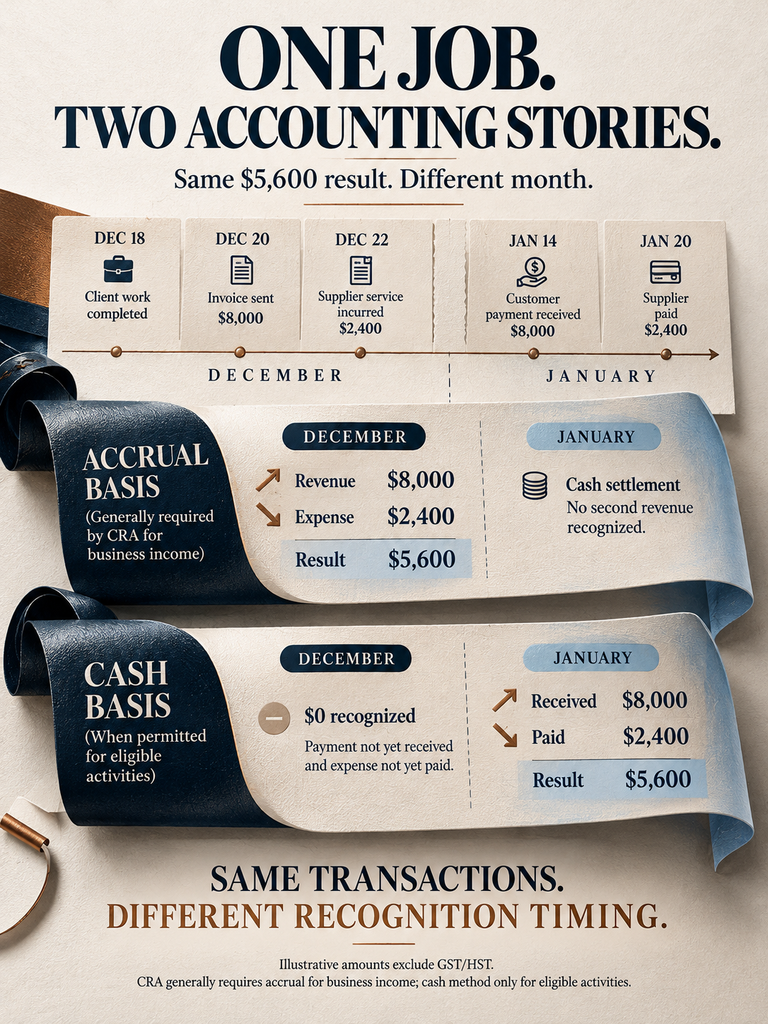
Under accrual accounting, the December balance sheet also reflects the outstanding customer receivable and supplier payable. Their settlement in January changes cash and those balances, rather than creating the same revenue and expense again.
For a business that is legally eligible for cash accounting, this timing difference can affect which tax year includes the amounts.
For a business required to use accrual accounting, it is not an optional way to move income into January.
Why the Timing Difference Matters
Now imagine that December is the company’s financial year-end.
The owner checks the bank account and sees no payment from the customer.
That does not necessarily mean the business has no December revenue.
If the $8,000 was earned in December under the accrual method, it generally belongs in that period even though payment has not arrived.
The corresponding tax implications depend on the business’s entire taxable income calculation, allowable deductions and other adjustments.
An unpaid invoice is not automatically untaxed income.
That is precisely why reviewing receivables before year-end matters.
Why Can Accrual Accounting Show Profit When Cash Is Tight?
Accrual accounting recognizes financial activity before every associated payment has been collected or made.
A business can complete profitable work, issue invoices and report revenue while its customers still owe money.
Meanwhile, rent, wages, supplier payments and tax obligations continue to require cash.
Imagine a growing business with several customers paying on 30-day terms.
Sales increased throughout the quarter. The income statement looks better each month.
But receivables also grow.
The company may be earning more while financing a larger amount of unfinished customer collections.
That does not mean the accrual method is producing incorrect information. It means the income statement and bank account measure different things.
For a closer look at that distinction, TaxRecon’s guide to cash flow vs profit explains how profitable businesses can still experience cash shortages.
The practical response is to track both operating performance and liquidity, not replace one with the other.
How Does Cash vs Accrual Accounting Affect GST/HST in Canada?
This is where a seemingly simple accounting choice can become a compliance issue.
GST/HST reporting follows separate rules from income tax accounting. In many ordinary taxable transactions, GST/HST must be reported before the customer has paid the invoice.
A business cannot assume that selecting a cash-basis report means it should report GST/HST only when deposits arrive.
The Unpaid Invoice Problem
Return to the Ontario consulting example.
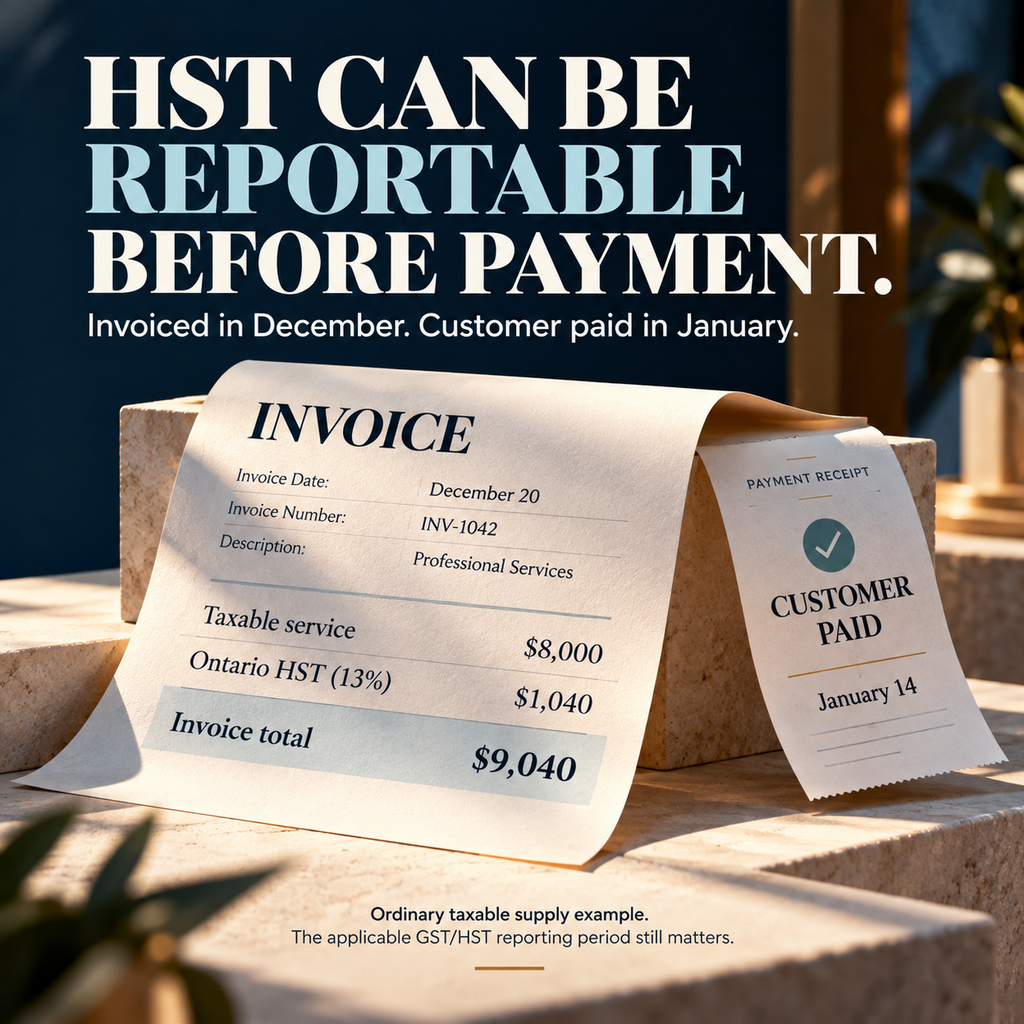
Suppose the $8,000 service is subject to Ontario’s 13% HST rate.
The invoice would show:
| Invoice component | Amount |
| Taxable service | $8,000 |
| HST at 13% | $1,040 |
| Total invoice | $9,040 |
The business issues the invoice in December but receives payment in January.
Under the usual GST/HST timing rules, the HST can become reportable in the December reporting period even though the customer has not paid.
The CRA’s General Information for GST/HST Registrants explains that GST/HST generally becomes payable on the earlier of payment received or payment becoming due, with additional timing rules for invoices and agreements.
The applicable reporting period and remittance deadline still matter.
This is one reason a business should not calculate its GST/HST obligation simply by applying a tax percentage to bank deposits.
Input Tax Credits Have Their Own Timing Rules
GST/HST paid or payable on eligible business purchases may qualify for input tax credits (ITCs), subject to the ordinary eligibility and documentation requirements.
In some circumstances, eligible ITCs can be claimed before a supplier invoice has been paid.
For example, an invoice for a qualifying business purchase might be received in December and paid in January.
The related ITC treatment may follow when the tax became payable rather than the payment date, provided the necessary conditions are met.
Keep the supplier invoice, GST/HST details and supporting records. The bank transaction alone may not contain everything needed to support a claim.
Is the GST/HST Quick Method the Same as Cash Accounting?
No.
The Quick Method of Accounting for GST/HST is an alternative way for eligible registrants to calculate their net GST/HST remittance.
It is not general permission to report business income on a cash basis.
The CRA describes a $400,000 revenue ceiling, including GST/HST and subject to specified measurement periods and other eligibility conditions, for businesses considering the regular Quick Method.
That threshold concerns the GST/HST calculation method, not whether the business can elect cash-basis income tax reporting.
For businesses struggling with invoice timing, supporting documents or sales-tax balances, TaxRecon’s GST/HST filing services address the records and reconciliation behind the return.
Which Accounting Method Is Right for Your Canadian Business?
The best starting point is a three-question test.
Not a software comparison. Not a preference survey.
Three questions that separate tax requirements from reporting needs.
1. Permission: Does the CRA Allow Your Business to Use Cash Accounting?
Start with eligibility.
Identify your business activity, legal structure and applicable tax treatment.
If your income must be reported using accrual accounting, the decision is largely settled for income tax purposes.
You can still monitor cash receipts and payments without changing the required tax reporting method.
If your activity qualifies for cash accounting, compare the available methods based on your records and reporting requirements.
2. Picture: What Do You Need Your Financial Reports to Show?
Think about the decisions you make using your accounts.
If customers pay later, suppliers extend credit or inventory moves through the business, you need visibility beyond the bank balance.
Accrual-based reporting can help you understand:
- How much customers owe you.
- Which supplier bills remain unpaid.
- Revenue earned during a particular month.
- Costs attributable to that period.
- Whether margins are changing.
- How outstanding obligations affect the financial position.
For a growing business, those details can influence hiring, pricing, borrowing and spending decisions.
3. Payments: Can You Manage the Gap Between Earnings and Cash?
Recognizing revenue does not put money into the bank.
Review when customers normally pay, when supplier bills come due and which tax obligations may arise before collections arrive.
A useful accounting setup may need both accrual financial statements and a cash-flow forecast.
The first measures recognized financial performance.
The second helps you plan for money coming in and going out.
The decision rule: Establish what the CRA requires, decide what your reports need to explain, and monitor cash separately. Do not use one accounting method to answer every financial question.
How Do You Switch Between Cash and Accrual Accounting in Canada?
Changing methods requires more than selecting another option in your bookkeeping software.
A genuine change in income tax reporting can affect opening balances, outstanding invoices, unpaid expenses, prior-period adjustments and the treatment of amounts already recognized.
The CRA also sets specific requirements for eligible taxpayers changing their reporting method.
From Cash Accounting to Accrual Accounting
Under the CRA’s published guidance for eligible cash-method users, changing to the accrual method requires a written request to the director of the applicable tax services office before the return’s due date.
The taxpayer must also account for the adjustments caused by the change.
From Accrual Accounting to Cash Accounting
Where a taxpayer qualifies to use the cash method, the CRA describes filing the return using cash accounting and attaching a statement of adjustments arising from the change.
These two procedures are not interchangeable.
Businesses outside the eligible cash-method categories should not assume they can switch to cash accounting.
Five Checks Before Changing Your Accounting Method
- Confirm eligibility and reporting requirements. Identify whether you are changing the legal tax reporting method or merely changing the view of an internal report.
- Reconcile existing balances. Compare bank accounts, outstanding invoices, supplier bills and relevant liabilities with supporting records.
- Review transactions crossing the change date. Identify revenue and expenses that could be omitted or counted twice.
- Check GST/HST separately. Confirm that sales-tax reporting follows its own applicable rules and that the accounting change has not altered required tax records.
- Document the transition. Retain the opening figures, adjustments, supporting calculations, approvals and filing information relevant to the change.
If your records contain unexplained balances or old transactions, changing methods without correcting them may carry those problems into the new reporting period.
TaxRecon’s article on bookkeeping cleanup explains the record checks that help establish a reliable starting position.
What Most Canadian Business Owners Get Wrong About Accounting Methods
Mistake 1: Assuming Every Small Business Can Choose Cash Accounting
A business may be small, have few expenses and receive payments immediately.
None of those facts alone determines whether cash accounting is permitted for its income tax return.
Do this: Check the CRA rules for the actual business activity.
Not that: Choose cash accounting simply because the operation is small.
Mistake 2: Treating Bank Deposits as the Complete Revenue Record
Under accrual accounting, an unpaid invoice can represent revenue already earned.
A deposit may also relate to an earlier invoice, financing, an owner contribution or another type of transaction.
Recording every deposit as current sales revenue can create reporting errors.
Mistake 3: Recording Every Payment as an Expense
Money leaving the bank is not always an immediate deductible expense.
Loan-principal repayments, equipment purchases, inventory, prepaid expenses and owner withdrawals can require different accounting treatment.
A payment tells you that cash moved.
It does not tell you how the transaction should be classified.
Mistake 4: Assuming a Software Setting Changes CRA Requirements
QuickBooks Online and other accounting systems may allow users to view reports using cash or accrual settings.
That functionality does not determine whether the business is eligible to file its income tax return on a cash basis.
A reporting preference and a tax method are different decisions.
Mistake 5: Forgetting the Balance Sheet
The income statement shows recognized revenue and expenses.
The balance sheet shows outstanding receivables, payables, loans, inventory and other assets or liabilities.
Ignoring those balances can make month-end reporting look complete when significant financial activity remains unexplained.
What Should You Review Before Your Next Year-End?
You do not need to wait for tax season to find out whether the bookkeeping has been following the wrong assumptions.
Start with the information already in the business.
Customer Invoices and Receivables
Review open invoices, payment dates, credit notes and any customer balances that have remained outstanding longer than expected.
An old receivable may represent a collection issue, an incorrectly matched payment or an amount that needs further review.
Supplier Bills and Payables
Confirm which expenses were incurred before year-end, which remain unpaid and whether they belong in that reporting period.
Do not assume every invoice belongs to the period in which it was entered into software.
Inventory and Prepaid Expenses
A business that buys goods for resale needs to understand what remains unsold and how inventory affects the cost of goods sold.
Prepaid insurance, rent or other costs may also require treatment that differs from the payment date.
GST/HST and Tax Balances
Compare the relevant GST/HST accounts with invoices, purchase records and previously filed returns.
Unexplained differences should be investigated before those figures move into another reporting period.
Cash and Bank Reconciliations
Reconcile bank and credit-card statements to the accounting records.
Then check that deposits and withdrawals were assigned to the correct transactions and accounts.
A reconciled bank account is a starting point, not proof that every revenue, expense or tax balance is correct.
How TaxRecon Helps Businesses Put the Right Accounting Method Behind the Numbers
Most business owners do not need a lecture about accounting standards.
They need to know whether their existing records are right, whether their reporting method fits the business and what needs correcting before another filing is prepared.
At TaxRecon, the review begins with the financial responsibilities involved.
That may mean examining unpaid invoices, outstanding supplier bills, year-end transactions, bank reconciliations, GST/HST records or the reporting setup within the accounting system.
Through our bookkeeping services in London, Ontario, businesses can get help with transaction categorization, reconciliations, historical cleanup and maintaining records that support tax preparation and financial reporting.
Sometimes the existing accounting method is correct, but the reports have been interpreted incorrectly.
Sometimes the records need adjustment.
And sometimes the question is really about cash collection, GST/HST timing or a year-end filing rather than the accounting method itself.
Finding that distinction first helps prevent unnecessary changes.
Final Thoughts
Cash and accrual accounting are not competing shortcuts to the same answer.
They recognize financial activity at different points in time. Both can provide useful information, but Canadian tax rules determine which methods are available for reporting business income.
For most businesses, accrual accounting is the required starting point. Eligible farming, fishing and self-employed commission activities have additional options.
The bigger lesson is to stop expecting a bank balance, income statement or software report to explain every part of the business on its own.
When comparing cash vs accrual accounting in Canada, begin with CRA eligibility, then examine what your invoices, expenses, outstanding balances and cash requirements are actually telling you.
The method should support a financial record you can explain, not merely a report that looks simpler.
Not Sure Your Books Are Using the Right Method?
If you are unsure whether your business is recording income correctly, the next step is not necessarily changing your software settings.
Start with the invoices, expenses and reporting periods that are causing confusion.
TaxRecon helps Canadian business owners review their accounting records and identify what needs attention before those numbers feed into tax returns or financial decisions.
Schedule a Free Consultation with TaxRecon
Frequently Asked Questions About Cash vs Accrual Accounting in Canada
1. Is cash or accrual accounting required in Canada?
The CRA generally requires accrual accounting for business income. Eligible farming, fishing and self-employed commission activities can use the cash method under specific rules. The correct method depends on the type of income and applicable tax treatment, not simply on whether a business is small or incorporated.
2. Can a Canadian freelancer use cash basis accounting?
Being a freelancer does not automatically make cash accounting available. Most ordinary freelance business income must be reported using the accrual method. The CRA permits cash accounting for certain qualifying activities, including eligible self-employed commission work. Freelancers should verify which rules apply before selecting their tax reporting method.
3. Is accrual accounting mandatory for Canadian corporations?
Ordinary Canadian corporations generally report business income using accrual accounting. Certain qualifying activities may have special provisions, so the exact treatment should be considered in context. A corporation cannot assume that recording only bank deposits and payments satisfies its income tax reporting obligations.
4. Can you use cash accounting in QuickBooks and still file taxes on an accrual basis?
QuickBooks may allow cash-basis and accrual-basis report views, but a software setting does not determine the required tax method. A business filing on an accrual basis needs accurate records for earned revenue, incurred expenses and relevant adjustments, even if it also reviews cash-basis reports for internal purposes.
5. Does accrual accounting mean paying tax before customers pay invoices?
It can result in taxable income being recognized before the related customer payment arrives. However, actual tax payable depends on the entire income tax calculation, allowable deductions and applicable adjustments. This is why receivables management and cash-flow planning matter for businesses that invoice customers on credit terms.
6. Can GST/HST be reported on a cash basis?
GST/HST generally follows its own statutory timing rules rather than the chosen income tax reporting method. In many cases, tax becomes reportable when payment is received or becomes due, whichever occurs first. Special accounting methods and other GST/HST provisions may apply to qualifying registrants.
7. Can a Canadian business switch from cash to accrual accounting?
Eligible taxpayers can change methods, but the CRA has procedural requirements. Its published guidance calls for written permission before the relevant filing deadline when moving from cash to accrual accounting. Opening balances, receivables, payables and adjustments also need review so income and expenses are not omitted or counted twice.
8. Does TaxRecon help businesses review their accounting method?
TaxRecon provides bookkeeping, reconciliation, tax and related accounting support for Canadian businesses. A review can examine how transactions, unpaid invoices, supplier bills and reporting records have been handled. The scope of any correction or reporting-method change depends on the business’s circumstances and applicable CRA requirements.
9. When should a small business in London, Ontario seek accounting help?
Consider getting help when books no longer reconcile, customer invoices remain unpaid, GST/HST figures look wrong, a year-end is approaching or financial reports do not explain the business’s position. Reviewing these issues before filing can reveal whether the problem concerns transaction records, reporting methods or a separate obligation.
Disclaimer: This article provides general educational information about Canadian accounting and tax reporting. It is not individualized accounting, tax or legal advice. Requirements may vary by business activity, structure and circumstances. Confirm your specific treatment before changing accounting methods or filing returns.